
Trending
"If it could only be like this always -- always summer, always alone, the fruit always ripe. -- Evelyn Waugh
The middle of July is pure summer -- lazy summer days with a warm sun and a cool breeze coming in off Lake Superior. Canadian wildfire smoke is still a consideration on many of these summer days, and the cool wind is a part of things more days than most would like, but still, it is the middle of July. Summer.
The local mosquitoes have abated a bit, but there are still deer flies and gnats. Yes, those pesky little buzzers and now some tiny gnats, hovering around and sometimes in the eyes are nuisances. A few ticks are also lingering around too. But July is a time to endure those little creatures and explore new places. One local treasure is the Vielmetti-Peters Conservation Preserve, maintained, and managed by the U.P. Land Conservancy (UPLC). The 123 acres preserve lies at the end of Brickyard Road in Negaunee Township off the west end roundabout.
Dedicated on Aug. 27, 2016, the UPLC eventually plans to acquire an additional 186 acres of adjacent land to create a 309-acre community forest adjacent to the Dead River according to a recent story in The Mining Journal https://upperpeninsulahistory.com/2021/12/14/dan-h-ball-owned-vielmetti-peters/. The UPLC website, https://www.uplandconservancy.org/vielmetti-peters-reserve describes the nearly four-mile trail system it contains with three loops to explore the land and biological diversity of the area.
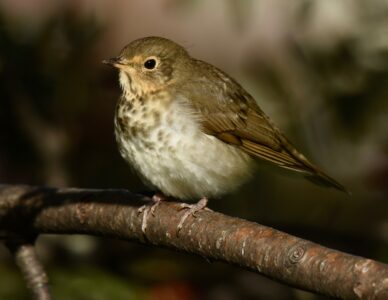
There is a short walk to the entrance of the reserve and the pathway in is a thrush paradise. To hear more complete songs, an early morning hike is needed, but along the way veeries, hermit and Swainson's thrushes can be heard. As the birds get busy feeding mates and young it is more common to hear shorter songs and call notes making bird song and call apps like Cornell's Merlin handy for figuring out who is calling during the day.
A number of warblers can also be heard there too. Nashville, chestnut-sided, blackburnian warblers, and several of ovenbirds and cedar waxwings and eastern wood-pewees in the forested areas join an indigo bunting in an open stretch of the trail to the preserve, making the trip in much more musical. The preserve's biological diversity is quickly recognize as a walk reveals dozens of amazing insects too. Common wood-nymphs, medium brown butterflies with prominent dots along the edges of their wings are numerous as they maneuver from one sunny roost to another in a delicate flutter. Dozens of metallic green damselflies with black wings ebony jewelwings, hunt along the edges of the path and rest on the bracken ferns. A few shadow darners, large dragonflies hunt there too. It is a relaxing hike through a beautiful section of Upper Peninsula forest.
Other woodsy locations are also providing continued diversity of bird species. Birders cruising the Peshekee Grade along the Marquette-Baraga County border were rewarded last Tuesday with 10 warbler species, a black-backed woodpecker and maybe the biggest surprise of the summer 25 white-winged crossbills. This season has seen a big influx of the crossbills in the northern part of the Upper Peninsula.
White-winged crossbills are somewhat unique in their approach to nesting choosing to nest whenever they find sufficient supply of food. They are known to breed in all months of the year, feeding on up to 3,000 seeds from small conifer cones each day.
They have been found at several sites in the central U.P. this month as they have moved into the area recently. They seek out areas with large numbers of conifer cones with seeds still present. In several past years the boreal areas along the Peshekee with their large number of both white and black spruce have provided good crops for crossbills.
Trumpeter swan families are popping up in several new places this summer. Two have been reported with young cygnets. The two newer sites, Portage Point in Delta County and Deer Lake in Marquette County bode well for the further spread of swans in the Upper Peninsula.
This past Wednesday a yellow-throated vireo was found near the Sands Township Park close to the Crossroads. This is a vireo more commonly found to the south in Wisconsin and Lower Michigan but has found its way farther north several times this summer into the U.P. This vireo does have one adaptation that may help it succeed when other birds may struggle. Unlike many songbirds, both males and females take turns incubating eggs. It may help keep both parents stronger for the time when both forage to feed their young fledglings.
Canada geese have disappeared from the edges it Lake Shore Blvd. a place where they were plainly present for much of June. As adults begin their summer molt, they are unable to fly and must take a less prominent profile in the community for a few weeks as their new flight feathers emerge. A single goose was seen in the mitigation pond at Presque Isle off Island Beach Road last Tuesday, keeping a low profile there.
Another rare bird, actually a species of concern in Michigan is the black tern, limited in range in the U.P. to a few locations along the Lake Michigan shore. It nests on small, raised areas in wetlands. A few were seen along Ogontz Bay this spring, but few reports have come in since then. Another Lake Michigan resident mentioned last week, the American white pelican made it to Marquette last Friday, as 50 were seen circling over Marquette, before presumably heading back to the Green Bay area. With July speeding along, enjoy the fruits of the season!
EDITOR'S NOTE: Scot Stewart is a teacher at Bothwell Middle School in Marquette and a freelance photographer.