
What’s Flying: There’s great beauty out there
Trending
"We know that in September, we will wander through the warm winds of summer's wreckage. We will welcome summer's ghost."-- Henry Rollins
And so, at last, September slides in from the wings to take center stage. After a rather spectacular summer, as another roller coaster season of temperatures, and a good amount of rainfall that can at critical times to provide the moisture the vegetation needed across most of the Upper Peninsula.
This week has features several big-numbers observations. In north Marquette County, 25 ruby-throated hummingbirds were seen on August 30 in north Marquette County at a feeding station. The end of August and the start of September are prime times for ruby-throated hummingbirds to begin their departure from the area as they head south for the winter. It is important to note the species here as other species like Anna's and rufous hummingbirds do occasionally pass through Michigan later in the fall as do some ruby-throated hummingbirds migrating south from Canada.
Other birders are seeing a slight uptick in hummingbirds at their feeders and a bit of an increase in the competition at some of them. An extra feeder or two right now is a great way to see more hummingbirds around the house, especially if they are placed far enough apart to avoid fights. Many often ask when feeders should be taken down. Feeders can be left up well into fall as the late arrivals from Canada, especially those that may have nested late are still coming though. Last hummingbirds can be western birds too blown off course, like those with rusty areas of plumage – the Anna's and rufous.
Another big-number highlight Aug. 28, 18 Hudsonian godwits moving past Whitefish Point. These are large, handsome shorebirds that rarely stop in the Upper Peninsula, but occasionally do, especially in the spring along the Great Lakes shores.
Last Monday evening probably saw one of the biggest and best spectacles of the week in the U.P. for birders. Around 400 common nighthawks were observed in Escanaba over the Lake Michigan shoreline on the south edge of town. Impressive nighttime fliers, they have large mouths and hair-like feathers around their mouths to catch moths and other flying insects after dark.
Because of their normal feeding patterns, they are not often seen during daylight hours, but are frequently heard when flying over inhabited areas. Their "peent" call is frequently heard as they patrol the skies, especially over lights where insects may be more common and in early summer males produce a loud booming sound when they suddenly dive and then arch their wings downward. Once common summer residents in the U.P. they have become more difficult to find. In late August though they become common early evening sights flying along across the U.P. and along Lake Michigan as they make their way south to much of South America. The Escanaba birds slowed to catch flying ants hovering over land as they made their way from ground colonies to areas seeking to start new ones.
Nighthawks are related to whip-poor-wills and other nocturnal birds that rely on insects. The numbers of both in the U.P. seem to be dropping, possibly in conjunction to diminishing numbers of insects, the use of insecticides and changes to their habitats. It only takes one long summer drive to know the number of insects on the windshield at the end of the trip is nowhere near what they used to be. Insects are definitely on the decline, and as their numbers drop so do bird numbers.
Common loons are also starting to be on the move as their numbers being counted at Whitefish Point are now getting into double digits each day. They are some days behind the red-necked grebes who are now making their fall run south, appearing in triple-digit numbers frequently at Whitefish Point.
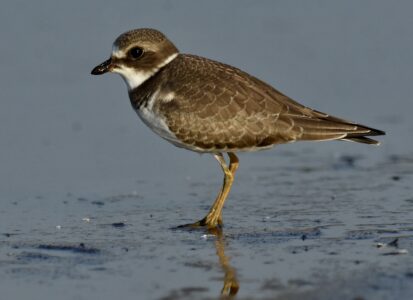
Dead River mouth and the breakwall in the Lower Harbor have been a great alternate places for those in Marquette unable to get to the mouth of the AuTrain River or Whitefish Point to look for shorebirds. While the diversity is a bit smaller there are often birds present, especially in the morning hours at the Dead River. Lesser yellowlegs, semipalmated and least sandpipers and semipalmated plovers have been seen recently at the Dead and a buff-breasted sandpiper appeared on the breakwall last Monday. Sanderlings, ruddy turnstones, red knots, whimbrels. black-bellied and American golden-plovers are all possibilities in Marquette in the fall.
It is also time to watch mountain ash trees for a wide range of foraging birds. Brown thrasher, gray catbirds, and robins can be seen heading to them now and in the next two weeks some warblers, scarlet tanagers, rose-breasted grosbeaks, house finches, hermit and gray-cheeked thrushes will be there too.
The increases in their activity will also attract other species like the warblers and some woodpeckers like the red-bellied woodpeckers who also eat fruits.
Late summer is the time when thistles start to produce their seeds. In larger fields where there are lots of thistle American goldfinches can be enjoyed as they hang from the droopy flower stems pulling the fluffy seeds out to eat. The goldfinches also use the downy see tips to line their nests as they are among the last songbirds to nest in the Upper Peninsula. The buffy down is easy to find and usually only a short wait is needed to find a goldfinch of two. The browning thistles are truly a part of summer's wreckage still providing for the color of late summer. Go see it!
EDITOR'S NOTE: Scot Stewart is a teacher at Bothwell Middle School in Marquette and a freelance photographer.