
What’s Flying: Summer readying to take flight
Trending
"In order to see birds, it is necessary to become a part of the silence." -- Robert Lynd
Changes are starting to become more apparent in the natural world of the Upper Peninsula. It has become yellow and purple time, as the asters and the goldenrods take their spots as the rulers of the roadsides and the woodland edges. The swamp maples are taking on their late summer ruby and crimson hues. Basswoods, maples, and mountain ash have taken on their heavy, lush loads of seeds and fruits. While bird migration has not yet worked up to full speed, subtle signs are there. Sandhill cranes are starting to stage. Bird songs and calls are still adding to the pleasures of life, but they too are winding down. A few cardinals are still brightening up the morning air and sending the sun on its way at day's end.
The warm weather may be slowing the pace for some shorebirds. Churchill, Manitoba, had a high of 78F Wednesday and is looking to hit 83 Saturday. Fairbanks has forecasted temperatures in upper 60s and low 70s through next week also. Seems like good weather to enjoy, especially if you are hunting insects and other invertebrates.
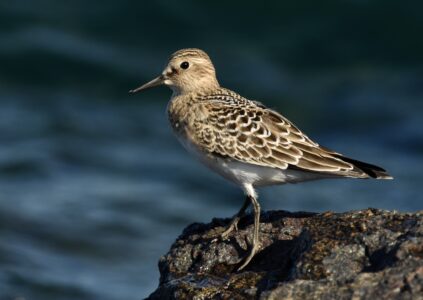
Across the U.P. there are small numbers of Baird's, pectoral, least, solitary, and semipalmated sandpipers, yellowlegs and both piping and semipalmated plovers.
Baird's seem to be showing up in the highest numbers so far with nine at Whitefish Point on Tuesday and at least six on Wednesday. They are one of the best sandpiper migrants, most traveling from the Arctic to the southern tip of Argentina and Chile at Tierra del Fuego, at trip of about 3700 miles. They can make the trip in five weeks, so stops at places like the U.P. are crucial to refueling on their way south.
The note on Whitefish Point highlights the start-up of the Fall Waterbird Count there for the season, https://dunkadoo.org/explore/whitefish-point-bird-observatory/wpbo-waterbirds-fall-2022. As has been said before, it is one of the best ways to get a feel for how fall migration is going, and when to expect a good stretch to visit when the weather is considered. The counts there are live, so it is possible to see how the day is developing and when the best times are to see the most.
Mornings are definitely best as birds crossing Lake Superior during the night are sometimes ready to make a stop for rest and food. Many ducks, loons, and grebes are simply flybys though. The fall waterbird counter is positioned near the east end of the point on the north side and watches the water off the shoreline to the west for passing birds. This provides some time for longer looks at birds in flight. Some, like hawks and loons may fly directly over the point near the counter.
There is plenty of good birding in other places too. In Marquette great blue herons, an American bittern and a family of belted kingfishers have been hunting in the ponds at the Park Cemetery in Marquette. The herons are fairly easy to find due to their size and hunting practices near the water's edge. The kingfishers perch in branches over water and dive for small fish and occasionally aquatic insects.
They may hover over the water until their prey comes to within range, then plunge straight down into the water to catch them in their beaks.
The bittern though is a different matter. Cryptically marked, it has brownish streaks on its chest to mimic brown, dead leaves of cattails. As it moves along the edges of vegetation it often goes along, deliberately moving in search of fish, frogs, and other small animals on or near the water surface. If alarmed, it freezes, lifts it head straight up so its bill becomes the tip of another cattail leaf look-alike. It can be nearly impossible to find unless it flushes, or one is patient enough to sit quietly until it pokes its head out at the edge of the reeds and cattails.
Another interesting bird making fairly regular appearances is a barred owl and its family on Presque Isle. Normally secretive, and most active at night and at times of low-level light, they most often tuck into conifers and thick cover during daytime. The owls on the "Island" though have been a bit more visible and even a bit territorial, or protective of their young.
Warblers have continued to be seen in some mixed flocks, with yellow-rumped, Nashville, yellow, and common yellow-throats being most visible of late.
Sandhill cranes are beginning to congregate in larger groups too. Families are beginning to meet in fields to feed in Alger County in a process called staging as they begin to organize for migration south. Many cranes from this area will head south from mid-September through October to an agricultural area in northern Indiana. At the heart of this area is the Jasper-Pulaski Wildlife Area. It is an amazing fall rest stop for sandhill cranes where up to 22,000 may congregate, before heading farther south as weather gets more extreme.
Eventually most from this area may end up in Texas at places like Hagerman National Wildlife Refuge, Bosque del Apache National Wildlife Refuge in New Mexico, and parts of northern Mexico. Eastern cranes head to southern Mexico in winter. Some of the biggest, historical staging area in the U.P. have been around Chatham in Alger County, and Fibre, in Chippewa County on the Trout Lake Road, now a ghost town.
It is a great time to watch quietly as summer readies to take flight.
EDITOR'S NOTE: Scot Stewart is a teacher at Bothwell Middle School in Marquette and a freelance photographer.