
What’s Flying: How to spend the final days of summer
Trending
"Happiness lies even in little tiny butterflies. You just have to open up your eyes and see where beauty flies to beautify your world lengthwise." -- Ana Claudia Antunes
With the end of August in sight, many may be looking back to assess how their summer went, what they accomplished, where they went and what they saw. Some also look ahead to consider how best to spend the remaining days of the summer season and wonder how it will wind down and autumn will usher itself in next month. After a relatively wet summer, it could be a fall full of mushrooms, aromas of wet rich soil and slowly decomposing leaves and plenty of fall flowers.
This summer has seen asters truly outdo themselves with many flowering large-leaved aster plants, often reluctant to send up their tall flower stalks with their pale purple flowers in the shadows of the maples and aspens. Goldenrods are also blasting out lots of yellow florets with plenty of pollinators taking advantage of pollen and nectar.
Whitefish Point in Chippewa County get a mention here almost every week, especially during migration seasons and with good reason. It offers a double-edged tool for tracking birds migrating through the Upper Peninsula. The fall waterbird counter monitors the daily sightings of birds at the tip of the Point for eight hours daily starting at sunrise https://dunkadoo.org/explore/whitefish-point-bird-observatory/wpbo-waterbirds-fall-2022. As of Wednesday, 109 species had already been observed in the first 10 days, with 4,788 individuals seen there.
Tuesday's and Wednesday's lists included two great firsts for the current count, a buff-breasted sandpiper, and a jaeger. The daily counts include a number of challenges, including morning fog and distant, hard to identify migrants flying through the middle of Whitefish Bay. On foggy mornings, like this past Sunday, only birds flying right over the point or actually stopping may be seen and possibly identified until for burned off. Some birds are simply missed. For some birds, like ducks, sandpipers and the jaegers, silhouettes and flight behavior may provide enough clues to identify the birds to group, but it may not be possible to identify to species.
That was the case for the first jaeger of the fall. There are three species of jaegers, long-tailed. parasitic, pomarine. Predatory gulls, they summer in the High Arctic, where they feed on birds and lemmings, but winter on the oceans, primarily in the Southern Hemisphere. Parasitic jaegers are the true pirates of the sea, often working to pry food away from other birds on the wing. As many as two dozen jaegers may pass through the Whitefish Point region in fall, but they frequently fly past far out from shore making it difficult to identify to species.
Things are different for other groups of birds though. Ducks, loons, grebes, and many waterbirds, including gulls and terns will just fly past the point, especially on days with following winds from the north. Under conditions with favorable winds and good visibility, they sail on past unless they need a rest or food. Songbirds are frequently weary after crossing Lake Superior and are often struggling to reach shore. Accipiters and falcons have come to recognize the opportunities and may wait along the shore to intercept tired birds.
Just last week the waterbird counter watched two merlins wait for a red-breasted approaching the point and after an extended chase, one was able to catch and eat the small bird. Northern harriers, several merlins and sharp-shinned hawks have been seen daily this week at the edge of the jack pines near the tip of the point, waiting for possible prey. Overhead a number of broad-winged hawks have been seen too.
A large pond and several smaller wetland spots attract sandpipers, plovers, geese, ducks, and occasionally herons. There are long stretches of Lake Superior shoreline that also provide foraging opportunities for the sandpipers and plovers. Five piping plover nests were found on the Point this summer, producing eleven chicks. Seven young survived. One female was killed before her eggs hatched and those eggs were hatched at a plover rearing facility and those chicks were successful reared and released, Adult birds leave summer ranges before the young do and it appears nearly all the summer resident plovers have now left.
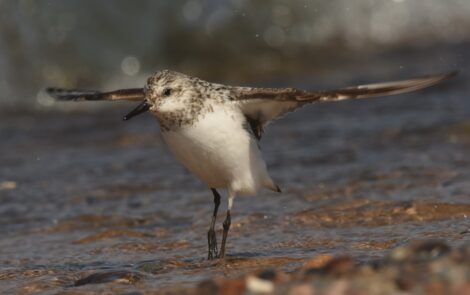
One young plover has been seen the past few days often foraging with semipalmated plovers, killdeer, sanderlings, semipalmated and least sandpipers. Ruddy turnstones, some yellowlegs, buff-breasted and pectoral sandpipers have also appeared on the point the past few days. It is not always clear which have overnighted on the Point, and which are new arrivals. Piping plovers are all wearing aluminum and color-coded leg bands and can be identified, but currently no records are being kept on the daily presence of individuals on the Point as they are sometimes difficult to find and do come and go during the day. There will be good shorebird days for the next few weeks, with at least the bulk of two species, black-bellied and American golden-plovers arrivals still a month and more off in the future.
Small numbers of shore birds continue to pop up at a wide variety of other sites, like the breakwalls in Marquette, and the mouths of the AuTrain River in Alger County and Dead River in Marquette. Larger mixed flocks of warblers, chickadees and woodpeckers are also being noted. Fall flowers, good crops of blueberries, migrants, and red maple leaves abound. A new beaver dam has flooded the edge of Harlow Lake and the flooded trees are bright red. Beauty is flying along!
EDITOR'S NOTE: Scot Stewart is a teacher at Bothwell Middle School in Marquette and a freelance photographer.