
Spring’s on the way (really, it is!)
Trending
"It's a great event to get outside and enjoy nature. I find it very exciting no matter how many times I see bald eagles." -- Karen Armstrong.
Spring days are coming. Last Saturday provided a tiny hint of what is to come with a day-long spell of sunshine. The time of year has come when the sun's warmth can actually be felt on a bright, cloudless day. It was glorious, drawing both wildlife and humans out to bask in that wonderful brightness.
The Black Rocks at Presque Isle Park are a great spot to look out at the Lake Superior's blue open water, now becoming more and more difficult to see with the clutter of cobbled ice covering the bays and shallower areas of the lake.
The rocks are a challenge to find, too, with their icy coating and huge new headlands of ice now protrude into the cove and nearby lake. It is an exciting place to be with the amazingly different look it now has. The intense bright rays of the sun found some tiny obstacles that day as small altocumulus clouds raced beneath, catching the light and breaking it into tiny rainbows in the clouds.
Amazingly, the sky was broken up further by the flight of two bald eagles, an adult, and a youngster. Both skimming the huge white pines on the cliffs, they cruised past, to the delight of hikers on the rocks. The adult circled back to land in the biggest pine on the ridge over the cove. The lake edges have become a great spot for eagle watching this winter as they jockey back and forth from the lake shore when they might occasionally find a meal in a fish at the surface of open water, and the county landfill, where meals are generally guaranteed, but may not be the most delectable or really edible.
Those moving across nearly any point in the park may look up to find an eagle soaring overhead, both white-headed and tailed adults and mottled black and white juveniles. Because they often circle at lower elevations and roost from time to time along the cliffs and at several points along Lakeshore Boulevard just south of the Dead River, there are many great opportunities to see both forms.
For the young, it is to see the differences between them as they change over the four years or so it takes to become adults and get their white heads and tails.
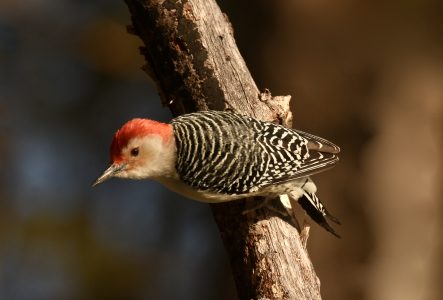
Around the "Island" there are many great chances to see other great birds too. There is an active, vocal pileated woodpecker population and because it is in the park, some of them have become very tame, allowing birders and others to approach for great looks. Downy, hairy and red-bellied woodpeckers are also present in the park, and the hairies and downies are showing distinct signs of courtship with chases, lots of vocalizations and stretched out displays to each other.
Merlins, small, brown falcons, appear to have returned to the park too. A very vocal merlin was seen chasing and harassing a crow on the southwest corner of the park last Saturday. Merlins historically has nested in the large white pines near the bandshell for many years in the park, and because they are quite vocal, are often easy to find.
They are quite fearless, fast flyers, and chase larger birds like crows and hawks, and hunt smaller birds in their range.
At Presque Isle and at many other feeding stations across the area large flocks of common redpolls, often joined by hoary redpolls, American goldfinches and in town centers house finches, are feeding on thistle and black-oil sunflower seeds. Around 40 were still showing up at feeders at the park, along with nuthatches, chickadees, and blue jays. Another big surprise at the park last weekend was a singing northern cardinal. Although they are becoming more and more common in town, they are still unusual out at Presque Isle.
And in their singing provide another reminder that spring is coming.
White-winged crossbills continue across Marquette County, although in smaller numbers than had been seen earlier this winter. With a preference for seeds from smaller conifer cones, they have depleted the spruce cones in many areas, but have begun to pick through spruces in the city of Marquette, adding observations of groups of two to four in multiple locations.
A pair of red crossbills was also reported this week at Wetmore Landing north of Marquette on Lake Superior. Small numbers of these crossbills do reside in the Upper Peninsula year-round, especially in the Grand Marais and Tahquamenon Falls areas.
Another sign of spring was noted in the Pickford area last weekend as sharp-tailed grouse were observed fighting in an opening just north of town. There has been a solid number of these grasslands birds seen in eastern Chippewa County this winter and they will head to leks, or dancing grounds, as the days lengthen. Once on the leks, males will call and dance in the early hours of morning to attract, impress and with hope, mate with females drawn to the activity. Habitat change and predators have eliminated several leks in the central U.P. so it is exciting to see and hear them in Chippewa County, in yet another sign of spring.
In the east, snowy owls are still being reported, and in much of the rest of the U.P. pine grosbeaks and bohemian waxwings are still showing up in fruit trees, so winter continues to hang on, but with incoming rain, longer days and warmer temperatures, can spring be far off?
EDITOR'S NOTE: Scot Stewart is a teacher at Bothwell Middle School in Marquette and a freelance photographer.