
Trending
"Do act mysterious. It always keeps them coming back for more." -- Carolyn Keene
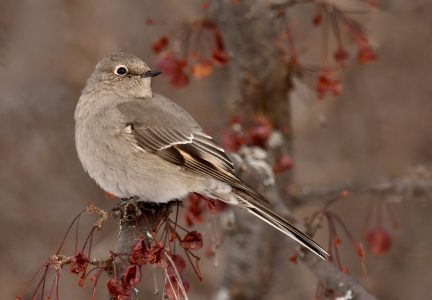
Coming back is becoming a theme for birds and birders alike in Marquette this month. There have been a number of birds this winter in Marquette that have provided wonderful opportunities to get out, find, and watch. Through much of the second half January through mid-February, a very dependable Townsend's solitaire could be found in a group of four crab apple trees in the Holy Cross Cemetery off Wright Street near the end off McClellan. The crab apple trees were a great attraction, not only for the solitaire, but also for pine grosbeaks and bohemian waxwings.
The three species provided some of the best birding in Marquette, in a quiet out-of-the way spot right in town. With the continual feeding activity, the crab apples eventually lost nearly all of their fruits in mid-February, and the birds moved on. When single vagrants like the solitaire move on, their subsequent fate is usually a mystery. With no bands or tracking devices and few if any distinguishing markings, they just disappear. However … another Townsend's solitaire was seen and photographed on Island Beach Road in north Marquette on March 14, for a single day, feeding with pine grosbeaks and cedar waxwings, before disappearing too. Birders now wait for new reports before spring officially arrives and solitaires head back to the foothills of the Rocky Mountains and other points west.
On the Dead River upstream from Tourist Park, waterfowl activity is beginning to pick. A variety of new arrivals has joined the winter resident mallards and American black ducks spending parts of their days on the river between the Tourist Park and the turbine plant at the end of the BLP Trails. Hooded merganser numbers have slowly increased, and common goldeneyes have continued, with at least one juvenile male beginning to transition to mature plumage. One of the species "coming back" was the trumpeter swan. The pair, possibly arriving with a third swan was seen on the river last weekend. It appeared it might be a very tame pair seen on the river above the Tourist Park from time to time in the spring and fall over the last few years. This pair spends several days on the river.
The scene there livened up even more last Sunday when a second pair arrived and began challenging the original pair, calling, and flying back and forth up and down the river. It only lasted a short time before one of the pairs left. Based on the tameness of the remaining pair, it seemed the original pair won out and stayed. Some locals and birders hope the pair will eventually find a suitable place to nest on the river, but so far, that hasn't happened. One issue that could factor in is the regular visits by bald eagles, and the presence of nesting great horned owls. A pair of eagle were seen divebombing the mallards there on Wednesday this week.
Common redpoll numbers have been phenomenal at feeders in the central Upper Peninsula for most of the past two months, draining many birders' bird seed budget this winter. The numbers have begun to wind down as the weather has warmed. However, with the onset of the recent ice and snow storm this week, some feeding stations have seen a resurgence of redpolls at their feeders again, signaling the possibilities of some serious impending weather conditions. Numbers at some spots jumped back up from the forties back to the eighties.
Maybe the best case for coming back belongs to a snowy owl. One appeared near the U.S. 41 bypass just before Thanksgiving and was seen in the area through the New Year, before disappearing. Last Tuesday a very similarly marked owl was seen. Snowy owls are a bit more unique in their markings, with juvenile birds usually very heavily marked, females marked well to blend in as they sit on their Arctic tundra ground nests, and older adult males can be nearly all white. The birds seen in south Marquette also looked to have a slightly closed right eye, as though it might have been slightly injured. The most recent sighting has been exactly where the fall owl spent so much time.
Common grackles, crows, ring-billed gulls, robins, Canada geese, red-winged blackbirds have begun appearing across the U.P. bringing assurances spring is indeed here, despite the ice and snow that has slowed everything down this week. The gulls, crows, and geese in particular have been not just present but vocal, leaving little doubt of their return. At the Picnic Rocks in Marquette, close to 400 gulls have been present at times on some afternoons, and have continued to include wandering iceland, glaucous and greater black-backed gulls that will continue on this month to other sites before heading to their summer ranges.
Glaucous gulls are probably the easiest to pick out of the huge flocks. Most of them that come this far south in winter are immature, large, entirely creamy white gulls. Adults resemble herring gulls with red dots on the lower mandibles but lack the black markings on the wing-tips. Their summer range is along the ocean coasts of Alaska, northern Canada, and Greenland. Iceland gulls are smaller gulls with light coloration and black bills. There are two species of black-backed gulls and as their name suggests, their upper wings are much darker than the area's summer gulls. Like our winter guest that come back, our summer residents are too.
Slip out and welcome them back.
EDITOR'S NOTE: Scot Stewart is a teacher at Bothwell Middle School in Marquette and a freelance photographer.