
Trending
"Imagine if birds were tickled by feathers. You'd see a flock of birds come by, laughing hysterically!" -- Steven Wright
If it were true, there would uproarious laughter in Marquette these days, and in plenty of other Upper Peninsula locations, too. Winter birding has had some great moments recently due to the large number of impressive flocks of common redpolls, pine grosbeaks, white-winged crossbills, and best of all, bohemian waxwings. This past week has seen many flocks of these species in treetops, on roadsides and at feeders.
On the Triple A Road in north Marquette County, hundreds of white-winged crossbills were seen last Friday, Feb. 4, along the road as they gritted -- picked up bits of sand along the road to help digest the conifer seeds they had eaten. This has been a great year to see these birds in the central U.P. Males are bright pinkish-red with black and white markings, and females are greenish-yellow with similar markings.
Up close, they stand out because of their oversized, specially adapted bills for prying open the bracts in conifer cones to extract the seeds.
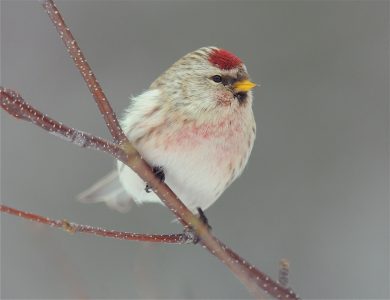
Common redpolls are another "winter finch" species utilizing the seeds of birches and taking advantage of feeder stations across parts of both the Upper and Lower Peninsula. Flocks of 80-100 have not been uncommon. Sparrow-like, they have streaked flanks and sparrow shapes, but also have a deep crimson patch on the front of their heads and males have a splash of red-blush on their chests. Flocks have been regular visitors at some feeders, especially thistle tubes where there are multiple feeders and stations to accomodate 20 or more redpolls at a time.
Considering the large numbers of common redpolls reported, it is has been somewhat surprising there have been only a very small number of hoary redpolls seen with them here this winter.
Much rarer than the common redpolls, the usual ratio seen during the winter here is about one hoary to every 100 common redpolls. One was reported in Marquette and a second in Ford River Township on Sunday, and another in Pickford last Monday. All three were seen with flocks of 35 or more common redpolls.
Hoary redpolls do have some interesting adaptations to the cold and life in the High Arctic. They do have particularly fluffy feathers to provide extra insulation to deal with low temperatures. When temperatures rise, they may pull some of these feathers, because they can grow back in just a few days if temperatures drop again. They also have sacs in their stomachs where they birch and other seeds eaten in open areas. They can then fly to more sheltered spots out of the wind to regurgitate, hull and reswallow the seeds
Crab apple and mountain ash trees continue to attract the fruit eaters - especially large flocks of pine grosbeaks and bohemian waxwings in Marquette and smaller flocks elsewhere. In Marquette several flocks of a dozen or more pine grosbeaks, mostly females and young, are still feeding in crab apple trees and the few mountain ash trees that still have fruit. They have all but cleaned out the crabs near the Dead River where the Townsend's solitaire had been feeding since early January forcing the solitaire to begin looking for other places to forage. It was back in the pair of trees at least twice last week to feed on a few remaining fruits but that's all.
The most exciting birding this past week has been the return of bohemian waxwings to Marquette. A number of flocks of over 100 birds have been seen, but last Thursday, a flock began landing on Hampton Street in south Marquette that outdid all the rest. While an exact count was not made, a flock numbering between 900 and 1,200 filled the tops of five large oak trees at the top of Hampton at sunset as they dove into several crab apple trees, stripping them in minutes. They started at a crab where a dozen pine grosbeaks were already feeding and appeared to literally be poured out of the sky. When they moved to a second tree, the sound of their wings was thunderous. Then headed from there to Altamont Street for their next, and possibly stop of the day.
Since then there have only been reports of much smaller flocks in town and in Harvey, but still in the range of 200 or so!
Earlier that same afternoon, the pine grosbeaks had been feeding in a mountain ash tree on Mesnard Street when they were joined by a very light-colored bird that appeared to almost be a pale orange color. It moved about in the center of the tree with the grosbeaks, occasionally feeding on a berry or two.
Finally, it move to an outside of the tree revealing it was a leucistic form of a bohemian waxwing. It still had the chestnut patches over the bill and under the tail, the black mask and the yellow tipped tail feathers, but the rest of the feathers were a buffy white, much lighter than the normal tan-brown feathers of a bohemian waxwing.
Leucistic individuals have a genetic mutation that prevents normal pigments of skin, hair and or scale color from being properly expressed. It is not an albino individual where the entire animal is without pigmentation, including the eyes, but does have either lighter or white pigmentation for some parts of its body.
Flocks are working quickly through neighborhoods now as trees are being stripped, so finding them is mostly by chance -- finding trees that provide food.
To find them it just takes some time and LUCK!
EDITOR'S NOTE: Scot Stewart is a teacher at Bothwell Middle School in Marquette and a freelance photographer.