
What’s Flying: Lack of common redpolls surprises
Trending
Along with rising and falling water, winter is the province of wind. When the sea-breath and mountain-roar bend the hemlocks of these hills, the birds hang on as best they can. -- Robert Michael Pyle
Winter seems to stand out clear and certain here in the Upper Peninsula as January drifts into February. A brief thaw quickly ended and brought the real winter back late this week with ripping winds and quickly dropping temperatures and snow.
After a quiet stretch in Marquette area this winter, bohemian waxwings reappeared in a number of large flocks of over 100. Like a horde of hit and run bandits, they have frequently dropped into crab apple and mountain ash trees and cleaned out remaining fruits in record time, only to quickly depart in search of more. The recent flocks of waxwings, grosbeaks and the Townsend's solitaire in Marquette have drawn a number of birders in the past few weeks. Birders traveling to Marquette County for the flocks of white-winged crossbills and the promise of other boreal species like Canada jays, black-backed woodpeckers, and boreal chickadees have also dipped into Marquette for the highlighted birds here too. This past Monday, 60 white-winged crossbills were found on the Peshekee Grade.
The impact of the waxwings and grosbeaks have become quite evident in Marquette. The tops of literally all the above-mentioned trees are stripped of fruit and many smaller trees are also bare now. Trees close to busy streets and crab apples with larger fruits are still relative untouched. The crab apples in the cemetery near the Dead River have been hit by both waxwings and pine grosbeaks this past week, leaving little for the solitaire. On Wednesday, a flock of nearly 400 bohemian waxwings was seen in south Marquette. A flock like that can clear a large tree in about two hours. Add to the hungry crowd a small flock of robins, and things are going fast. Single robins have been seen in south Marquette and on West Fair Avenue, but one observer reported a flock of nine this past week in town too.
The eastern U.P. continues to provide plenty of birds who enjoy the winter visitors. A check of most of the main areas this past Monday found five northern shrikes, seven rough-legged hawks, all light-phase individuals, 60 snow buntings, six bald eagles and a whopping 15 snowy owls.
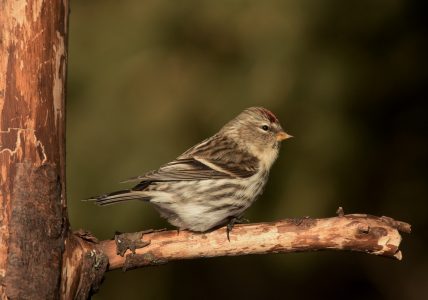
Probably the biggest surprise on the Chippewa County list was the lack of common redpolls. There have been plenty of them in the Marquette area this past week as they alternate between white birch treetops eating the seeds in catkins, and local feeders with their sunflower seeds and thistle. When the temperature drops, the number at feeding stations always seems to increase. Feeders near Tierney and Hampton in south Marquette and at Presque Isle are open to the public and offer good opportunities to get looks at these winter finches. Flocks of 40 and 60 have been seen recently. While there have been plenty of American goldfinches with the redpolls, there have been few hoary redpolls or pine siskins.
The recent thaw and high winds have reopened large parts of Lake Superior between Harvey and Presque Isle, creating more open water, where long-tailed ducks, goldeneyes and mergansers, as well as bald eagles can forage. A number of long-tails have stuck around in Marquette, making them one of the more unusual ducks here this winter.
The final results of the 2021 Marquette Audubon Christmas Bird Count have been tallied. 54 species were found, just two short of the record number seen in 2012 and again in 2020. The total included four other species were seen during the week. Twenty-four birders participated, including feeder watchers. While there were no new species found, there were still some rarer species for the season, including an orange-crowned warbler, northern pintail duck, redhead duck, red-tailed hawk, fox sparrow, and lesser scaup.
While it is difficult to keep track of moving flocks during the day with so many counters in the field, it is still impressive to get some figures for the day for birds like mallards and herring gulls. Almost 1,200 mallards were counted and over 1,300 herring gulls were found. Some of these large numbers are due to another mild fall and the expanses of open water available to both species. A horned grebe, common loon, 24 long-tailed ducks, and a record 67 common mergansers were also on the water. Feeder stations help support the mallards and the landfill helps feed the gulls. 35 common ravens and five bald eagles were also seen at the landfill off County Road 480.
CBC's offer great opportunities to monitor bird population trends and the effects of climate and habitat changes using citizen science. It is some of the best data available. Numbers and winter ranges are tracked. When birders in Marquette began participating in the counts in the 1940s, northern cardinals, red-bellied woodpeckers, mourning doves and American crows almost never showed up on the counts. Now all four appear regularly in ever growing numbers. Similar changes, as noted here, have come with the increasing amount of open water and how it has drawn waterfowl like ducks, loons and grebes as well as increasing numbers of gulls. The latter of course has also benefited from the landfill.
Now other tools, like eBird, have also begun providing more data about bird populations and a guide to where to see birds currently a given area https://ebird.org/home. There has never been a better time to enjoy winter birding.
EDITOR'S NOTE: Scot Stewart is a teacher at Bothwell Middle School in Marquette and a freelance photographer.