
What’s Flying: Birds provide bit of wintertime color
Trending
"Color! What a deep and mysterious language, a language of dreams." -- Paul Gauguin
Those in the Upper Peninsula can become color starved in winter. As the season dives deeper into the late winter mix of near zero temperatures and tantalizing thaws the lack of vibrant colors makes those post thaw dips in the thermometers even more painful.
Luckily there are some wisps of color flashing through the snowflake-filled icy winds to brighten up just about anybody's day. With the extreme temperatures across the U.P. recently, large flocks of common redpolls have continued throughout the area, with many digging in at feeder stations, especially at those with multiple thistle tubes or socks. Their deep crimson crowns are an easy, colorful way to distinguish them from goldfinches and pine siskins, two other finches currently feeding with the redpoll flocks. An added dash of color comes from the pinkish-red blush splashed across the chests of the males.
The redpolls naturally feed on birch seed, they have really targeted feeding stations as the birches in the area have been cleaned out.In the wild they may eat up to 40% of their weight in birch seeds each winter day, which is truly saying something. When examining the actual size of a seed, it stands just barely larger than a pinhead.
Redpolls are extremely hardly. They can store seeds in throat patches in their esophagusi to be regurgitated and eaten later in more sheltered spots out of the bare branches of the birches. According to the Cornell Lab of Ornithology, https://www.allaboutbirds.org/guide/Common_Redpoll/overview, they can store up to two grams there, nearly a fourth of the daily need. At night they can stay down in the snow to escape the cold.
At least five or six different flocks of 50-80 redpolls are being reported daily in Marquette at feeders, and other flocks have been seen across the U.P., lower Michigan and in other Great Lakes states. They can be seen at two public locations in Marquette currently, at Presque Isle and at the edge of school property at the corner of Hampton and Tierney streets in south Marquette. They do wander in winter months across the top of the Northern Hemisphere in search of birch seeds, with banded birds found thousands of miles away in subsequent years looking for birch seeds.
Flocks of red male and yellow-olive female white-winged crossbills continue to pop up across the U.P. too. A large flock was seen near Harlow Lake last week, and flocks of 20-50 have been reported in Brimley, Dafter and Pickford in the eastern U.P.
Many feeders have seen an up tick in other birds of color with the colder temperatures. Year-round resident woodpeckers are spending much more time at some suet feeders trying to keep up the food intake as the suet is much less work to eat than drilling into dead tree limbs and trunks for ant, beetle and wasp larvae.
Two great public sites to see the largest resident woodpecker, the pileated woodpecker, in Marquette are the Fit Strip at the Park Cemetery in north Marquette, where there are no feeders and at Presque Isle Park where they can be seen in the woods and at feeders.
The pair currently coming to feeders there seem quite tame and have on occasion come to feeders at the same time to feed. Both males and females have red crests. Males can be told from the females by their red "moustaches" marking on their cheeks. Females have black marking there.
Those feeders at Presque Isle have also attract three other species of woodpeckers, all with some red markings. More common are the downy and larger hairy woodpeckers. Males have red spots on the backs of their heads, females do not. Also, being seen at many Marquette feeders and some in other towns are the ever more common red-bellied woodpeckers, One of the few birds currently expanding its range, the woodpecker has a range moving slowly northward. Males have a red stripe running from the bill to the back of the head, females have only half a strip across the head to the nape. They also have a very faint blush of pinkish-red on their breasts, hence the name.
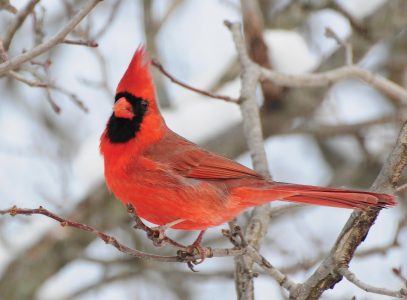
Perhaps the most dramatic bird of color in the U.P. in winter now is the northern cardinal. Once an extreme rarity in the U.P., it is now found in many U.P. towns usually close to feeders. They are a bird often seen feeding on the ground and have a difficult time foraging in winter in the woods.
Most active early in the morning and at dusk, they provide a true shot of wonder when they show up with their bright red feathers. The can do an amazing disappearing act by simply turning to show their brick red backs that blend so well with tree trunk.
Even more amazing, their fall molt leaves them with new dark-tipped feathers. As the tips wear away, their red actually becomes more intense as they near the breeding season in spring.
Other highlights this week around the area include a northern harrier at the Soo in Chippewa County, at least 16 snowy owls seen in one day in the Rudyard area, and five horned larks seen near Pickford.
The Soo-Pickford-Rudyard has been a frequent stop for birders this winter as snowy owl watching has again been a top draw.
So, color your day with a bird fix, you will be happy you did!
EDITOR'S NOTE: Scot Stewart is a teacher at Bothwell Middle School in Marquette and a freelance photographer.