
Trending
"In February there is everything to hope for and nothing to regret." -- Patience Strong
The final days of February always bring the sense of hope to Upper Peninsula residents. While there is still at least a solid month of winter lingering, maybe more, the signs of spring are unmistakable. The deep crimson buds of the red maple trees seem to swell a bit more with each sunny day, even when it is still below zero! Maple syrup collectors are also beginning their toil of love for that sweet, smoky souvenir of spring. Birders begin their watch for the return of the first migrants of spring -- unbelievably they are the ring-billed gulls, the stakeholders at Picnic Rocks in Marquette and other small islands on the Great Lakes.
Birders have been able to enjoy the continuing activity of hundreds of common redpolls, plus companion sets of American goldfinches, house finches and pine siskins. Birders have been astounded by the huge numbers of redpolls currently at many area feeders. The top attraction for the birds has been thistle seed, and many redpolls have been more than happy to visit and feed on spilt seed lying atop the snow. Feeding stations with multiple thistle tube or sock feeders have attracted the largest flocks, sometime approaching 200 birds, but some redpolls have been ambitious enough to tackle black-oil sunflower seeds also. Their smallish bills are well adapted to pry tiny birch seeds out of catkins, but they can handle the larger sunflower seeds too.
Birding across the U.P. has remained surprisingly constant the past few weeks. In the eastern U.P. snowy owls, northern shrikes, snow buntings, sharp-tailed grouse, rough-legged and red-tailed hawks continue to appear on ebird lists of birders travelling through the triangle of the Soo, Pickford, and Rudyard. A number of beautiful, nearly all white male snowy owls continue to be seen, with two recently featured in the Chippewa County ebird photos https://ebird.org/region/US-MI-033/activity , one in Rudyard and another south of the Soo.
Pine grosbeaks and bohemian waxwings continue to circle back to crab apple trees in Marquette, looking for the remaining fruits, and brave their way to some trees along busier roads. There is a line of crab apple trees on Fisher Street across from the Jacobetti Veteran Facility, a fairly busy street, that finally drew a group of pine grosbeaks last weekend, and another set of trees in a parking lot on Washington Street near a drive-through window had a second visit from grosbeaks too.
Birders in nearly all parts of the Upper Peninsula are reporting some notable numbers of bald eagles this winter. In Marquette they are being seen almost daily in the Lower Harbor and on Lakeshore Blvd. near the Dead River. Ice conditions on Lake Superior and the lower portions of the Dead River have changed almost daily, with the rises in temperatures and wind conditions, offering occasional stretches of open waters for hunting. While bald eagles are primarily fish eaters, they also prey on ducks, gulls and other water birds, carrion, like road kills, and unfortunately garbage.
Their flexible, adaptable diets have made it possible for them to spend winters here in the U.P. During the week of Christmas, eagles were seen on a large number of roadkills as deer heading for winter yards met untimely ends on the highways. The Dafter landfill in Chippewa County, and the Marquette County landfill see eagles there regularly, feeding on the mounds of newly arrived refuse. Recently a pair of eagles was seen chasing a diver duck over the ice in the Lower Harbor in Marquette until it finally found some open water where it instantly dove in. The eagles hung around on the ice for a while, hoping to surprise the duck, but finally left, empty taloned. Eagles can eat a large enough amount of food at one time to last them several days, carrying them through stretches of winter when food amounts change radically day to day.
Mallards, black ducks, common goldeneyes, long-tailed ducks, red-breasted and common mergansers are the ducks currently being seen in Marquette and open waters in most of the U.P. With the occasional low temperatures, some of the divers have had to head farther out into Lake Superior to find open water. Some have headed to open stretches of some rivers, like the Dead River near the BLP trails in north Marquette, On the Escanaba River common goldeneyes, sometimes more that 25 have been counted in the area upstream from U.S. 41.
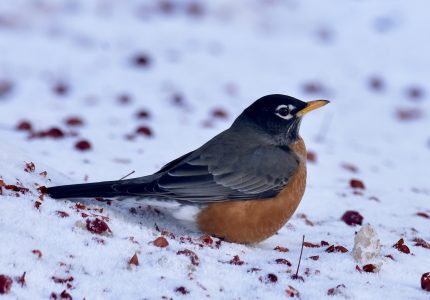
There are some other bird sightings that could offer further hopes for spring. Robins have remained in Marquette this winter, feasting on mountain ash berries early and more recently on crab apples. Single individuals are the general rule, but a flock of ten has been seen from time to time. Even more unusual, a common grackle, a large blackbird, has lingered along the Chocolay River in Harvey, returning to a set of feeders regularly.
Resident birds are getting into the act too. Black-capped chickadees are beginning to sing their territorial song. As spring draws closer, groups of chickadees will begin to split up as dominant pairs begin to defend the best territories, and younger, lower ranking birds try to settle into sustainable areas. Cardinals are beginning to sing too. One male on the East Side was heard singing on consecutive days when the conditions were calm and there was no precipitation.
The big storm this week had silenced them and had even limited their travels to some feeders. The snow will still come but hope reigns, for Spring.
EDITOR'S NOTE: Scot Stewart is a teacher at Bothwell Middle School in Marquette and a freelance photographer.