
What’s Flying: Savor the winter nuggets of hope
Trending
"'Hear! Hear!" screamed the jay from a neighboring tree, where i had heard a tittering form some time, 'winter has a concentrated and nutty kernel, if you know where to look for it.'" -- Henry David Thoreau
Winter has officially arrived all across the Northern Hemisphere. There are definitely diverging thoughts from Thoreau's exclamation. There are nuggets of hope, brightness, and changes to savor. In the Upper Peninsula, it means the weather may choose to finally get serious. Subzero temperatures, blizzards, snow drifts are the traditional fare. But it is also the time when the earth begins it top half tilt back toward the sun. The days start getting longer again even though for the time being, it is colder.
The changes have not stopped with changes to the day and to the weather. There truly seems to be changes in the birding in the central Upper Peninsula too. Marquette's Audubon Christmas Bird Count (CBC) last Saturday lived up to expectations and beyond. Hopes and hard work produced a species count of around 50 for the day from a group of about a dozen birders who started the day before dawn in search of owls and ended after dark doing the same. With most of the checklists for the day have been reported only two species of owls were found -- three great horned owls in Chocolay Township and two snowy owls in the city. There are definitely more great horned owls in Marquette -- they were just quiet when the birders came by.
One warbler was found -- the continuing orange-crowned warbler that has been seen along Whetstone Creek at Founders' Landing. A number of duck species were also found that are unusual in Marquette during the winter months. On Lake Superior, a flock of long-tailed ducks, a ring-necked duck and a surprising redhead duck were all found. All three species of mergansers, American black ducks, common goldeneyes, and a bufflehead were all found. The large population of mallards were spread across town during the day in flocks of up to 100 but the final total should again come up to over 600.
Also seen on the Lower Harbor in Marquette were a common loon and a horned grebe. These two are also late departures, but both have appeared on multiple CBC's in Marquette.
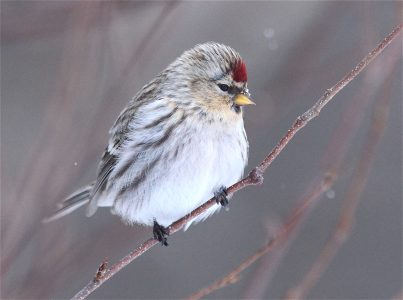
Some species like American robins and northern shrikes, just seen in the past week or so were absent, but there seemed to be a large influx of winter finches just before the count that provided lots of excitement for birders. A large flock of 50 white-winged crossbills were found at the Chocolay River Marina Saturday morning. They feed on conifer cone seeds and move rapidly through the forest canopy looking for patches with good cone crops. In many white birch tops common redpoll flocks were found. Back at Founders' Landing a flock of eight of the rarer hoary redpolls was also seen. Flocks this size are more unusual so this was a great find.
Pine grosbeaks also made in into town in some good numbers. Small flocks were found on Saturday and since then, at least one flock of 12 has been seen in south Marquette. When the pine grosbeaks first arrive, they usually seek out mountain ash, a native species found across Canada where most of these birds are from and often exhaust the fruits in a tree, starting at the top and working their way down to levels where they feel comfortable. Occasionally they may be joined by waxwings, robins, goldfinches, house finches or starlings.
Once the majority of mountain ash are cleaned out, if they stay, they move into crab apple trees and begin feeding of their larger fruits. This activity can become quite humorous as they bite into the crab apples and proceed to get the mealy, orange fruit smeared across their bills and cheeks.
Waxwings also made it onto the Marquette CBC as a lovely flock of cedar waxwings showed up at set of crab apple trees off Fair Avenue. Most were cedar waxwings, another summer resident that occasionally stays on into the winter months. There was one bohemian waxwing with them. Cedar waxwings can be distinguished by their yellowish breasts while the slightly larger bohemian waxwings are a darker buffy brown with chestnut patches above their bills, on their cheeks and under-part of their rumps. A small group of bohemians had been around last week, but they were not relocated. A single American goldfinch was also with the waxwings.
American goldfinches were one of the most numerous birds of the day for the CBC with several flocks of 30 or more. Over 170 were seen in the count circle, sometimes with a pine siskin or two. They have moved from feeding stations with thistle and sunflower seeds to the tops of birch and their seeds.
Earlier this week a birder caught sight of another larger white raptor in Marquette, thought to possibly be a gyrfalcon, another vagrant from the northern parts of Canada and Alaska. Gyrfalcons are the largest falcons, several inches bigger than peregrines. They are irregular U.P. visitors. One was seen for several days in north Marquette in early January.
In the Cedarville CBC last week, a stunning 71 sharp-tailed grouse were found north of town in one field. Snowy owls were found on that count too. Several days later 55 bald eagles were counted at the Dafter landfill to the north.
There continue to be kernels of wonder across the U.P. -- you just have to look!
EDITOR'S NOTE: Scot Stewart is a teacher at Bothwell Middle School in Marquette and a freelance photographer.