
What’s Flying: Sometimes you must stand in cold
Trending
"To appreciate the beauty of a snowflake it is necessary to stand out in the cold." -- Aristotle
There is a special beauty to the Upper Peninsula after a few snows when there is just a dusting of snow on the ground and the puddles and creek edges are iced in a thin crystalline layer. The cold air seems to seep into the skin in a new almost welcome way to usher the new season to the woods and shore alike. While early snows often feature large wet clumps of heavy crystals, the cold new snows are intricate flakes worth gently trapping and studying.
Cold weather birding has also been good. In a private pond in Brimley and impressive congregation of ducks was seen last Thursday. Along with a pair of trumpeter swans and a part of horned grebes 32 long-tailed ducks and 78 bufflehead ducks were seen resting.
In Delta County and in Marquette County, common mergansers have been frequently spotted. They have been in Ludington Park in Escanaba and at Peninsula Point both in Delta, and in small groups on Teal Lake in Negaunee and on Lake Superior in the Lower Harbor. They have also been seen in the harbor in Munising, in Alger County, Other ducks continuing in the Lower Harbor in Marquette are mallards, white-winged scoters, common goldeneyes and long-tailed ducks. A few red-breasted mergansers have also been seen.
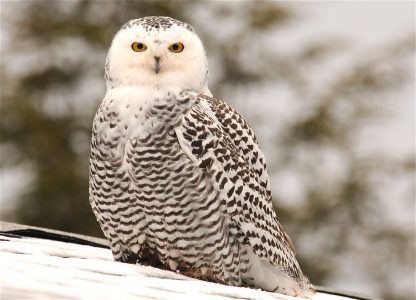
There were several reports from the Lower Harbor breakwall this past week of a snowy owl. Snowy owls spend their lives in the tundra of Canada and Alaska, but in certain years large numbers of them move southward in search of better more prosperous places to hunt, Called irruption years, these winters have large numbers of snowy owls visiting the northern Great Lake States and North Dakota, Some even make it to the New England states to the south. Recently 2013, 2014, 2015, and 2017 were all remarkable irruption years.
This year is off to a very slow start with only three reported in Michigan on eBird, a citizen science site to report bird sightings as of last Sunday.Three more were reported in Wisconsin and none in Minnesota. Although more could come later, it looks to be a slower year for snowies this year, according to an excellent story in the Milwaukee Journal last Saturday:
https://www.jsonline.com/story/sports/outdoors/2021/11/20/first-snowy-owl-sightings-indicate-few-likely-wisconsin-winter/8686413002/..
The shore of Lake Superior is one of the best places to see snowy owls in the Marquette area.The Lower Harbor and the stretch between Wright Street and Island Beach Road are among the best, Snowy owls hunt pigeons, cottontails, small ducks and rodents along the shore and find a surprising number of all four. They do turn inland more once the shoreline freezes though and seem to like the U.S. 41 corridor where they zero in on cottontails and the pigeons. Business signs and rooftops are favorite perches to watch, especially close to dusk. Unfortunately, they have had little contact with motor vehicles and lose the battles with them while hunting along and over the highway.
Pine grosbeaks and bohemian waxwings continue to inch their way closer to habitations and the crab apple and mountain ash trees in towns. Both species have been seen in more undeveloped areas and both finally made it into the town of Republic last Sunday with three waxwings and 17 grosbeaks spotted. As they get closer to Marquette, the crab apple trees at the southeast corner of the county courthouse, the streets north of the Park Cemetery between Seventh and Lincoln, the south side of Marquette between Fisher and Pioneer west of Front Street, and store parking lots in Marquette Township are all good places to watch.
The crab apple trees with smaller fruits and the mountain ash trees are best for bohemian and possibly a few cedar waxwings, The pine grosbeaks like the larger crab apples and actually take messy bites out of the fruits smearing the mealy small apples over their beaks and faces.
The best bird in the U.P. this past week for most birders was a common eider seen in Marquette's Lower Harbor. With the significant number of excellent birders checking the Lake Superior shoreline daily more and more often, unusual waterfowl and other rarities are more frequent discoveries.
A common eider was first reported Nov. 17th and has been seen regularly from the south side of the ore dock to the U.S. Coast Guard dock next to the breakwall.
Common eiders are large sea birds spending their summers along the shores of northern Canada and Alaska. Winters are spent along the Atlantic Coast from Labrador to New Jersey, along the Alaska Coast the coast of southern Greenland and around a group of islands in Hudson's Bay.
They are also found in northern Europe. They feed mostly on crustaceans and mollusks, so the bird in Marquette, probably a female, with its brown plumage, is diving for crayfish, clams, snails and mussels in the harbor. The common eider is most easily recognized by its bill that slopes almost directly down from it crown. Females are a dark brown and males have black, white and in summer yellow bills They are the largest duck in the Northern Hemisphere. Ironically, a second female common eider was found at the boat dock in Copper Harbor Nov. 22.
Enjoy the snow and cold, it's a refreshing break from a hot plate of leftovers.
EDITOR'S NOTE: Scot Stewart is a teacher at Bothwell Middle School in Marquette and a freelance photographer.