
Trending
Despite the connotations of odd duck, lame duck and ducking out of things, those ducks really are really remarkable. -- Anonymous
November is a great duck month in Marquette and in many other places where ducks are still migrating or stopping either on migration or in the search for suitable places to spend some time as they prepare for winter on the Great Lakes. Armed with a strong pair of binoculars or a spotting scope (a modified telescope used for watching wildlife) birders can have a really enjoyable time scoping the Lower Harbor in Marquette these days from the Lower Harbor Breakwall or from public access areas at Mattson Park and south of the ore dock.
A good variety of waterbirds has continued from in the harbor, from occasional common loons to horned and red-necked grebes and ducks. A mix of diving ducks has changed daily, with a flock of about a dozen and a half long-tailed ducks regularly highlighting the group. A daily change-up in numbers of white-winged and black scoters has cruised through the middle of the harbor, with the black scoters occasionally cruising in closer to shore near the Cinder Pond east of Mattson Park or north of the mouth of Whetstone Brook at Founders Landing.
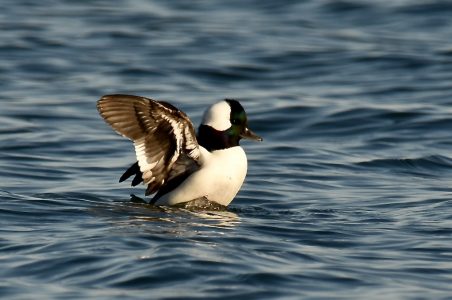
A few other ducks have been in the Lower Harbor mix including greater scaup, common and red-breasted mergansers, a few common goldeneyes, and a good number of buffleheads. A patient scanning of the entire harbor can often yield dozens of waterfowl, but patience is the key. In rougher water the birds may be difficult to spot riding up and down in the waves.
They are also diving for fish, mollusks and other invertebrates and can disappear for minutes at a time, only to reappear several hundred yards from where they started their dive.
Tyler Hoar's Winter Finch Forecast from Ontario, https://finchnetwork.org/winter-finch-forecast-2021-2022-by-tyler-hoar, reported this fall on most of the finches found in the Upper Peninsula during the winter months and their predicted movements based on the status of their winter food supplies. As stated last week, many of the predictions seem to be spot on, at least for how some of the species might move through the U.P. this winter. Common redpolls continue to move southward to the U.P., in some cases in good numbers from areas of birch in Canada. 65 were seen at Peninsula Point in Delta County Nov. 9 and over 3,000 have been seen at Whitefish Point so far this fall.
American goldfinches have been good too. While not directly covered by the report their numbers often parallel pine siskins, redpolls, or other species in some years. 771 were counted at Whitefish Point on Nov. 8! White-winged crossbills are also showing up in impressive numbers, with 170 counted at the Point the same day. Smaller number of them have been seen a multiple sites in the central U.P.
Some shorebirds are still coming through Lake Superior. Sporadically a sanderling or two is still showing up at the mouth to the AuTrain River on Lake Superior in Alger County. Three sanderlings were counted at the point each day from the 5th to the 9th, and a handful of black-bellied and American golden-plovers have been seen too. Some other great birds -- a blue-gray gnatcatcher and a Sprague's pipit were also tallied at Whitefish Point this week.
The changing of the guard for U.P. hawks is underway as the growing numbers of red-tails reported this past summer and fall head south to Illinois, Wisconsin, and Lower Michigan to hunt in areas with less snow and are replaced by rough-legged hawks. The rough-legs continue to wander down from the Arctic. Single individuals have been seen in Delta County and cruising over the breakwall in Marquette this past week. Well-adapted for cold winters, they are the only hawks with legs feathered to the toes, keeping them warmer in extreme weather. Like the red-tails, they prefer to hunt over fields and more open country, looking for mice, rabbits, and other small mammals. When hunting they can hover over a spot for several minutes waiting for the right moment to dive down and grab their prey.
Birders at the mouth of the Dead River have had another treat with a continuing show by five river otters hunting and playing in the backwaters that parallels Lakeshore Boulevard. They were seen again this past weekend and last Tuesday. Their dinner fare has included both brown bullheads and apparently a small eastern painted turtle. They have been seen on various parts of the Dead River, particularly on the wider waters near the old power plant and later in past winters above the Tourist Park. Recently though they have spent lots of time near the river mouth.
Perhaps the last big wave of robins just swept through the central U.P. for the winter. A flock of nine was seen in south Marquette last Friday and a larger flock of close to 50 was seen recently in Delta County. A few remaining robins may join the influx of pine grosbeaks beginning to move into the area and feed with them in the multitude of crab apple trees in the Marquette area.
This season's crop of fruit varies from tree to tree but as is usually the case, there is a healthy crop to keep both species and any waxwings that move into the area well fed for weeks. A few robins may spend the entire winter here, but often as these foods disappear, they move further south until spring. Lots on the move so grab some binoculars and join them!
EDITOR'S NOTE: Scot Stewart is a teacher at Bothwell Middle School in Marquette and a freelance photographer.