
What’s Flying: Melancholy gives way to excitement
Trending
"You don't waste October sunshine. Soon the old autumn sun would bed down in cloud blankets, and there would be weeks of gray rain before it finally decided to snow." -- Katherine Arden, Small Spaces
The month of October seem to be rocketing through time changing the face of woods and water toward the inevitable signs of a new season, a new feeling, a new emotion. There is a touch of melancholy in the changes, but also the excitement of a cleansing, a renewal, and the promise of a time of rest before the cycle begins again next spring.
There is an intrinsic energy in the October air. Winds keep leaves in a perpetual freefall. Even after they have fallen, they seem to continue in a new life of motion on the ground and the urgent sounds of their mad dashes to find a quiet spot are continual reminders of the urgency of their plans.
Birds, chipmunks and squirrels seem to be nearly permanent fixtures at some feeders, many acorn piles under oaks, and anywhere where even miniscule surpluses of food pile up on the extra fat to still make their way south, ready for life at lower temperatures or prepare for the long rest ahead.
Even a quintet of river otters seemed a bit more determined to hunt down brown bullheads in the Dead River last Friday along the river near the mouth. The otters spent several hours in and out of the water along Lakeshore Boulevard, regularly pulling up small bullheads to munch on before diving again.
At the mouth of the Dead, flocks of ring-billed and herring gulls have numbered over 200 in late afternoons with occasional drop-ins that have included glaucous, iceland, Thayer's, lesser and greater black-backed gulls. The lesser black-backs, one of the more unusual gulls occasionally stopping in the central Upper Peninsula, spent several days here.
Out on the bays of Marquette, common loons, black scoters, a few buffleheads, long-tailed ducks, horned and red-necked grebes have all been seen livening up the waters. The small numbers of these are often a gentle reflection of the actual numbers of at least some of these species migrating through the area.
On Oct. 24-25, 1,430 and 2,470 long-tailed ducks were counted at Whitefish Point. Nearly all the long-tails there were in flight, and simply continued past the point on their way to Lake Michigan for the winter. In Marquette, most of these waterbirds are seen on a stop while they rest and forage.
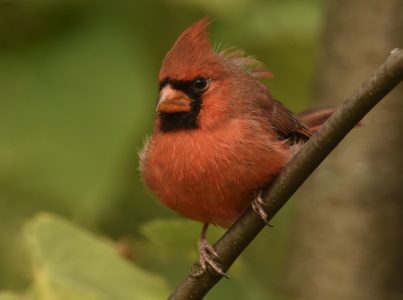
Northern cardinals seem to be working on one last set of fledglings in the Marquette area. A number of feeders have seen small groups of cardinals this summer as the population in Marquette continues to grow and nesting pairs seem to be successfully rearing multiple broods. Several feeders in town have seen five or more cardinals at a time visiting.
A more unusual cardinal observation was made at Peninsula Point at the tip of the Stonington in Delta County last Saturday when 11 cardinals were seen. Cardinals don't migrate, but in late fall and winter they do sometimes form groups, called colleges, radiances, or conclaves, as they search for larger sources or food.
Flocks as large as 70 can form, especially near large feeding stations when weather is particularly challenging. Because they are mostly ground feeders, primary places to see them in the deep snow of U.P. winters are in yards around feeders.
The increase in town feeders has led to a modest increase in their range across the northern U.P. Most maps do not show them in the northern U.P. counties, but they are definitely here.
Purple and house finches have also made a serious dent in the sunflower seeds as some Marquette houses this week. The males of both species definitely add another dash of color with their bold deep pinks. Purple finches can be identified by their unstreaked breasts and flanks and a sharp brown streak through each eye.
Common redpolls seem to be making some moves into the central Upper Peninsula this past week. Birders found them at two different sites in the Marquette area on Oct. 25. Two dozen of them were found at Presque Isle and half a dozen more were found at Harlow Lake eight miles north of town.
Redpolls are finches fond of birch catkins and are usually found this time of year foraging across the tops of birches and only rarely making it down to feeding stations with black-oil sunflower seeds. 16 were seen at Whitefish Point Oct. 25.
On the 26th though, 985 of them were seen before noon! Pine grosbeaks are also starting to move into the area with two seen south of Gwinn last Tuesday.
Canada jays are one of those boreal birds bringing tourists here to the U.P. to see unusual birds not found in the rest of the state and other areas to the south. Birders begin heading to the western parts of Marquette County to find them, boreal chickadees, black-backed woodpeckers, and crossbills at places like the Peshekee Grade. This year it has been one to see most of these birds there and a few other sites have already boasted the Canada jays. Also called gray jays and whiskey jacks, they are very sociable birds more than willing to dip in for an easy handout or raid an unwatched picnic table full of food.
The watch is on to see who else drops in from Canada to spend some winter time in the U.P.
EDITOR'S NOTE: Scot Stewart is a teacher at Bothwell Middle School in Marquette and a freelance photographer.