
Warm weather coincides with calling owls

A great horned owl. (Scot Stewart photo)
-
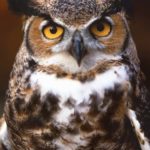
- A great horned owl. (Scot Stewart photo)
-

- Scot Stewart
An envelope of fog wrapping around a dense cedar swamp is broken by a sharp, repetitive metallic whistle. It’s not a sound that is immediately recognizable. Miles away in a stand of tall, thick white pines a pair of hoots, one a deep bass with a stirring tremolo, followed by a second higher hoot call out. Owls! Mid-January seems hardly the time for birds to be announcing their nesting territories or beginning to court their mates, but it is, because timing is everything.
In the damp cedar swamp of Chocolay Township a tiny saw-whet owl calls can be heard currently. Without previous knowledge, most would not recognize it as an owl call, but as the loggers thought over than a century ago, it was more like the sound of a saw being sharpened. Saw-whet owls look like “baby owls” when seen for the first time, but at 9 inches they are full grown. They feed on small rodents, especially deer mice and in the summer on insects too.
With their deep “hoo, hoo, hoo … hoo, hoo,” calling great horned owls are being reported at multiple sites around the U.P. and from multiple spots around the city of Marquette. Sometimes called tigers of the sky, they will eat anything they can catch: birds, rabbits, mice. Owls begin defending territories in mid-winter and will be on nest by mid-March here. After an incubation of 30 days, young great horned owls will be nearly full size, just about the time most other animals will be presenting their own young, providing a bounty of food for the young owls. Last Friday night the musky smell of a skunk filled the air near the Dead River, possibly indicating the activity of hunting great horned owls. The owls are among the only predators to hunt them. Shortly after the odor wafted into the heavy fog and rain of the evening, the pair was heard along the river.
Winter finches are starting to show up in a few new places even though it hasn’t felt much like winter. A red crossbills type 3 was heard near Bete Grise. Red crossbills have been divided into 10 different types based primarily on the part of the country they inhabit, their bill size and their calls. Type 3 are most often found in western coastal areas and the Great Lakes and are associated with hemlock trees, having small bills to extract their seeds. Their calls are described by ebird as a squeaky tik-tik. More specific information on all 10 types can be found on the ebird website, http://ebird.org/content/ebird/news/recrtype/. In Gullliver Schoolcraft County, a flock of 300 common redpolls was spotted on Jan. 23.

Scot Stewart
In keeping with the strangeness of this winter, a large flock of more than 100 robins has been feeding in winterberry bushes along the Arnheim Road north of Baraga. This fall there was a great production of berries on the winterberry bushes, often found on the edge of wetlands. The robins were seen from the road, but appeared to be working into the areas away from the road and even were seen in snow covered fields nearby. Waxwings and grosbeaks are also know to feed on these berries and might be found in similar areas.
Ducks have been among the more visible birds in the central Upper Peninsula recently. The Dead River area has been one of the better spots with its horde of the mallards being punctuated with a few delights. The oddities stand out at times, but must be carefully sought out with binoculars or a spotting scope at others. At the warm water holding pond adjacent to the power plant near the river mouth a canvasback duck continues. First seen in mid-December it has remained in the area into the new year. Upstream, west of the Tourist Park Lake, the flock has included black ducks, a least one black-mallard hybrid, common goldeneyes and three northern pintails — two drakes and one hen. The pintails have become a little easier to find in recent winters in Marquette. Wood ducks, seen in many recent winters in the same area, have not been sighted so far this season.
Marquette is not alone in its unusual waterfowl reports. In Munising a large flock of mallards was visited Jan. 24 by a green-winged teal drake. At the head of Keweenaw Bay common goldeneyes, long-tailed ducks and mallards have been accompanied by five swans. Birders have identified four as tundra swans, migrants headed from the far northwest of Alaska and Canada, normally headed for the Chesapeake area along the Atlantic. The fifth has been difficult to identity as a tundra, trumpeter or possibly a hybrid.
The warm weather not only coincided with calling owls, but more singing birds too. Since the songs of robins began two weeks ago, cardinals and American goldfinches have also been heard in the Marquette area. The return of snow and cooler weather will probably bring some of winter’s silence back, at least for a while, but March is barely a month away, and with it the return of noisy ring-billed gulls, maple sap and the first signs of spring.
EDITOR’S NOTE: Scot Stewart is a teacher at Bothwell Middle School in Marquette and a freelance photographer.
Community

Caving Grounds: Marquette Hardcore
Ishpeming VFW bingo Sunday
ISHPEMING -- There will be Bingo at the Ishpeming VFW on Sunday, June 8th. Doors open at noon. Snack and beverages ...
Emanuel Church fundraiser Saturday
SKANDIA — Emanuel Lutheran Church will be holding a fundraiser Saturday to raise money for a new stove and oven ...
Marquette Fringe to host Midwinter Ball
By DREYMA BERONJA Journal Staff Writer MARQUETTE — Marquette Fringe is inviting the public to an ...

Honoring decades of dedicated volunteer service
Downtown New Years Eve festivities go ‘very well’
By ALEXANDRIA BOURNONVILLE Journal Staff Writer MARQUETTE — A safe and happy New Year’s celebration in ...