
Recalling John Mangum
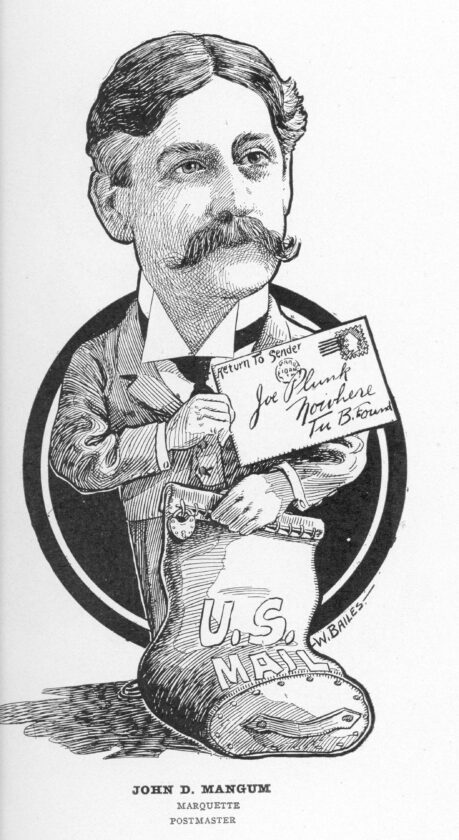
John Mangum caricatured. (Photo courtesy of the Marquette Regional History Center)
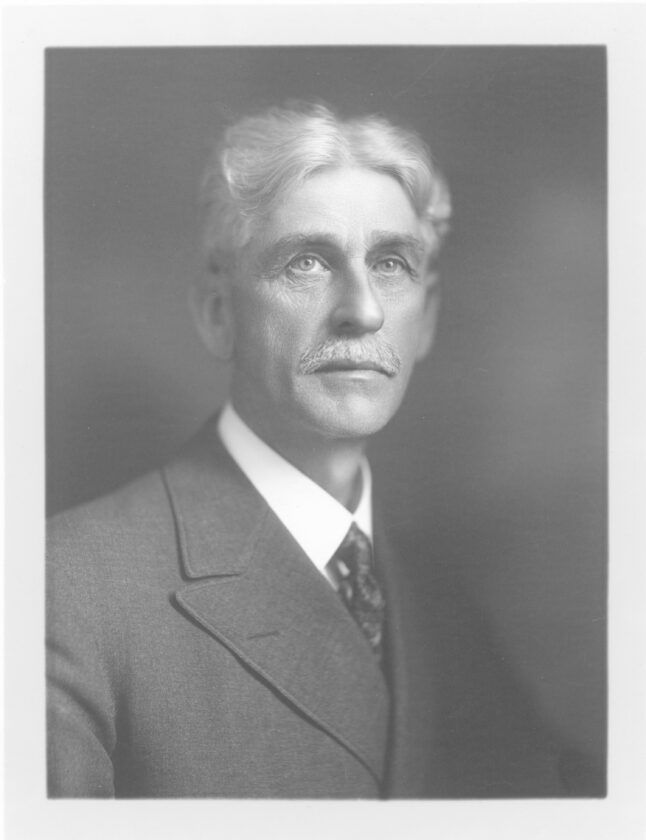
John Mangum. (Photo courtesy of the Marquette Regional History Center)
John Mangum caricatured. (Photo courtesy of the Marquette Regional History Center)
John Mangum. (Photo courtesy of the Marquette Regional History Center)
Trending
MARQUETTE -- The Village of Mangum was a small farming and lumbering settlement about ten miles southeast of Marquette on the Minneapolis, St. Paul and Sault Ste. Marie Railroad. It had a population of 100 and a post office from 1902-1927. The town began when Joseph Dupras and his brothers built a sawmill in the midst of a large hardwood and hemlock stand. A settlement grew around the business and in 1905, the post office opened. By 1910, Mangum also had a school house, feed and grain store, and saloon and was a stop on the Marquette and Southeastern Railroad. The post office closed in 1927.
The village was named for John D. Mangum, a local businessman and politician. No doubt the railway officials were the ones who named the settlement for him. He had a large farm and a big stone house in the area.
John was born in October 1859 in Jackson County, Michigan to John Mangum Sr. and his wife, Margaret. It appears that John Sr. died fairly young and Margaret supported herself and her son by working as a domestic servant. John spent his childhood attending elementary and high school in Jackson County.
In 1890, John was a travelling salesman employed by S. A. Welling in selling wholesale men's furnishings when he married Mary Garrity. The couple had one daughter, Evangeline, before divorcing in 1893. In the legal proceedings, John claimed that Mary was insanely jealous and, "Made his life a burden by following him from place to place and abusing him." Mary refuted these claims, and the legal proceedings between them continued for another 11 years.
During this time, around 1893, John was married again to Nellie Wellbesky. After taking many trips to the Upper Peninsula throughout his career as a salesman, John decided to build his home in Marquette. He arrived with Nellie in 1895. His mother, Margaret, eventually followed them to the area as well. John and Nellie did not have any children of their own, but they took in a local girl, Ida Leona Erickson, as their foster daughter.
After moving to the U.P., Mangum became involved in the timber business. In 1902 he became treasurer of the Chocolay Land Company, which controlled some 4,500 acres. Sometime later, he became director of the Northern Land Company. Still later, he assisted in the organization of the Johnason Clothing & Shoe Company and managed that firm before pivoting into a role in politics.
John Mangum served one term as mayor of Marquette. He also served three terms as postmaster of Marquette from 1902-1914. In 1915 Mangum became chairman of the state Republican party, leading the fight against the re-election of President Woodrow Wilson. Although Wilson was re-elected, Mangum's work reportedly "swung Wayne County into the Republican column."
In 1918 he oversaw the senate campaign for Republican Truman Newberry, a former Secretary of the Navy. Newberry was challenged in the Republican primary by automobile industrialist Henry Ford. Ford lost the Republican primary, but he had also run in the Democratic primary, which he won. So, the two men faced off again in the general election.
The race was highly controversial for illegal campaign spending by both major candidates. Even before election day occurred, Ford hired a team of 40 private investigators to find proof of his rival's campaign finance violations. He turned over his findings to the United States Department of Justice for further investigation.
Eager to avoid Michigan juries sympathetic to Newberry, the government convened a grand jury in New York because Newberry had signed papers related to his candidacy there while serving in the Navy. Mangum headed to New York City in early October 1918 to deal with the legal case.
Around this time, Mangum was suffering from ill health and his friends worried that overworking on the campaign was damaging his health further. They feared that unless he reduced his workload, he might not survive the year. But Mangum was unwilling to contemplate the thought of giving up his work in politics and stayed on with the campaign team in New York.
In the end, the grand jury voted 16-1 against an indictment. In early November, Newberry narrowly won the general election but was plagued by further efforts to prevent him from being seated, including both FBI and Senate investigations.
Unfortunately, the predictions of his friends proved prophetic, and John D. Mangum died at the Biltmore Hotel in New York just before Christmas 1918. Following his death, one friend eulogized him saying, "He was a loyal friend, and a bitter enemy. He loved a fight, and his fights, in no small measure, wore him down."
Although Mangum did not live to see it, Newberry was finally seated as senator in 1919. In 1921 he was again tried for campaign spending violations under the Federal Corrupt Practices Act and convicted. Although the conviction was appealed by the U.S. Supreme Court which ruled the act unconstitutional and he was allowed to retain his seat, he faced severe condemnation by the Senate and ultimately resigned in 1922.
EDITOR’S NOTE: The village of Newberry in the eastern Upper Peninsula is named for Truman's father, John Stoughton Newberry, an industrialist and politician who represented Michigan's 1st District in the U.S. House of Representatives.