
Vina Winifred Lacey
Trending
EDITOR'S NOTE: This work was adapted from an article by Miriam Hilton in the spring 1973 in "Harlow's Wooden Man."
MARQUETTE -- It's early fall and like generations before them, students and educators have returned to their classrooms. While some things remain constant, other things like class sizes and teaching methods have changed considerably over the years.
September 1902. It was the first day of classes at the Cleveland School in Ishpeming. Twenty-seven-year-old teacher Vina Winifred Lacey, an Ishpeming native who was the youngest daughter of Irish immigrants, looked over the students crowding into her first-grade classroom.
Nothing she had learned during her brief time at Ypsilanti State College, or her short teaching career, could have prepared her for what she saw.
There were 96 new students. They answered her questions in Swedish, Norwegian, Finnish, German and Italian; only three understood English. Waiting mothers and older siblings helped translate until they were all enrolled.
Vina was promised help: one high school girl and a book on the new Batavia method of individual instruction.
The Batavia method was recommended by the Ishpeming school superintendent, President Leonard of the Michigan Normal Schools, and President Hall of Clark University in Worcester, Massachusetts, the leading teacher training institution in the country.
Founded in Batavia, New York, in 1898, to deal with overcrowded schools, the system focused on individual instruction supplementing regular class teaching. In a large class, instead of splitting into two classes, a second teacher was added to the room to provide individual instruction.
While the regular teacher proceeded with class recitation, the second teacher, in this case the high school student assigned to help Lacey, gave individual help to pupils one at a time in another part of the room, focusing on the needs of each child.
By the next fall, Miss Lacey reported to the Upper Peninsula Education Association that a third of her class had been promoted to third grade, while the remaining students were in a high second. Her fellow teachers were eager to learn more about her methods.
In 1904, Vina received her Michigan life teaching certificate from Northern State Normal School (now Northern Michigan University). Shortly afterwards, President Kaye asked her to join the summer faculty at the school to give a course for other educators on her methods of teaching children of foreign parentage. The course proved tremendously popular. The material was practical and her enthusiasm was catching.
In 1909, Ypsilanti State College awarded Vina with an honorary degree of Master of Pedagogy. The following year, a series of articles explaining her methods was published in The American Primary Teacher.
That same year, when women could first vote in Michigan school elections, she ran for county school commissioner. Regrettably, she lost to the incumbent, Commissioner Albert E. Sterne.
Throughout her career, Vina continued to advocate for students and the community. In a letter printed in the November 1915 issue of the Journal of Education, she pointed out to her fellow teachers that they were responsible for helping children experience the joy of Christmas. "The majority of our children come from homes where the mother is burdened with more than her share of family cares and income is limited," she reminded them.
She concluded her letter with a list of simple and practical projects designed to make each day in December especially fun.
During World War I, she encouraged children to save aluminum foil. The drive was so successful that it was given nationwide publicity as an example of what small communities could do.
Through her efforts as chairwoman of the Women's Service Club, the group sent 1,000 Christmas boxes to soldiers overseas.
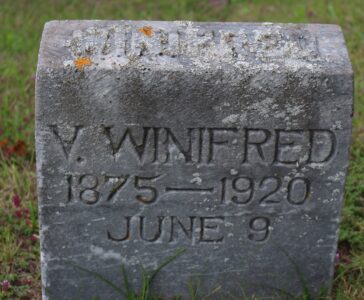
On June 9, 1920, just six days before her 45th birthday, Vina collapsed and lost consciousness as she was preparing to go to work at Cleveland Elementary School. Before she could be taken to the hospital, she died from complications of diabetes. Classes were dismissed for the day throughout the city.
To learn more about other local educators, join the Marquette Regional History Center for our 18th Annual Cemetery Walk: Educators on Thursday, Sept. 14, 2023, at Park Cemetery in Marquette.
There are several options to enjoy the walk: The 1 p.m. tour is self-guided with maps available near the Park Cemetery main gates on 7th Street. The 6 p.m. tour is guided, or a seated version is available for those who cannot or do not want to walk. (Please bring your own lawn chair.)
Meet near the Park Cemetery main gates on 7th Street. The suggested donation is $5. For more information, please visit marquettehistory.org or call 906-226-3571.