
Headed for the record books
Trending
By CHRISTIE MASTRIC
Journal Staff Writer
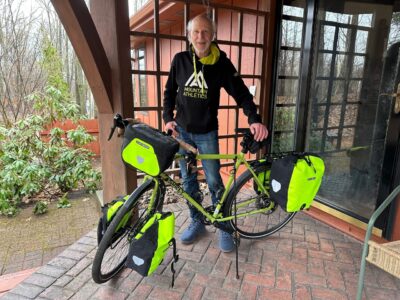
MARQUETTE -- The specialized bicycle situated outside Bruce Closser's south Marquette home soon could be part of a world record-breaking journey.
Closser, at age 78, plans to become the oldest person to ride a bike across the United States, having already given the go-head to make the attempt by Guinness World Records.
Closser, a retired real estate appraiser, isn't spending his retirement in a typical way. His plans are to bike from the Atlantic Coast to the Pacific Coast -- specifically, Yorktown, Virginia to Astoria, Oregon-- following the designated TransAmerica Bicycle Trail.
"It's kind of been on my bucket list for a long time, something I always wanted to do, but it takes a lot of time," Closser said. "It takes a specialized type of bicycle, which I didn't have."
Closser said he brought up the subject of a trek across America to his late wife, Sally, who he acknowledged wasn't thrilled over the idea of spending an entire summer by herself.
"I thought, well, maybe someday," he said.
That "someday" will begin on May 5, with the trek expected to last three months.
Closser has Parkinson's disease, which also afflicted his wife; she died from the disease in August. His kids then became concerned that their father would become a couch potato and withdraw from the world.
There's not much chance of that happening.
While in Colorado this past winter, Closser saw in a local newspaper an article about a 75-year-old man who had ridden his bike across the U.S. That man looked up the Guinness world record in this category and discovered the recordholder was only 70, and eventually broke the record.
Closser applied to Guinness, which accepted his proposal.
"This is an official world record attempt," Closser said.
He noted he has a "strategically placed" daughter in Baltimore, so he will ship his gear to her and fly there to start his trip. His son, who lives in California, will meet him at the end of his journey, after which they will drive to San Jose. His return trip will involve his gear being shipped back from California as well as a flight -- not bicycle ride -- home.
"It's a self-supported solo ride," Closser said of his upcoming trek. "That is, there's not a car following me with all of my stuff."
He will, however, try to make a daily Facebook post to let people know how his journey is going.
Closser said the consensus is that the most difficult part of the trail route is the section that goes across the Appalachian Mountains into Kentucky.
"Even though it goes through a lot of mountain ranges, this is the hardest one," he said of the trail. "They're very steep, and it's just ridge after ridge after ridge after ridge. It just goes on for a couple hundred miles."
Westbound, the trail picks up in the Ozark Mountains and heads across the Continental Divide and into the western United States, finishing up along the Pacific Coast in Astoria.
Special journey, special bike
Closser, who already has a trim physique, is training for his upcoming trek, having only recently gotten his special bicycle, a Surly Disc Trucker. The Surly Bikes website called the Disc Trucker a purebred drop bar touring bike suitable for traveling anywhere in the world on mostly paved roads.
"A touring bike has particular needs," Closser said. "It needs a really low gear because you're carrying a loaded bike up mountain roads, and then it also needs high gears because you're on paved roads and sometimes you're going downhill. You like to be able to pedal."
He said the route goes through mostly small towns for reduced traffic, and he probably will stay in motels when they're available. Other options are camping -- meaning he will have to carry the appropriate gear -- or facilities that the TransAmerica Bicycle Trail offers, which are sites like a community building, church basement or park pavilion.
An organization called Warm Showers, Closser said, is a network of people who open their homes to touring bicyclists, providing, along with warm showers, a place to sleep or breakfast, or sometimes a yard in which to pitch a tent.
Closser has read a lot about -- and spoken with -- people who have made such long bicycle trips.
"Everybody seems uniformly agreed that they didn't have trouble with people," he said. "In fact, people were out of their way to be kind and interested in what they were doing. They met a lot of people along the way.
"The biggest detriment was loose dogs, but not wild animals."
Christie Mastric can be reached at 906-228-2500, ext. 250. Her email address is cbleck@miningjournal.net.