
Habitat Conservation Plans have potential for helping bats
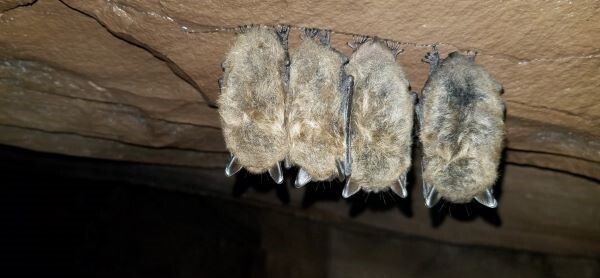
Bat conservation is the goal of the Lakes State Forest Management Bat Habitat Conservation Plan. (Photo courtesy of the Michigan Department of Natural Resources)
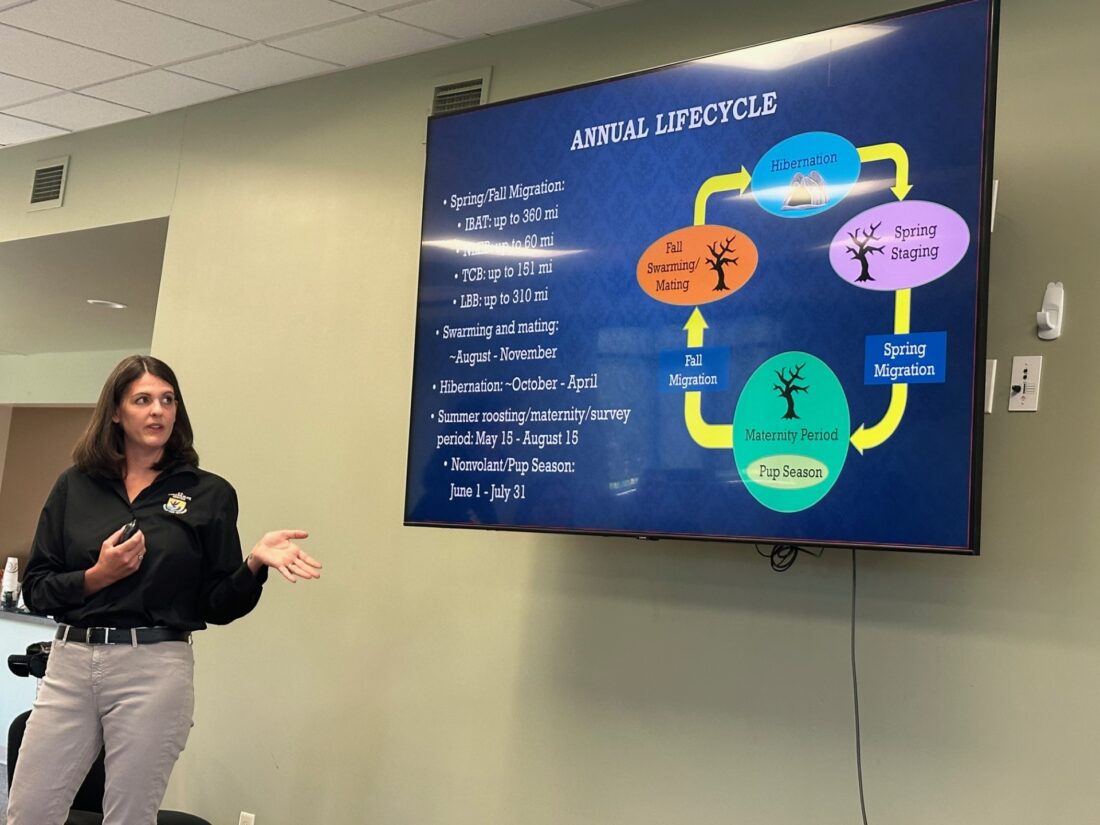
Jenny Wong, a biologist with the U.S. Fish and Wildlife Service’s Michigan Ecological Field Office in East Lansing, talks about the annual life cycle of bats during a special Aug. 15 presentation at the Marquette Township Community Center. The presentation focused on the Lakes State Forest Management Bat Habitat Conservation Plan. (Journal photo by Christie Mastric)
Bat conservation is the goal of the Lakes State Forest Management Bat Habitat Conservation Plan. (Photo courtesy of the Michigan Department of Natural Resources)
Jenny Wong, a biologist with the U.S. Fish and Wildlife Service’s Michigan Ecological Field Office in East Lansing, talks about the annual life cycle of bats during a special Aug. 15 presentation at the Marquette Township Community Center. The presentation focused on the Lakes State Forest Management Bat Habitat Conservation Plan. (Journal photo by Christie Mastric)
Trending
MARQUETTE -- Landowners can help reduce harm to bat species in Michigan -- some of which are federally endangered -- through a variety of management activities.
The Michigan Department of Natural Resources and U.S. Fish and Wildlife Service on Aug. 15 gave a presentation at the Marquette Township Community Center on threats to bats and tools such as the Lakes States Forest Management Bat Habitat Conservation Plan.
A Habitat Conservation Plan is an application for an incidental take permit, issued under the federal Endangered Species Act, to nonfederal entities undertaking projects that might negatively affect an endangered or threatened species. Eligible nonfederal landowners can take part in the Lakes States Forest Management Bat HCP and receive coverage under Michigan's federal incidental take permit from the USFWS for the Indiana bat, northern long-eared bat, little brown bat and tricolored bat.
The permit allows for forest management activities, prescribed fires, and certain road and trail construction as long as the activities are implemented consistent with the HCP.
The DNR and the U.S. Fish and Wildlife Service worked to develop the plan, said Keith Kintigh, acting wildlife planning and adaptation section supervisor with the DNR.
Forest activities have the potential to negatively impact bats, he said.
"This HCP acknowledges the important role that forest management plays in creating habitat for bats while also outlining various actions that outline a conservation benefit for bats," Kintigh said.
Some species endangered
Jenny Wong, a biologist with the USFWS's Michigan Ecological Field Office in East Lansing, explained the background of the four bat species covered in the HCP.
Two of the bats -- the Indiana bat and the northern long-eared bat -- and federally listed as endangered. Threats to the Indiana bat, she said, include white-nose syndrome, loss of priority hibernation sites and summer habitat loss.
Michigan is in this species' northern edge of its range, Wong said, having been detected throughout much of the southern Lower Peninsula.
The northern long-eared bat, can be found in the northern Lower Peninsula as well as the historic mining regions in the western Upper Peninsula.
The major threat to this species is white-nose syndrome, she said.
"They're very severely impacted by the disease," Wong said. "The hibernating population in Michigan has declined by at least 98.5 percent based on winter survey data."
The tricolored bat, Wong noted, is not currently federally listed as endangered in Michigan, but the USFWS in 2022 proposed the species for this list. It too is affected by WNS, she said, but never was common in Michigan. However, it is listed as threatened in Michigan.
Also listed as threatened in Michigan -- and affected by WNS is the little brown bat, Wong said, with the USFWS undergoing a discretionary status review to determine if listing it under the ESA is warranted.
Why protect bats, which unfairly or not, aren't held in high esteem by some people?
Some education is essential to change that misperception.
"They look like mice with wings, but they're really different from rodents," Wong said. "They have very slow life histories and really low reproductive output."
Bats also are essential to a healthy forest ecosystem.
The four bats listed in the Lakes State Forest Management Bat HCP, she said, are voracious insectivores.
"They're really important to our agricultural industry, and likely our forest products industry as well," Wong said. "They consume a lot of crop pests and forest pests, and also disease vectors."
Forest management essential
Scott Hicks, field supervisor with the USFWS's Ecological Services Program in Michigan, said, "Private forest management is critical for the conservation of lots of species, including some of our listed bats."
Wildlife officials, he stressed, known bat hibernacula exists on private lands.
"We recognize the important role that forest management plays in bat conservation, and the HCP is one way of helping to address regulatory requirements that may come into play, but it doesn't mean that an HCP is always required for every type of forest management," Hicks said. "It's really going to depend a lot on where and when and the type of activity."
He called the HCP a "comprehensive strategy" that could potentially cover many landowners and large tracts of land, which provides more flexibility than what might be available if just one property owner were involved.
"It reflects too the important role that working forests play in conservation," Hicks said. "The DNR worked really hard to make sure that what's reflected in the HCP reflects what's doable in terms of sustaining forest management on the land, because we recognize that's really important to do."
Jennifer Kleitch, endangered species specialist with the DNR, said that currently the HCP is for landowners with 10,000 or more acres, although it's possible that number soon will be lowered to 500 acres.
John DePue, DNR wildlife biologist, said a condition of an HCP is that it must demonstrate an overall benefit for the covered species bats. The incidental take permit, he said, is 50 years.
"What's covered primarily is timber harvest related to forest management activities," DePue said.
The steps to an HCP are:
≤ eligibility determination;
≤ an application;
≤ an application review and decision;
≤ landowner agreement development;
≤ a review of the landowner agreement;
≤ signing of the certificate of inclusion; and
≤ landowner agreement implementation.
The DNR is the administrator of the Landowner Enrollment Program.
The Landowner Enrollment Program Guide, eligibility checklist and landowner application are expected to be available soon at www.michigan.gov/dnr/education/michigan-species/mammals/bats/bat-hcp.