
Keweenaw County gets grant to support first responders unit
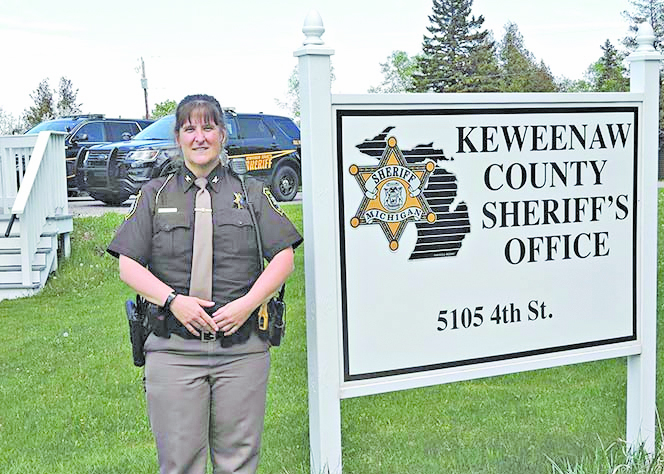
Keweenaw County Undersheriff Tonya Stefonich says the county is happy with receiving a grant award from the First Responder Training and Grant Program. (Houghton Daily Mining Gazette photo)
EAGLE RIVER — Keweenaw County was awarded $82,172 to support first responders from the $5 million First Responder Training and Grant Program.
The grant program supports efforts of local governments to expand recruitment, improve training and provide additional professional development and support to first responders in local governments.
“Michigan’s first responders put their lives on the line to keep us all safe and we must have their backs,” Gov. Gretchen Whitmer said in a statement Friday. “Today’s grants will help more than 60 communities across Michigan train and recruit first responders. And in my budget for next fiscal year, I’ve proposed additional funds to help communities hire and train even more first responders, including firefighters, police officers, paramedics and EMTs. Let’s keep working together to keep Michiganders safe.”
As a part of the First Responder Training and Recruitment Grant Program, all Michigan cities, villages, townships, counties and fire authorities were eligible to apply for a grant related to first responder training and recruitment. First responders are police officers, firefighters, emergency medical technicians, paramedics and local unit of government corrections officers.
Keweenaw County Undersheriff Tonya Stefonich said the sheriff’s office is happy to have been granted the funding. It will help with recruitment and training, she said.
“One of the things we’re looking at,” she said, “is sponsoring somebody through one of the police academies.”
Normally, people go through the police academy and they pay their own way, Stefonich explained.
“With this grant, we’re hoping that we can sponsor somebody through that police academy, and when they graduate from the academy, they will come and work for the sheriff’s office,” she said.
The remaining money will be applied to training the department’s officers, she said.
Stefonich said the sheriff’s office holds a medical first responders license for the county, so the remaining grant money will be used for training the department’s officers.
The grant will also, to some degree, benefit the search and rescue currently being organized by the sheriff’s office, though it will benefit the department more, she said.
“It will benefit some of the training for the search and rescue,” Stefonich said.
In April, Keweenaw County Sheriff Curt Pennala announced an organization meeting to discuss the formation of the Keweenaw Search & Rescue.
Currently the county has an off-road rescue service that has been staffed by the Ahmeek fire department, Pennala said in April.
The goal now is to restructure and expand the service and over time, add more specialty elements to it.
“We already have a lot of the necessary equipment,” Pennala said, “and obviously, additional things are needed, but the added equipment would be dual-purpose between both patrol and search and rescue also.”
Currently, the department owns a patrol boat, a personal watercraft and snowmobiles, but added equipment would be dual-purpose items that the county is lacking.
A major element of concern for the department is that due to the attraction and the topographical features of the Keweenaw Peninsula, it draws a lot of outdoor enthusiasts, Pennala said.
In the past few years, particularly during the COVID outbreak, and even prior to that, he said, the number of enthusiasts has been dramatically increasing every year.
One skill that is of interest to first responders in the area, Pennala said, is high-angle rescue. His office has had a group reach out requesting to become involved in that.
High-angle rescue operations involve terrains with slopes of 60 degrees or greater, according to Elite Rescue Technical Services.
In these scenarios, the rescue personnel require a more comprehensive set of skills, as they rely entirely on ropes and other specialized hauling and hoisting equipment to access and rescue the people who are stranded.
This characteristic places both rescuer and rescuee at a greater risk of injury to life and limb if the rope system fails.
To minimize this risk, in addition to needing specialized training and certifications, rescue personnel must be in good physical condition to be qualified to perform high angle rescues.
Pennala said over the years, his department has responded to several calls regarding climbers stuck on the bluffs along Cliff Drive.
“Right now,” he said, “there isn’t a group for them.”
Tuesday: Health

Talk With the Doc: Our pancreas is an essential human organ

Urology Pearls: Life and death in a quiet red hue

Our conscious and subconscious mind

Urology Pearls: To nap, or not to nap?

Talk With the Doc: March is Colorectal Cancer Awareness Month