
Blizzards a real danger for those caught unprepared
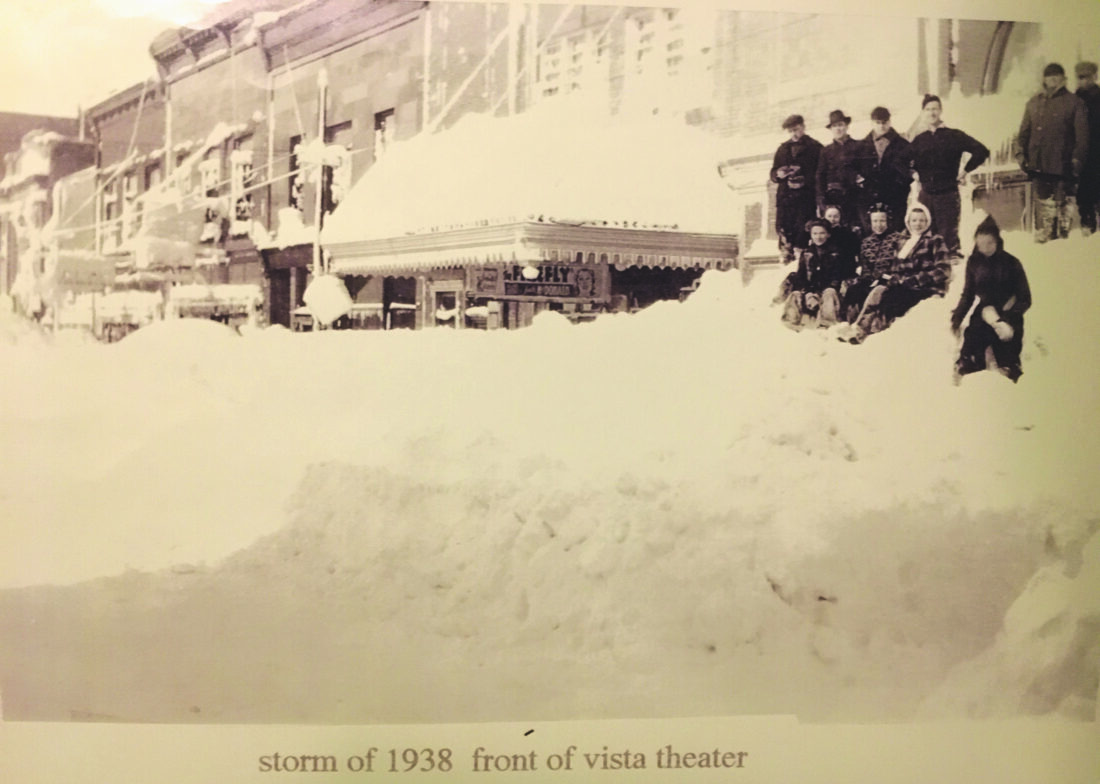
Area residents sit in a snowbank in front of the Vista Theater in Negaunee after the blizzard of 1938. (Photo courtesy Virginia Paulson)\
You can’t meet a group of people without the conversation turning into a weather report.
Are churches and schools closed? Where do we put the snow? Have you shoveled off your roof?
At this point, most of us can’t see any traffic going down our street because the snowbank has taken over. Roofs are collapsing.
It’s a good time to write about some problems with snow from the past. I gathered some information from Karl Bohnak’s book, “So Cold A Sky.”
In 1922, three Ishpeming girls spent a harrowing night in a blizzard. They attended a dance in Negaunee and after they went to the train station and waited for the midnight train, which finally arrived at 5 a.m.
When they reached Ishpeming, they started walking to their homes in Cleveland Location, but the storm was so severe they lost their way. Confused, exhausted and near frozen, they took shelter in the doorway of a factory. In the morning, a passerby noticed the girls huddled together and crying. The man realized that they were in a bad way and urged them to seek shelter in the depot.
None of the three seemed able to walk, so he carried them one by one to the station. After about an hour spent thawing out, the girls set out on another trek, this time a successful attempt to reach their homes.
In October 1925, there was an unexpected storm that brought 6 to 8 inches of snow to Ishpeming and Negaunee, while more than a foot piled up in Diorite. As it had been a nice day, five boys went up on the bluff. They were two miles north of Diorite when they decided to head for home. They lost their way and wandered in the woods for three hours.
The five split ways and three made it home. Two of the boys were not familiar with the woods. A search party went to look for them, thinking they may have found shelter in a camp, but didn’t find the pair. The boys were exhausted and made a lean-to for protection.
When one of the boys, they were actually a nephew and a young uncle, awoke he noticed that his companion was gone and started to follow his tracks. He finally reached a farmhouse five miles north of Clarksburg, exhausted and deranged. His hands and face were swollen and his feet were frozen. He eventually had to have both legs cut off below the knee.
A search party followed the tracks of the one boy and found the other boy under a tree. He had put up a fight for his life and had covered his face with branches for protection from the storm and fell asleep and died. His death and the injuries of the other boy are reminders that you shouldn’t go out in Upper Michigan’s woods unprepared.
In 1938, we had just experienced a January thaw and the snow banks were going down. The day started out cloudy with a stiff northeasterly wind, with a forecast of rain or snow and cold temperatures. It was part of a sequence of events during a normal winter.
But this storm was going to be different. The blizzard of 1938 was to become the Upper Peninsula’s storm of the century. The newspaper said it was a raging blizzard, the worst since 1905.
The snow fell for at least 30 hours. It began wet and heavy with temperatures about 34 degrees. Gale force winds drove the sticky snow into mountainous drifts that had the consistency of sand. The drifts brought transportation to a standstill for days.
Snow removal technology was no match for this blizzard. They had big tractors, not the kind of plows that we have now. Today’s plows can get up enough speed to push the snow to the side, while the tractors moved slowly and all they did was make ruts and big banks. They would bog down and a crew would have to remove snow with shovels. The “tier” shoveling technique was used by these crews — you had to back the truck in and the guys would shovel down to the next group of guys and shovel it in the truck. The county hired them for six-hour shifts.
It took six days to get from Negaunee to Palmer, a distance of 10 miles. This had to be done before the tractor could get through. In 1938, Marquette County had only 19 snow plows and tractors responsible for 742 miles of roads.
The storm started early in the day and the weather forecast failed to describe the intensity, so schools opened as usual that day. Officials called school authorities advising them that snow and wind would continue and all Marquette County schools were closed.
Buses in Eagle Mills did not leave until the storm was at its peak. One bus finished most of its run but had to return to Negaunee because of zero visibility and severe drifting. Five children had to spend the night at Negaunee homes. School closed on Monday and opened again on Thursday, and got out early on Friday because the storm wasn’t quite over.
Iron Street was like a tunnel. Ten men were marooned at the Mary Charlotte Mine and two men snowshoed in to bring them food. Men were also stranded at the Blueberry, Athens, Negaunee and Maas mines. Most of the mines did not operate with the afternoon shifts until Thursday.
Many of us may still have a button from nearly 50 years ago that says, “I survived the storm of ’78.” It began in the evening of Jan. 25. Travel was impossible. M-35, U.S. 41 and M-28 were closed.
The snow drifts were packed so hard you could walk on top of them without sinking. Negaunee Township recorded 27 inches of wind-whipped snow. Record cold followed the blizzard.
Maybe the year 2026 will go down as our snowiest winter.
Virginia Paulson has been a trustee with the Negaunee Historical Society for more than two decades, previously having been on the Negaunee Public Schools board of education for 23 years and MARESA board for 17 years.
Morning UP

NASA revamps Artemis moon program to look more like Apollo
Blizzards a real danger for those caught unprepared

Adventure in Alaska starts with trying to get there

Total lunar eclipse visible Tuesday morning
Alaska to save memorial dedicated to black soldier workers