
Study: Quake monitors can also track incoming space junk
Trending
CAPE CANAVERAL, Fla. -- As more and more space junk comes crashing down, a new study shows how earthquake monitors can better track incoming objects by tuning into their sonic booms.
Scientists reported Thursday that seismic readings from sonic booms that were generated when a discarded module from a Chinese crew capsule re-entered over Southern California in 2024 allowed them to place the object’s path nearly 20 miles farther south than radar had predicted from orbit.
Using this method to track uncontrolled objects plummeting at supersonic speeds, they said, could help recovery teams reach any surviving pieces more quickly -- crucial if the debris is dangerous.
“The problem at the moment is we can track stuff very well in space,” said Johns Hopkins University’s Benjamin Fernando, the lead researcher. “But once it gets to the point that it’s actually breaking up in the atmosphere, it becomes very difficult to track.”
His team’s findings, published in the journal Science, focus on just one debris event. But the researchers already have used publicly available data from seismic networks to track a few dozen other re-entries, including debris from three failed SpaceX Starship test flights in Texas.
A growing concern among scientists and others is that falling space debris could strike a plane in flight.
“There are thousands, tens of thousands, more satellites in orbit than there were 10 years ago,” including SpaceX’s Starlinks and other companies’ internet satellites, said Fernando. “Unfortunately, we don’t really have anything other than the word of the company to say that when they break up, they completely burn up in the atmosphere.”
Fernando, who normally studies quakes on the moon and Mars, teamed up with Imperial College London’s Constantinos Charalambous the day after the Chinese debris streaked across the California sky in 2024. Over time, they gathered data from more than 120 seismometers that captured the sonic booms from the reentry, using that data to plot the object’s suspected path.
China’s out-of-control module had been abandoned in a decaying orbit ever since it was cut loose from the Shenzhou-15 capsule returning three Chinese astronauts from their country’s space station in 2023. The 1.5-ton module -- more than 3 feet in size -- broke into countless smaller pieces as it plummeted through the atmosphere, resulting in multiple sonic booms. Besides attempting to trace the object’s fall, the seismic readings provided a sense of the cascading breakup, Fernando said.
Fernando acknowledged it’s impossible to know how close his team’s predictions are to the actual path since no debris was reported on the ground.
The goal is to ascertain, within minutes or even seconds, the speed and direction of the incoming space junk as well as its fragmentation. In remote areas like the South Pacific, nuclear blast monitoring stations could potentially track the sonic booms to fine-tune the paths of descent. That’s where NASA plans to ditch the International Space Station in five years. SpaceX is working on the deorbiting vehicle to ensure a controlled entry.
___
The Associated Press Health and Science Department receives support from the Howard Hughes Medical Institute’s Department of Science Education and the Robert Wood Johnson Foundation. The AP is solely responsible for all content.
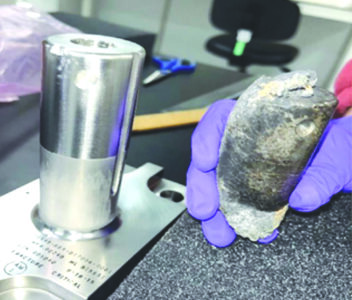
This photo provided by NASA shows a recovered chunk of space junk from equipment discarded at the International Space Station. The cylindrical object that tore through a home in Naples, Fla., on March 8, 2024, was subsequently taken to the Kennedy Space Center in Cape Canaveral, Fla., for analysis. (NASA via AP)