
‘America’s Notre Dame’ getting rehab, too
Trending
COVINGTON, Ky. -- Gargoyles have watched over this small Kentucky city for more than a century from their lofty perches on a cathedral known as “America’s Notre Dame.” A new renovation will ensure they keep their posts for years to come on the meticulously restored facade of the towering stone sanctuary.
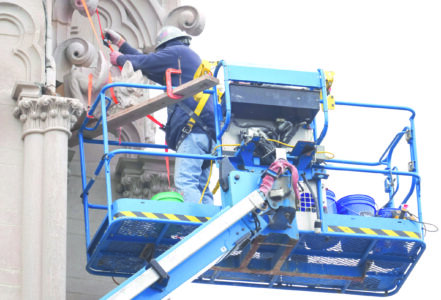
Workers in recent weeks have been installing new terra cotta gargoyles as one of the final steps of a major, two-year restoration of the Cathedral Basilica of the Assumption. The Catholic cathedral’s nickname stems from how its exterior was modeled on the larger Notre Dame Cathedral in Paris -- from the pointed arches and flying buttresses to the gargoyles and chimeras with their reptilian grins and piercing, canine eyes.
Unlike the Paris landmark, which recently underwent a massive renovation because of a sudden and devastating fire, the Covington cathedral needed a rehab due to the slow deterioration of old stone, metal and terra cotta after 125 years of exposure to the elements in its Ohio River city across from Cincinnati.
“We consider ourselves blessed to be able to ensure the cathedral is taken care of for coming generations,” said Assumption’s rector, the Very Rev. Ryan Maher.
Workers have been painstakingly repairing and replacing tons of Indiana limestone. The new gargoyles are replicas based on meticulous scans of the 32 worn originals.
Workers aim to complete the two-year restoration by March. The finishing touch will be the installation of new 26 chimeras along the rooftop. These grotesque creatures, similar to gargoyles, are exact replicas of their weathered predecessors.
“It’s hard to believe that you’re able to replicate a piece that was built a hundred years ago by men that are no longer with us,” said Brian Walter, executive vice president of Trisco Systems, the prime contractor for the restoration.
‘An art and a science’
Workers have faced numerous challenges throughout the project: hoisting and fitting heavy stones into the façade while operating cranes above a busy street in the heat, cold and wind. They have been patching and fixing what they can and replacing other parts entirely.
“It’s an art and a science that’s passed down from generation to generation,” Walter said. “Every part of it is challenging.”
Those challenges began long before the materials even arrived at the cathedral, for a project involving architects, stonecutters, terra cotta artists and more.
Workers made precise scans of deteriorated finials, arches, balustrades and other architectural elements so stonecutters could make exact matches. Organizers sourced stone from Bedford, Indiana, where limestone for the original cathedral was quarried.
Over the generations, the cathedral has had several renovations and overhauls, with exterior statues added in 2019.
But Maher knew a comprehensive exterior renovation was needed when, in 2018, he found a large, fallen piece of stone -- evidence of a wider deterioration.
This time, workers used more durable stainless steel pins and brackets to secure the stone and replace the original carbon steel, which had rusted.
Bishop with big ambition
The cathedral opened in 1901, following a multiyear construction campaign by the Belgian-born Bishop Camillus Paul Maes, head of the Diocese of Covington and an admirer of the French Gothic style.
While the exterior is modeled on Notre Dame, it has adaptations. It is just under half of the Paris cathedral’s size, lacking the original’s twin towers and featuring a narrower but still imposing façade. The high-vaulted interior, bathed in light from large stained-glass windows, is modeled on another landmark Paris cathedral, Saint-Denis.
The ambition was striking, cathedral historian Stephen Enzweiler said. The city then had just over 40,000 people, similar to its population today.
“At the time, no one had ever heard of Covington,” Enzweiler said.
Maes wanted a sanctuary large enough to accommodate the rapidly growing immigrant Catholic population and grand enough to fulfill the medieval vision of a cathedral that would “represent heaven on earth,” he said.
The cathedral was part of a larger Gothic revival happening around the turn of the century that also saw the emergence of such landmark cathedrals as St. Patrick’s and St. John the Divine in New York.
“This is a smaller version of that revival of French Gothic in America, done at a very high level in a little town at the time, of surprisingly high quality,” said Duncan Stroik, an architect, professor of architecture at the University of Notre Dame and author of “The Church Building as a Sacred Place: Beauty, Transcendence and the Eternal.”
“It shows the talent of the bishop, the architect and the craftsmen,” he said.
___
Associated Press religion coverage receives support through the AP’s collaboration with The Conversation US, with funding from Lilly Endowment Inc. The AP is solely responsible for this content.
Workers install gargoyles on the Cathedral Basilica of the Assumption on Jan. 8 in Covington, Ky. (AP photo)