Virtual reality allows seniors to rebuild connection to former lives
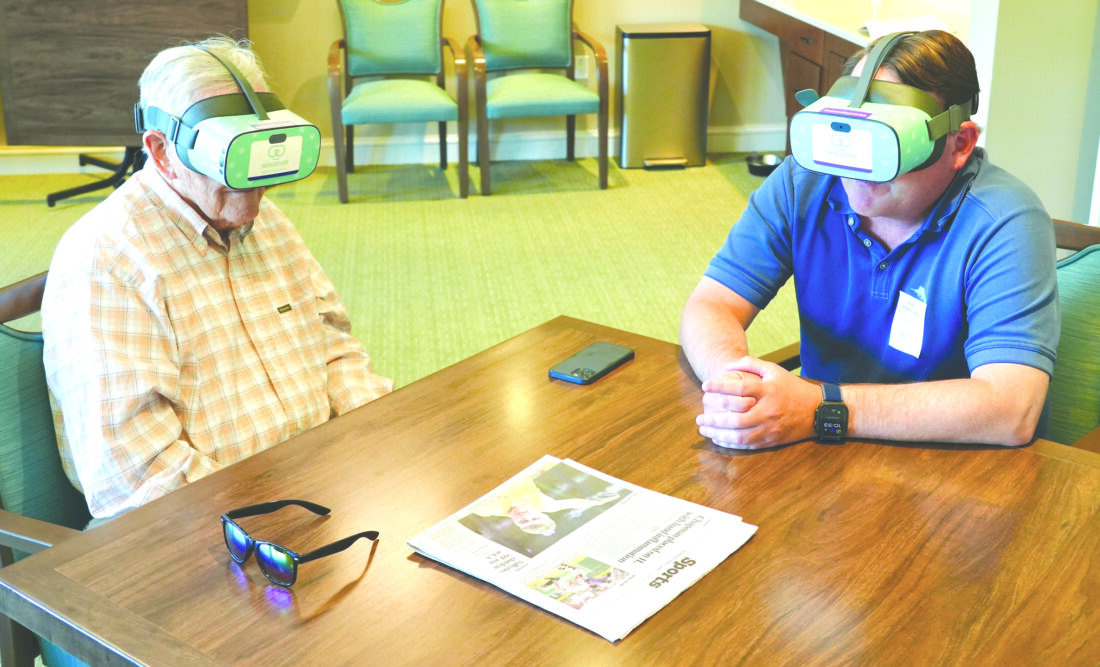
Jim Holtshouse, left, and his son Mike Holtshouse watch video through Rendever virtual-reality headsets at the Forum at Rancho San Antonio retirement community in Cupertino, Calif., on June 11. (AP file photo)
LOS GATOS, Calif. — Like many retirement communities, The Terraces serves as a tranquil refuge for a nucleus of older people who no longer can travel to faraway places or engage in bold adventures.
But they can still be thrust back to their days of wanderlust and thrill-seeking whenever caretakers at the community in Los Gatos, California, schedule a date for residents — many of whom are in their 80s and 90s — to take turns donning virtual reality headsets.
Within a matter of minutes, the headsets can transport them to Europe, immerse them in the ocean depths or send them soaring on breathtaking hang-gliding expeditions while they sit by each other. The selection of VR programming was curated by Rendever, a company that has turned a sometimes isolating form of technology into a catalyst for better cognition and social connections in 800 retirement communities in the United States and Canada.
A group of The Terraces residents who participated in a VR session earlier this year found themselves paddling their arms alongside their chairs as they swam with a pod of dolphins while watching one of Rendever’s 3D programs. “We got to go underwater and didn’t even have to hold our breath!” exclaimed 81-year-old Ginny Baird following the virtual submersion.
During a session featuring a virtual ride in a hot-air balloon, one resident gasped, “Oh my God!” Another shuddered, “It’s hard to watch!”
The Rendever technology can also be used to virtually take older adults back to the places where they grew up as children. For some, it will be the first time they’ve seen their hometowns in decades.
A virtual trip to her childhood neighborhood in New York City’s Queens borough helped sell Sue Livingstone, 84, on the merits of the VR technology even though she still is able to get out more often than many residents of The Terraces, which is located in Silicon Valley about 55 miles south of San Francisco.
“It isn’t just about being able to see it again, it’s about all the memories that it brings back,” Livingstone said. “There are a few people living here who never really leave their comfort zones. But if you could entice them to come down to try out a headset, they might find that they really enjoy it.”
Adrian Marshall, The Terraces’ community life director, said that once word about a VR experience spreads from one resident to another, more of the uninitiated typically become curious enough to try it out — even if it means missing out on playing Mexican Train, a dominoes-like board game that’s popular in the community.
“It turns into a conversation starter for them. It really does connect people,” Marshall said of Rendever’s VR programming. “It helps create a human bridge that makes them realize they share certain similarities and interests. It turns the artificial world into reality.”
Rendever, a privately owned company based in Somerville, Massachusetts, hopes to build upon its senior living platform with a recent grant from the National Institutes of Health that will provide nearly $4.5 million to study ways to reduce social isolation among seniors living at home and their caregivers.
Some studies have found VR programming presented in a limited viewing format can help older people maintain and improve cognitive functions, burnish memories and foster social connections with their families and fellow residents of care facilities. Experts say the technology may be useful as an addition to and not a replacement for other activities.
“There is always a risk of too much screen time,” Katherine “Kate” Dupuis, a neuropsychologist and professor who studies aging issues at Sheridan College in Canada, said. “But if you use it cautiously, with meaning and purpose, it can be very helpful. It can be an opportunity for the elderly to engage with someone and share a sense of wonder.”
Morning UP

Study: Saturn’s moon Titan may not have buried ocean

How to lower waste footprint of returned gifts
Virtual reality allows seniors to rebuild connection to former lives

Monstrous shark ruled southern sea during age of dinosaurs
India’s push for battery recycling has multiple benefits