
Cranberries thrive right in our neck of the woods
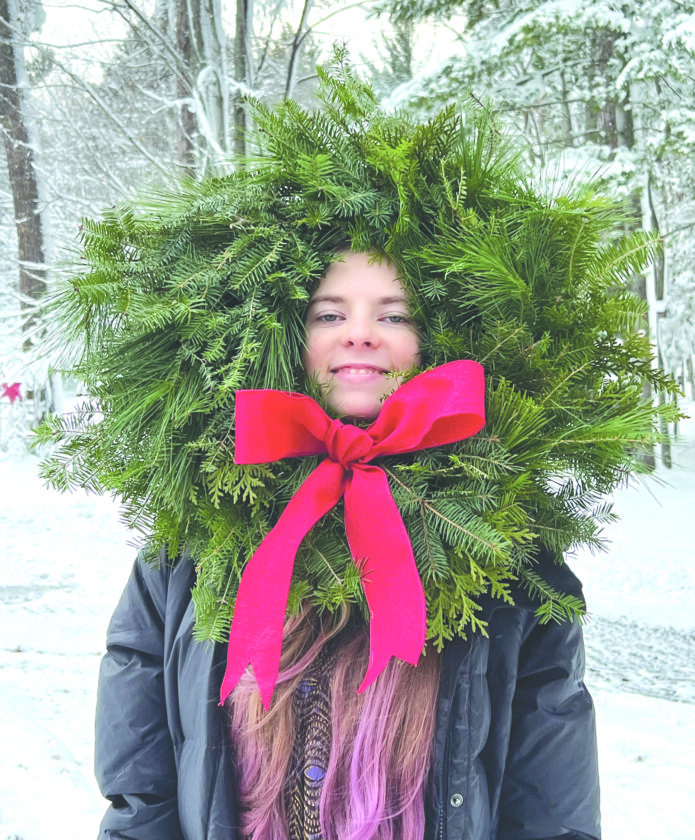
Eleanor Dohrenwend uses a true pine wreath with a bow for her festive holiday portrait. (Photo courtesy 8-18 Media director Marnie Foucault)
 I have learned quite a bit about cranberries this year, and I wanted to share my research.
In August, I visited a cranberry bog near Eagle River, Wisconsin, not far from the Michigan border, while on a trip with my mother and sister to get a spinning wheel I found on Facebook Marketplace.
The cranberry bog we visited was Lake Nokomis Cranberry Farm, which hosts free tours during the summer. You can check out its website at https://www.lakenokomiscranberries.com/.
The farm was such a delight with a cute little gift shop and a cranberry-colored bus for tours. The employee who gave the tour was extremely knowledgeable after working there for a few years.
This cranberry bog specifically has been around for 50-plus years. Since the beginning, the farm has grown from 50 acres to 320 acres, with plans of further expansion. In 2024, it sold 197 semi-truck loads of cranberries, with just under half of them going to the Ocean Spray company.
Lake Nokomis Cranberry Farm grows nine varieties of cranberries, some varieties still going from more than 50 years ago! Many people think cranberries grow in water, similar to a wet bog, but they actually grow in sand.
The cranberries are only fully submerged during the harvesting season when the cranberries float and get harvested, while the plants are submerged in water over the winter to protect the vines.
Until then, they grow in deep beds similar to rice patties of sand. The cranberry flowers are pollinated by bees. The farm has 56 bumblebee boxes for pollinating efficiency. Bumblebees are not the main pollinators of cranberries, but they work well in harsher conditions, and are more dedicated to pollinating, competing with honey bees, and making them work harder.
Cranberries have a 16-month growth cycle from flower to fruit.
The buds of fruit go dormant with the plant over the winter. In summer and fall, they have overlapping growth cycles, where some fruit is forming, and some with fruit buds that are just forming.
Every few seasons, the farm also adds a layer of sand on the crop, called “sanding” or “turfing,” to encourage new growth and suppress weeds.
Sometimes the farm replants areas after a while when the vines grow old, become less productive and are more likely to be susceptible to disease. They do this by saving cuttings from pruning and putting the vine sections into the ground.
On the tour, they showed us a section of the farm where they were replanting, and it was surprising to me to know what looked like brown twigs in parts of the sand were going to turn into living cranberry plants!
Unlike most cranberry bogs, the water that goes through the Lake Nokomis farm comes out cleaner due to the bog filtering out debris and sediment.
Here in the Upper Peninsula, you may find cranberry fens in forest bogs. These cranberries grow in a more moisture-rich environment, on a base of sphagnum moss. Sphagnum moss can retain up to 20 times its weight in water, and although only taking up 3% of the world’s land, bogs store one third of the world’s soil carbon!
These cranberries last through the winter in the snow, and many critters eat them, as well as insects such as moths, leafhoppers and weevils.
Cranberry farming is quite local to our region, and I love knowing this during the current season when cranberries find themselves in many holiday dishes and festivities.
Eleanor Dohrenwend is a 16-year-old, partly homeschooled student who has two cats, Sammy (or Boba), a big black cat, and Violet, a tuxedo cat who loves paper bags.
Morning UP
India’s push for battery recycling has multiple benefits

Sunday’s winter solstice shortest day of year
Cranberries thrive right in our neck of the woods
Animals evolve extreme ways to catch precious sleep
Feeding frenzy encouraging sign for brown pelicans