
Trending
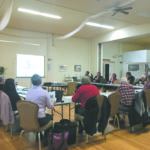
K.I. SAWYER -- The Air Force Civil Engineer Center provided a briefing of its investigation into the presence of per- and polyfluoroalkyl substances, or PFAS, at the former K.I. Sawyer Air Force Base Wednesday at the annual meeting of the Restoration Advisory Board.
Attending were board members; local, state and Air Force officials; as well as residents.
The Air Force has focused its investigation on K.I. Sawyer's drinking water to determine if the two PFAS chemicals classified as emerging contaminants by the U.S. Environmental Protection Agency -- perfluorooctanesulfonic acid, or PFOS, and perfluorooctanoic acid, or PFOA -- are present above lifetime health advisory limits in drinking water.
The investigation began in 2015 because aqueous film forming foam, or AFFF, containing PFOS and PFOA had been used by the Air Force for firefighting beginning in the 1970s, leading to concerns about potential water and soil contamination at the former base.
Officials said neither compound has been found at levels above the EPA's lifetime health advisory limit in K.I. Sawyer's municipal drinking water, with the compounds not detected in three of four municipal wells and very low levels found in the fourth well.
However, one private residential well with an actionable level of PFAS has been identified, officials said.
"We found exactly one private drinking water well at a camp that had values slightly above the (health advisory), which is also now the Michigan regulation," said Kay Grosinske, Air Force Civil Engineer Center program manager for environmental work at K.I. Sawyer. "When we found them, we provided the residents with bottled water and then over the winter season, when the camp was dormant, we designed a system, a carbon and resin treatment system. When the camp was opened in the spring, we installed that system and it's been running now since June."
Since then, the well has been tested quarterly, with each test confirming the system has reduced PFAS to non-detectible levels, officials said.
The contamination found in this residential well is believed to originate from a fire training site on the base, FT007, officials said, as surface water and groundwater at FT007 tested at levels above the health advisory for PFAS and the residential well was downgradient from FT007.
However, it's not clear how the contamination is traveling from FT007 to the residential well, officials said.
"Somehow it's getting from the firefighting training area to this particular residence and nowhere else that we can figure," Grosinske said. "So we are going to do (it) in three stages. We're going to put in more monitoring wells to try to figure out what the pathway is between the one and the other and (FT007 is) a little over a mile away, so it's a short distance but we just don't know how it gets there. So, we're going to try to figure that out."
A contract was recently awarded for this work to delineate the path between the two sites, she said, with additional monitoring wells to be placed in the area in three phases: this fall, spring 2019 and fall 2019.
"We're doing more work to figure out the path," she said.
While the main focus is currently on drinking water, Grosinske said they are also working to address concerns about groundwater and surface water contamination by sampling these areas.
"I know that Silver Lake Creek is incredibly important here," Grosinske said. "I've known that ever since I started working here, so I made sure, pushed actually, really pushed to make sure that we sampled it. And we're good. We have some very low levels, but they're below the (health advisory)."
Overall, the issue is being addressed through following the Comprehensive Environmental Response, Compensation and Liability Act, or CERCLA, process, which is a federal law administered by the EPA that mandates a specific process for the investigation and cleanup of sites on the National Priorities List.
"We are following the CERCLA process, which is a staged process. We're in step two, which is the site investigations," she said.
The investigation began in 2015, officials said, with the Air Force conducting a preliminary assessment of the potential for PFOS/PFOA contamination in the drinking water from potential releases of AFFF by the Air Force.
Now, they are performing site investigations to determine the actual release of PFAS and identify a complete pathway from the source to the drinking water.
The response plan includes mitigating the Air Force-induced PFOS/PFOA impact above the health advisory limit in drinking water following the CERCLA process, and complying with applicable state regulations, officials said.
"We are blessed, I would say, to have a former base where we have very little problems," Grosinske said. "And while it is in a few areas at very low levels, we are going forward and doing everything we can and everything necessary to protect human health and the environment."
Another meeting will be scheduled for spring 2019 to provide updates on work done this fall, Grosinske said.
For more information on the Air Force's response to PFOS/PFOA, visit afcec.af.mil/WhatWeDo/Environment/Perfluorinated-Compounds/.
To access the Air Force Civil Engineer Center's CERCLA Administrative Record Search, which allows search and review of public documents regarding environmental testing and sampling at Air Force installations, such as K.I. Sawyer, visit afcec.publi cadmin-record.us.af.mil/
For more information on Michigan's response to PFAS, visit michigan.gov /pfasresponse
Cecilia Brown can be reached at 906-228-2500, ext. 248. Her email address is cbrown@miningjournal .net.