
NMU hosts presentation on raptors
Trending
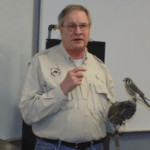
Jerry Maynard, co-founder of the Chocolay Raptor Center, talks about Rey, an American kestrel kept at the facility, Friday at a presentation on raptors at Jamrich Hall at Northern Michigan University. The Northwoods Wildlife Center also was represented at the event. (Journal photo by Christie Bleck)
MARQUETTE -- It was standing-room only at a Friday presentation on raptors at 1320 Jamrich Hall at Northern Michigan University.
The NMU Fisheries and Wildlife Association, funded by the Student Finance Committee, put on the popular event to educate students and the community on birds of prey, which include eagles, hawks, falcons, owls and the like.
Making presentations were staff from the Chocolay Raptor Center, based in Harvey, and the Northwoods Wildlife Center, based in Minocqua, Wisconsin.
One of the event's stars was making its public debut: Rey, the newest "ambassador bird" for the Chocolay Raptor Center.
Rey is a falcon, specifically an American kestrel.
"This is her first public occasion," said Jerry Maynard, center cofounder.
Maynard held the small bird while walking through the audience so people could get a close -- but not too close -- view of her, with the kestrel making little if any fuss.
The center rescues and rehabs raptors, although education is considered its primary focus.
For instance, Maynard talked about a bald eagle the center rescued in December after it was discovered ill in Munising Bay. The center doesn't have the proper license to rehabilitate eagles, so it was transferred to a facility that could nurse it back to health.
It turned out the eagle was suffering from lead poisoning.
"If they eat carrion that's been shot, they get lead, and if gets into the digestive tract, a very minor amount will poison them to the point where they can't fly and they die," Maynard said.
In this case, the poisoning was moderate, although the bird also was wounded from being in a skirmish with another eagle.
Maynard said the center gave 78 programs in 2017.
"We try to aim, really, at young people because if you get young people to fall in love with the raptors, and get excited about the raptors the way we are, that's going to be a whole army of young people who are going to spend the rest of their lives advocating for the birds," Maynard said.
Maynard said the center saved about half of the raptors it tried to rehabilitate in 2017.
He was pleased with that success rate.
"If you think about it, any bird that's going to let you walk up to it and grab it is pretty bad off," Maynard said.
He also stressed the center must have the proper state and federal permits to rehabilitate hawks, owls and falcons.
Birds that are successfully rehabilitated typically are released back into the wild, but Rey, which the center received about 10 months ago, is unable to fly, said Bob Jensen, center cofounder.
People shouldn't let a kestrel's small size fool them.
"She's a predator, just like all the other raptors," Jensen said.
Maynard agreed.
"She's a stone cold killer," he said.
Maynard said Rey weighs about 3 ounces, but has to be fed dead prey like mice and quail from a commercial source.
Feeding her live prey, though, wouldn't be practical since Rey's feathers could be damaged if she were to hunt in her confined living space, he said.
Although the focus was on birds with talons, Bart Kotarba, director of education at the Northwoods Wildlife Center, gave a presentation on turtles.
Kotarba passed around live turtles -- a painted and a wood turtle -- during his presentation.
However, he provided a lesson on turtle anatomy and lifestyle, giving pointers on what people can do to help turtle populations.
For instance, if an individual who sees a turtle crossing a road decides to capture it and turn it loose in a wetland in a different area, that's not what's best for the animal.
"That was a nice thought, but you kidnapped the turtle," Kotarba said.
Instead, people should just move the turtle away from the road, but not too far.
For more information, the Chocolay Raptor Center and the Northwoods Wildlife Center have Facebook pages, while Northwoods maintains a website at www.northwoodswildlifecen ter.org.
Christie Bleck can be reached at 906-228-2500, ext. 250. Her email address is cbleck@miningjournal.net.