
Protesters in multiple states press Target to oppose the immigration crackdown in Minnesota
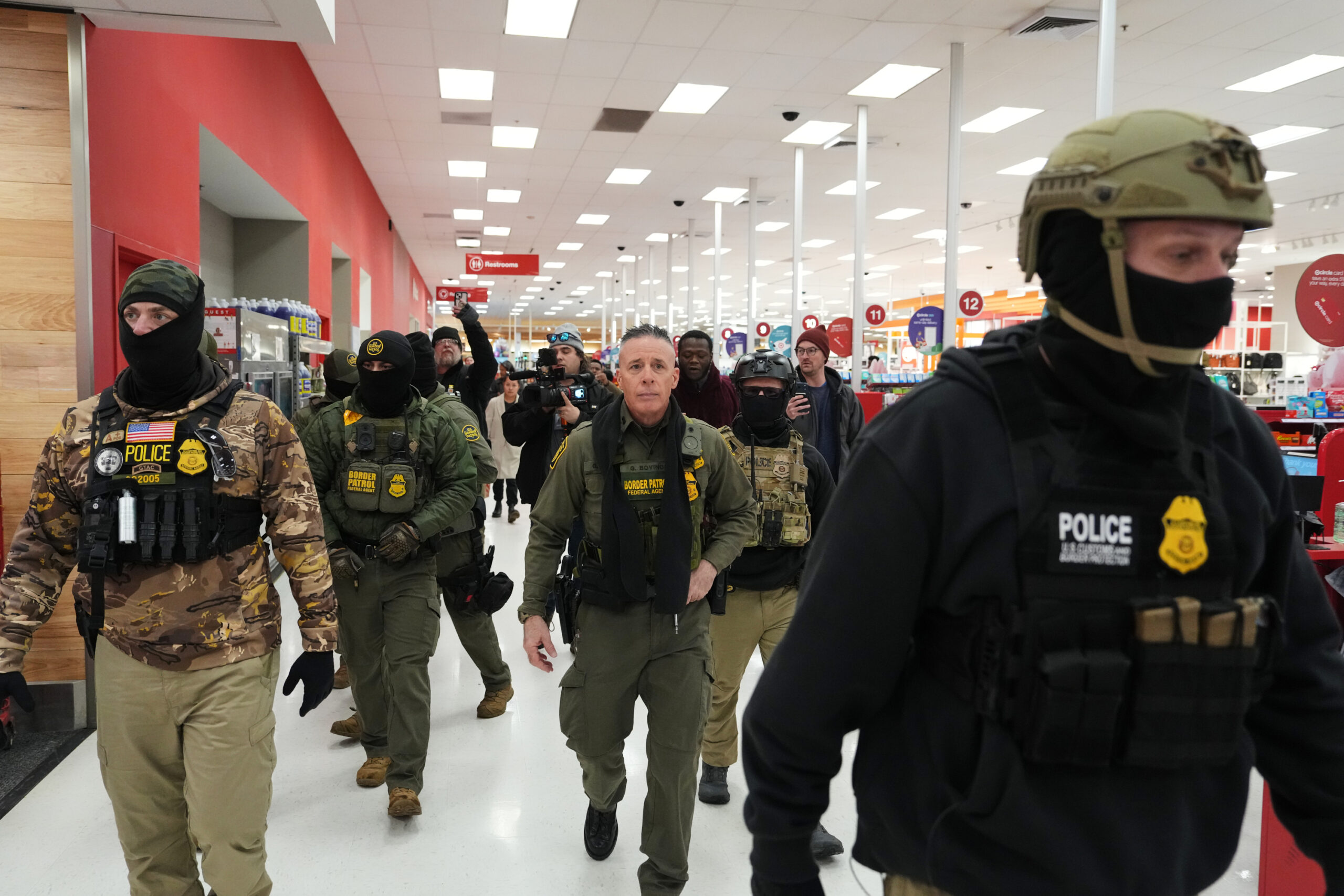
FILE - U.S. Border Patrol Cmdr. Gregory Bovino walks through a Target store Jan. 11, 2026, in St. Paul, Minn. (AP Photo/Adam Gray, File)
NEW YORK (AP) — Activists planned protests at more than two dozen Target stores around the United States on Wednesday to pressure the discount retailer into taking a public stand against the 5-week-old immigration crackdown in its home state of Minnesota.
ICE Out Minnesota, a coalition of community groups, religious leaders, labor unions and other critics of the federal operation, called for sit-ins and other demonstrations to continue at Target locations for a full week. Target’s headquarters are located in Minneapolis, where federal officers last month killed two residents who had participated in anti-ICE protests, and its name adorns the city’s major league baseball stadium and an arena where its basketball teams plays.
“They claim to be part of the community, but they are not standing up to ICE,” said Elan Axelbank, a member of the Minnesota chapter of Socialist Alternative, which describes itself as a revolutionary political group. He organized a Wednesday protest outside a Target store in Minneapolis’ Dinkytown commercial district.
Demonstrations also were scheduled in St. Paul, Minnesota, Boston, Chicago, Honolulu, Philadelphia, Pittsburgh, Raleigh, North Carolina, San Diego, Seattle and other cities, as well as in suburban areas of Minnesota, California and Massachusetts. Target declined Wednesday to comment on the protests.
Target first became a bull’s-eye for critics of the Trump administration’s surge in immigration enforcement activity after a widely-circulated video showed federal agents detaining two Target employees in a store in the Minneapolis suburb of Richfield last month. Luis Argueta, a spokesperson for Unidos Minnesota, an immigrant-led social justice advocacy organization that is part of the ICE Out Minnesota coalition, said his group is focusing its protests on the Richfield store.
One of the demands of Wednesday’s protests is for Target to deny federal agents entry to stores unless they have judicial warrants authorizing arrests.
But most legal experts have argued that anyone, including U.S. Border Patrol and Immigration and Customers Enforcement agents without signed warrants, can enter public areas of a business as they wish. Public areas include restaurant dining sections, open parking lots, office lobbies and shopping aisles, but not back offices, closed-off kitchens or other areas of a business that are generally off-limits to the public and where privacy would be reasonably expected, those lawyers say.
Neil Saunders, managing director of the retail division of market research firm GlobalData, added that some people say Target should take more action, but he noted Target has to abide by the law.
“It can’t just say ICE is not allowed in stores because legally they are,” he added.
Target has not commented publicly on the detention of the store employees. CEO Michael Fiddelke, who became Target’s chief executive on Feb. 2, sent a video message to the company’s 400,000 workers two days after a Border Patrol agent and a Customs and Border Protection officer shot and killed Minneapolis resident Alex Pretti on Jan. 24.
Fiddelke said the “violence and loss of life in our community is incredibly painful,” but he did not mention the immigration crackdown or the fatal shootings of Pretti, an ICU nurse at a medical center for U.S. veterans in Minneapolis, and Renee Good, a mother of three fired on in her car by an ICE agent.
Fiddelke was one of 60 CEOs of Minnesota-based companies who, in the wake of Pretti’s death, signed an open letter “calling for an immediate de-escalation of tensions and for state, local and federal officials to work together to find real solutions.”
The protests over its alleged failure to oppose the immigration crackdown in Minnesota come a year after Target faced protests and boycotts over the company’s decision to roll back its diversity, equity and inclusion initiatives. At the time, critics said the decision marked a betrayal of Target’s retail giant’s philanthropic commitment to fighting racial disparities and promoting progressive values in liberal Minneapolis and beyond.
The retail chain also is struggling with a persistent sales malaise. Critics have complained of disheveled stores that are missing the budget-priced flair that long ago earned the retailer the nickname “Tarzhay.”
While Wednesday’s protests targeted a tiny fraction of the company’s nearly 2,000 stores, the negative attention serves as another distraction from Target’s business, according to Saunders, managing director of the retail division of market research firm GlobalData.
In recent days, a national coalition of Mennonite congregations organized roughly a dozen demonstrations inside and outside of Target stores across the country, singing and urging Target to publicly call Congress to defund Immigration and Customs Enforcement among other demands.
A spokesperson for Mennonite Action said the coalition was not formally connected to ICE Out but following the lead of organizers in Minneapolis.
The Rev. Joanna Lawrence Shenk, associate pastor at First Mennonite Church of San Francisco, said the group did not plan any actions on Wednesday but was mapping out weekend singalong events at Targets in a handful of towns and cities, including Pittsburgh and Harrisonburg, Virginia. She estimated that by the end of the weekend more than 1,000 congregation members will have participated.
Shenk noted that the Mennonites sing “This Little Light of Mine” and other gospel songs and hymns.
“The singing was an expression of our love for immigrant neighbors who are at risk right now and who are also a part of our congregation,” she said. “For us, it’s not just standing in solidarity with others but it’s also protecting people who are vulnerable.”