
Hook a lake sturgeon while ice fishing? Protect these fish by releasing immediately
Trending
MARQUETTE -- The Michigan Department of Natural Resources reminds anglers of lake sturgeon fishing regulations and rehabilitation efforts
Michigan’s cold winter temperatures have made for good ice fishing conditions, but anglers on the ice targeting walleye or other fish may unexpectedly find themselves with a lake sturgeon on the line.
When that happens, releasing the sturgeon as quickly as possible is essential to ensuring the fish's survival, as well as complying with fishing regulations for the species.
The DNR reminds anglers that regulations on the targeting and harvest of lake sturgeon are in effect. On most waters of the state, fishing for lake sturgeon is prohibited and any lake sturgeon caught must be released immediately.
What is a lake sturgeon?
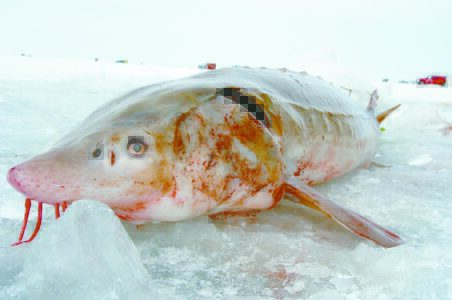
Lake sturgeon (Acipenser fulvescens), the only sturgeon species found in the Great Lakes, are unique in appearance and characteristics. They have five rows of bony plates, called scutes, on their backs and sides, as well as whisker like barbels near their mouths. Often referred to as "living fossils" or "dinosaur fish," lake sturgeon first appeared in the fossil record in the Mesozoic Era, 100 million to 150 million years ago. These fish are long-lived, with some documented at more than 100 years old.
Lake sturgeon are freshwater fish native to Michigan and found in North America throughout the Great Lakes, Mississippi and Hudson River basins. The species is an important cultural resource in the region, in addition to its ecological significance. But due to overfishing and habitat loss and degradation, lake sturgeon populations in Michigan began to decline in the 1800s.
Why are lake sturgeon protected?
As a result of declines in lake sturgeon populations, the state of Michigan in 1994 listed lake sturgeon as a threatened species. Since then, the DNR has partnered with state, federal and tribal agencies to rehabilitate lake sturgeon in the state. The goals of these efforts are to conserve lake sturgeon populations that are currently self-sustaining and to rehabilitate depressed or declining populations to self-sustaining levels so that lake sturgeon can be removed from the threatened species list.
The DNR and partners stock lake sturgeon in several rivers and lakes in Michigan as part of this rehabilitation strategy. Lake sturgeon are raised in stream side rearing facilities. At these facilities, naturally produced eggs or larval lake sturgeon are captured in their natal (birthplace) streams and brought into the rearing facilities, where they are protected from predators while still "imprinting" on the stream or river. This increases their survival and the chances that the sturgeon will return to the stream or river as mature adults to reproduce.