
Can Michigan protect nearly a third of its lands and waters by 2030?
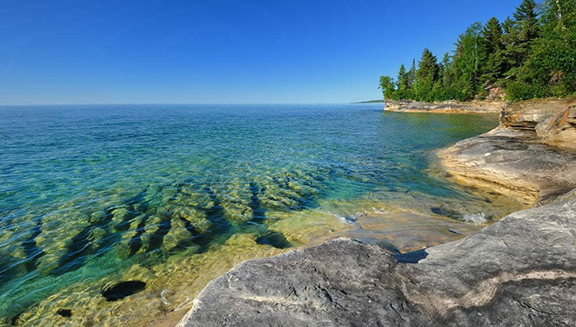
A stretch of Lake Superior shoreline is pictured. (Photo courtesy of the Department of Environment, Great Lakes and Energy)
MARQUETTE — The Department of Natural Resources is in the final stages of completing a “Pathways to Michigan the Beautiful” report to map out how to protect about a third of the state’s lands and waters in the next five years.
The initiative is modeled after the Biden administration’s 2021 “America the Beautiful” initiative — also dubbed “30 x 30” — that called for locally led, voluntary conservation efforts to conserve 30% of U.S. lands and waters by 2030.
“We’ve taken ‘America the Beautiful’ and dropped it down to our state,” said Scott Whitcomb, the director of the Office of Public Lands at the DNR.
Other partners involved are the Nature Conservancy, University of Michigan’s Water Center, Ducks Unlimited and tribes.
Whitcomb said Michigan’s approach is a little different than other states’ methods.
“We’re trying to reflect Michigan values. We have a lot of public lands that would be at the core of this,” he said.
“But then we’re also looking at some of those practices on lands that maybe other states aren’t looking at, and that’s our working lands that are under some sort of conservation” management, he said.
Whitcomb said they got input from various stakeholders, including the Michigan Farm Bureau, forest products industry and large landowners.
“Having the working lands at the table – and not adversarial to the department – is going to result in a better environment for everybody,” he said.
That could include private lands, such as those enrolled in the DNR’s Commercial Forest Program or the federal Conservation Reserve Program, which provide tax or other financial incentives to encourage sustainable management practices.
“We feel there’s a place to count those,” he said. “They may not be durable conservation measures that are permanent, but they are contributing to the quality of life and the quality of those lands.”
But mapping conservation measures on private lands that are administered through different programs is challenging, Whitcomb said.
“One of the things that everyone gets hung up on is, what are the numbers?” he said. “We’re in the process of crunching those numbers.”
Exactly how much land is already conserved depends on whom you ask.
An online map by Ducks Unlimited estimates that nearly 20% of land is currently protected.
The DNR’s estimate is higher at about 24% of land and 19% of water protected.
“The DNR has taken a broader view,” Whitcomb said. “We don’t necessarily want to say it’s got to be in state government ownership or federal ownership.”
Protecting land is also a pillar of the MI Healthy Climate Plan, which calls for reducing greenhouse gas emissions and achieving 100% carbon-free clean energy by 2050. Native vegetation can naturally sequester carbon, Whitcomb said.
It also benefits people, he said.
“There are benefits for equitable access to public spaces. There’s benefit to our economy. It’s beneficial to our quality of life,” he said.
Besides the pathways report, another product available to the public will be a new online map viewer that shows protected lands, Whitcomb said.
Last year Sen. Sue Shink, D-Northfield Township, introduced a “Michigan the Beautiful” bill to require the DNR to coordinate state efforts to create regional plans to protect 30% of lands and waters by 2030.
The bill was co-sponsored by Sens. Dayna Polehanki, D-Livonia, and Mary Cavanagh, D-Redford Township, and supported by the DNR but didn’t pass.
Whitcomb said, “It would have potentially brought resources, but it would have also lent legislative support that would say publicly, ‘yes, we support the work of conservation in our state for all of the benefits that it can provide.'”
Whitcomb said the DNR is working with the nonprofit Nature Conservancy to complete an initial assessment of protected lands and worked with consultants to conduct polling and outreach for public input.
Patrick Doran takes a selfie photo on a beach on a sunny day Patrick Doran, Midwest division director of strategy, measures and science with the Nature Conservancy. Courtesy photo.
Patrick Doran, the Nature Conservancy’s Midwest division director of strategy, measures and science, said the organization led the analysis of habitat types in the state.
“How much is protected, what areas are underrepresented in current land management protections” for grasslands, wetlands and aquatic systems, Doran said.
Doran said even small projects can be valuable in reaching the 30% goal, but it’s important to be thoughtful about where and how conservation actions are implemented.
“All these little actions are stepwise improvements in the health of the system. Whether it’s a stream or a forest or a grassland, it can really go a long way,” he said.
And while federal funding is important, “it goes much beyond the ability of public funding to support it because the problem is so big.”
Doran said it’s important that businesses recognize the value of the natural world for their operations.
“For example, maintaining healthy wetlands near your business property might reduce the impacts of storm surges or flooding,” he said. “Nature can manage those things many times more effectively and cheaper than some types of infrastructure.”
While the DNR and conservancy focused mainly on land-based aspects of Michigan the Beautiful, students at U-M’s Water Center, led by director Jennifer Read, studied the coastal and Great Lakes components.
“The goal was to understand what areas of the coast are already under some kind of management or protection,” she said, “and then what the options would be to increase that so we reach the 30% goal.”
She said they tried to understand options that would work with landowners and other groups, including county and local governments, land conservancies and tribes.
That information would then be provided to the DNR to lay a foundation for its pathways document on how to achieve their goals, she said.
“So much of our state’s identity, who we are as Michiganders, is as much about Michigan – the water, the lands, the birds, the fish, the animals and our interactions with it – as it is about anything else,” Read said. “That’s who we are, and we want to continue that.”