
Historically speaking
Streetcars desired
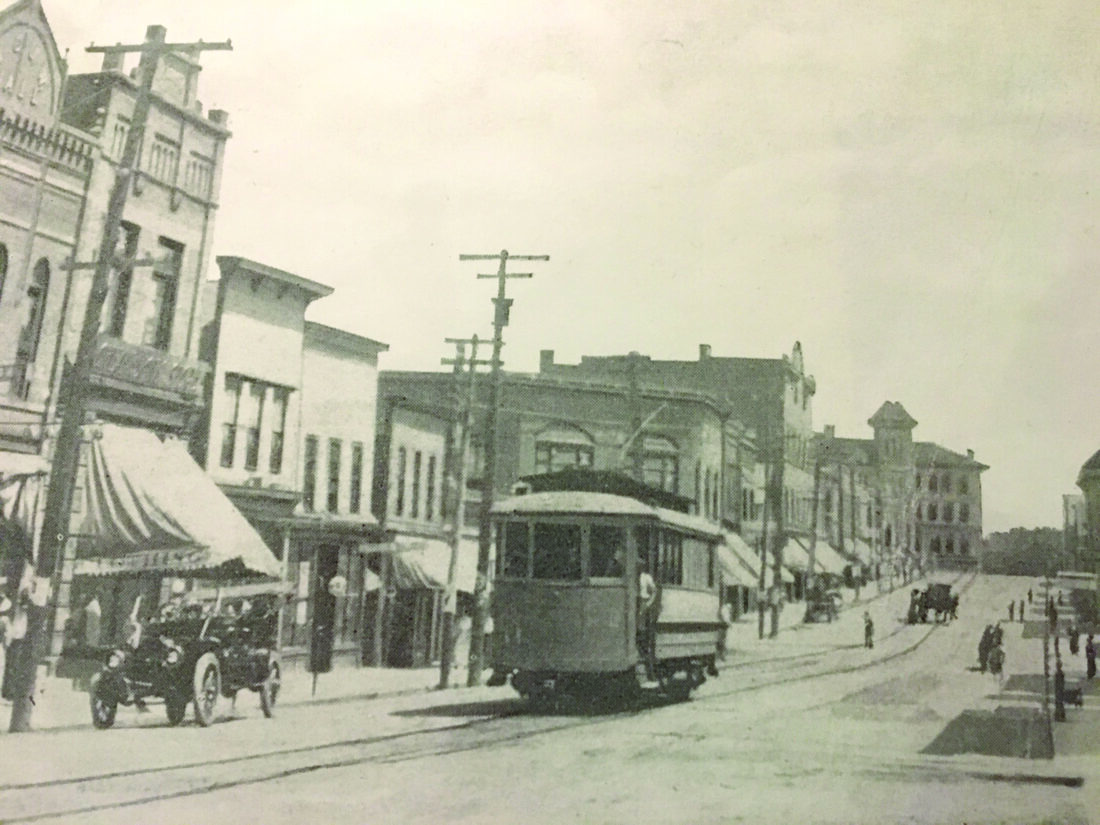
A streetcar is seen in the city of Negaunee. (Photo courtesy of the Negaunee Historical Society)
NEGAUNEE –The popularity of the automobile put the streetcar line between Negaunee and Ishpeming out of business in 1927, after 35 years of operation.
The three mile line began to take shape in 1890 when groups in Negaunee and Ishpeming met to discuss the project and to persuade their respective communities to grant them franchises to operate.
In March of that year the Negaunee City Council passed an ordinance authorizing five men to proceed with the project. The five were P. B. Kirkwood, Reiner Hoch, N. Laughlin, A.C. Sueass and Dr. A.C. McKenzie.
As soon as spring came, James Joplin, a civil engineer in Marquette made a survey. In October the Ishpeming and Negaunee Street Electric Railway Co, filed articles with the Secretary of State, listing the following directors: John Jones, Ishpeming, A.C. Seass, of Negaunee and T.S. Athey and T.L. and T.J Johnson of Cleveland.
But the necessary capital wasn’t forthcoming and the project was dropped until the spring of 1891, S.J. Nelson representing the Union Manufacturing Co. of Champagne, Illinois came up to look over the project and did nothing more. finally the Ishpeming City Council repealed the old ordinance and granted a franchise in July of 1891 to Fred Braasted of Ishpeming and associates including A.Maitland, E.C.Anthony ,P.B Kirkwood and A.C.Seass of Negaunee.
The franchise was to run for 30 years. The fare inside the city limits was five cents and between the cities was ten cents. The cars were to be heated and were not to run more than six miles per hour in the city limits.
Then things started to move. Two crews started grading in September and in November, Joseph Guy of Marquette was in charge of laying the track from Negaunee to Ishpeming. The rails were made at the South Chicago Steel Works with iron ore from the Barnum Mine in Ishpeming. It was announced in the same month that the company proposed to furnish the city of Negaunee with electric lights from its power plant and the firm’s name was changed to the Negaunee and Ishpeming Railway and Light Company.
Early in January 1892 Maitland said that dynamos for the power plant had been shipped, trolley wires were being strung and the light poles were almost all installed. The first trial run was made February 1, 1892.
No passengers were carried but it drew a lot of attention. For some reason the line was named the broomstick train. It was possibly because the tracks had to be carefully swept so there wouldn’t be any derailments or possibly because the snow plow had a revolving brush.
The first official trip was made by the Negaunee councilmen who went to Ishpeming and took the Ishpeming city officials for an evening ride. The street cas ran between the two communities every half hour for many years.
On the last Sunday in February the cars carried about 2,500 passengers between the two cities. Negaunee’s first street lights were turned on early in February and that caused considerable excitement. The gas lamps were being used at the same time so the downtown area was twice as bright as usual.
Harvey Pearce was manager of the car line the first few years. In1901 an extension was made to Winthrop and in 1902 to the golf course and the Union Park. (The golf course and Union Park were located on what is now the Malton road area.) The streetcar system was purchased by Granger Farwel Co.of Chicago for $289,000 in 1906. Improvements were made and larger streetcars were purchased.
The cars were charted almost every evening in the summer months for trolly parties. The streetcar ccmpany had a few successful years financially, the peak season being from 1910 to 1913 during which time Negaunee and Ishpeming had strong baseball teams and huge crowds turned out for the games at Union Park and also for the horseracing.
Cleveland Park was also used a great deal for picnics and other gatherings. And since there were very few cars in those days the streetcar was the way to go. Victor Anderson started with the line in 1895 and was one employee who stayed with the line until 1927 when it was discontinued. Victor said some young men wanted to work there as a hobby, something to do for fun.
They didn’t last long, in one month, officials fired 35 of them. Two other veteran employees had 15 years, William Vivian, and Wlliam Royea.