
It takes a village above ground to raise a mine, pte 2
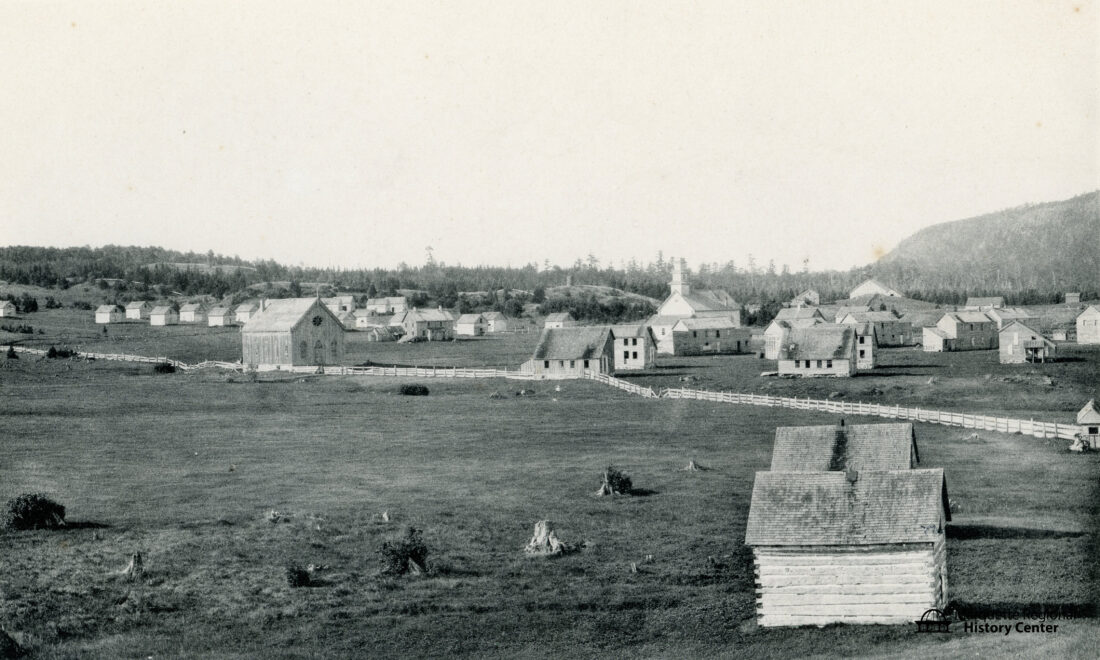
Pictured is the deserted village at Cliff Copper Mine, Acton photo from about 1900. (Photo courtesy of the Marquette Regional History Center)
KEWEENAW COUNTY — Central Mine in Keweenaw County was organized on Nov. 15, 1854, and opened the following year. One of the Copper Country’s most successful mines, Central had a population of about 1,200 people at its peak in 1883.
The mine closed on July 20, 1898, having produced nearly 52 million pounds of copper and its population dispersed.
Starting in 1907, a reunion has been held every July at the Central Mine Methodist Church. Originally serving as a homecoming for former residents, later generations now pay tribute to the memory of the hardy pioneers of all faiths from all the early copper mining settlements that once dotted Keweenaw County.
These articles are adapted from a sermon by Pastor Larry Molloy at the 117th Annual Central Mine Reunion Service, July 30, 2023. The 118th Annual Central Mine Reunion Service will be held at 9 a.m. and 11 a.m. on July 28.
Last week’s article about the 1870 U.S. Census for Central Mine included the statement, “Of the 159 listed as ‘copper miner,’ 106 came from England (including Cornwall).” Then asked, “But did that mean that all 159 were actually miners?” No, just as jobs above ground differed so did jobs below ground.
Let’s start with what we would all call “miners.” In 1870 you would have found miners working in pairs by candlelight, with one miner swinging an 8-pound hammer at a drill steel held by his partner who would twist the drill to make a hole. What was it like to be a miner working by candlelight? In his book “The Long Winter Ends,” Newton G. Thomas tells the story of five young men who leave Cornwall to come to the Keweenaw to find work. Here’s how Newton describes drilling a hole into the rock:
“Jake stood against the breast [the working face of the mine], his hands slightly higher than his eyes as they gripped the bitted steel. They were close to his face also, as they had to be to give him control and ease in twisting. It was not an easy hole to drill for either of them, but it had to be done. A blow that missed the drill head would find his hands or face. But of that neither thought… Again, the drill was raised, turned, and rang, was raised, turned, and sank under the hammer. There was something satisfying in the flushness and certainty of its blow – music in its ring on the steel. These men knew the pride of the frontier marksman, of the woodsman with his ax.”
But there were numerous others working underground who were lumped into the “copper miner” group. Trammers shoveled and moved ore to the shaft where it was hoisted to the surface. Timbermen maneuvered trunks of trees down the shaft to the places where the miners needed to support the roof. There were other specialized workers underground. In fact, there was an entire community of different skills underground.
But don’t forget another very important job at Central, those 154 women “keeping house.” While many homes were the traditional 1870 family home — father, mother and perhaps up to 5 children, many households also listed the names of from 2 to 4 men with different last names.
These were boarders who lived in the home. They paid a monthly fee for room and board, which included the “boardin’ missus” making their lunch. These women earned money for the family and they earned every penny if not more. Thomas describes one woman who was “keeping house” when the main characters entered the kitchen of their boarding home, joining four men from the nightshift:
“All seemed absorbed in the “boardin’ missus’ doin’s.” She was loading the pails for the men who went to work that night. She scanned each one for initials or other mark scratched on the tin to indicate its owner. She put slices of cold beef between cuts of bread spread with butter softened on the stove and adjusted them in the upper half of the pail. Then she tucked a bit of “tetty cake” in one, a “seedy nubby” in another, or a saffron bun. A store cooky topped the meal for all. When she put the lid in place, Mrs. Uren said “E’s a pity they can’t all eat the same, ‘twould save a lot of work.” Nobody answered. She’ve prob’ly said the same times on end, Jim thought. Into the large compartment of the pail, she poured a bountiful supply of cold black tea, added sugar to one, milk to another, both to the next.
That job done, Mrs. Uren took a shawl from the wall, threw it over her head and shoulders, fastened it under her chin and went out to the hydrant for water. When she came back her bare arms were red as was her face, her eyes watered and she was breathless. She put the bucket in place and fetched two armfuls of wood for the stove. Then she removed the shawl and wiped her cheeks and nose with the underside of her apron. Nobody volunteered to help her. Every man there regarded that as her job. The “boardin’ boss” was responsible for the pile outdoors; she was responsible for the woodbox behind the stove. The men paid their board and were expected to do no more. None of them wished to be tagged a “fancy boarder.””
Can you imagine doing that job? Central would not have been Central without these 154 “boardin’ missus” doing their work, each and every day to keep the mine and community going.
Central could not have become Central without the help of so many people with different physical skills and talents which they shared with all. It truly took all the people in the village, working together both above and below ground, to make Central a successful mine.