
Historically speaking
Edward Breitung recalled
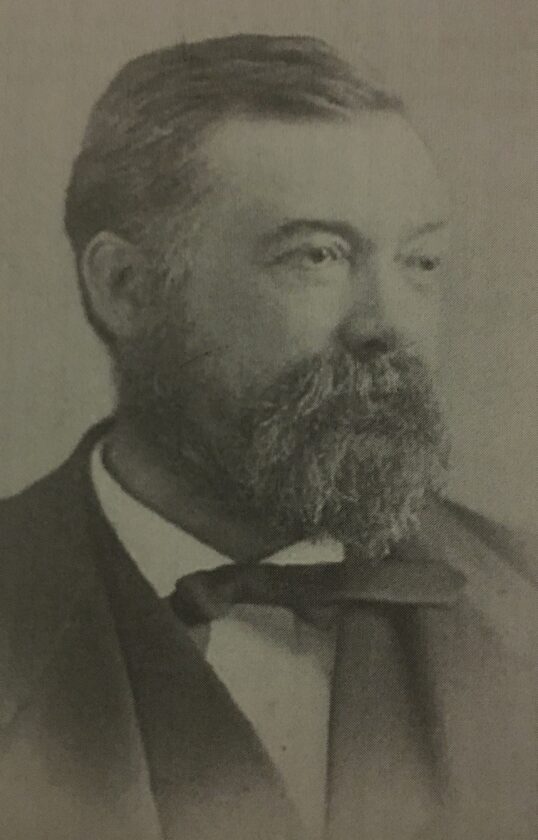
Edward Breitung
NEGAUNEE –I had the privilege to be able to go into the Breitung mausoleum in the Park Cemetery in Marquette containing the caskets of the Breitung family, which prompted me to write this article.
Edward’s casket is the oldest, dating back to 1888. The Breitung Hotel was a significant part of Negaunee’s history but I never really paid attention to the history behind the man named Breitung.
Edward Breitung was born in Germany on November 10, 1831. He was the son of a Lutheran Pastor, Rev. John Breitung and his mother’s name was Mary. After going through a prep school he entered the college of mining in Meiningen and graduated in 1849. When he completed his education he came to America and settled in Kalamazoo, Michigan.
Here he attended school for the purpose of learning the English language. He worked for two years in the grocery store.
From there he went to Detroit and worked as a bookkeeper. In 1885 he moved to Marquette which was a small village and went into the mercantile business. In 1859 he sold his business and moved to Negaunee where he became partners with Israel B. Case and opened up the Pioneer Furnace and also operated a mercantile business.
In 1864, he sold his mercantile business and started to devote his time to mining interests. He became one of the pioneers of the mining industry in Negaunee and Republic. He began to develop iron properties.
He initiated the opening of mines in the Negaunee Range. He opened the Republic Mine in 1871. No one believed that the ore there was good, but it came to be known as the largest and most profitable iron mine in the country, if not the world.
He explored the Menominee Range and became interested in the Vermillion iron range in Minnesota. All these investments proved highly profitable and proved his good judgement and knowledge of mining and minerals. Edward Breitung had a loyal interest in the welfare of his city and worked to support all its enterprises to advance its welfare. He was a staunch Republican and served as a member of the State Legislaturefrom 1873-1877.
He was elected to the forty-eighth congress from this district by a large majority in1883, and served his term, declining renomination.
He was mayor of Negaunee from 1880-1883 and it was said that no man worked as hard to promote the material and civic advancement of Negaunee as did Edward Breitung.
Mr. Breitung was just shy of 39 years of age when he married Mary Paulin, age 21. They were married at St. Paul’s Catholic Church in Negaunee in November of 1870. Edward met his wife in a boarding house in Republic, Michigan (then called Smiths Mine) where he often ate when in town on business and where she worked as a chambermaid.
They had two children, Edward and William who died in infancy. Edward purchased two paintings by a Negaunee artist, Mr. Pascoe.
One was Smith’s Mountain (Republic) and the other Lake Michigamme. With the iron mines opening up, the demand for lodging in Negaunee was high. Andrew Suess, a local cigar maker commissioned D.M.Harteau to design a hotel.
Construction on The Seass Hotel began in 1879. (Now Negaunee Band shell) but because of lack of funding it was not completed until 1880.
The Negaunee Iron Herald of October 1880 states that Andrew Seass named the hotel “The Breitung” after Edward Breitung, the mayor of Negaunee and retired representative of the House of Representatives.Other sources also say Mr. Breitung may have become financially involved during the financial problems.
Edward Breitung died at his winter home in Eastman, Georgia on March 3, 1887. His death was attributed to pneumonia. When news of his death reached Negaunee the whole town was shocked and grieved over the loss of one of its best loved citizens.
The Breitung House was heavily draped in respect for his memory and by the order of acting Mayor Hoch, the city flag was draped and suspended across Iton Street.
Mr. Breitung was brought back to his home on Cyr Street where hundreds of mourners paid their respects. It was said to have been one of the largest funerals ever held in Negaunee.
His four column eulogy written by C.G. Griffey, editor of the Iron Herald, reflects the love and respect Negaunee had for this highly esteemed man. Edward Breitung was laid to rest in a wooden casket in a Protestant Cemetery in Negaunee.
Six months after Edwards death a $6000 mausoleum was constructed in Park Cemetery Marquette where he would be moved. He was interred there in 1888 in an elegant metallic casket with gold and silver trimmings.
His son, William, was re-interred there also.