Trending
By Maddie Pederson
Marquette Regional
History Center
Special to the Journal
The world of science and the world of art were coming together to build a foundation for the photography that we know and love today. In the early 1800's, scientists and inventors were racing to discover exactly what it takes to paint with light.
With all the glass plates, silver, camera obscuras and whatever else it took to develop and fix an image – there was a much simpler method right under the nose of a mathematician, trying to find a way to copy his notes.
That man was named Sir John Herschel. He was the son of William Herschel, the revolutionary astronomer who discovered Uranus. John followed in his father's footsteps, but he carried his scientific background into the realm of artwork.
Sir John Herschel is credited with many photographic discoveries, but his invention of the cyanotype brought forth not only the ability to copy his notes, but also one of the simplest printing processes known to this day. From the mixture of two chemicals, sunlight, and water – an image is born.
In 1842 Herschel published the cyanotype process at the Royal Society. In hues of Prussian blue, Herschel could easily copy his notes and diagrams. The "cyan" in "cyanotype" refers to the beautiful blue that is revealed after developing the image. Those deep, blue tones gave way to an architectural term we commonly hear today, known as the "blueprint".
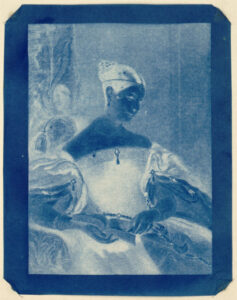
As previously stated, Herschel's main use for the printing process was for scientific purposes. Although he did dabble in the arts, printing a few portraits with cyanotype – as shown in the image below.
With astronomers, botanists and even artists in his inner circle – Sir John Herschel eventually encountered a woman who would profoundly impact the world of science, art and photography. That woman was Anna Atkins. She was a British botanist who made detailed illustrations of her flora and fauna specimens.
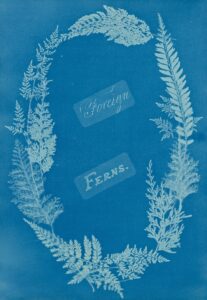
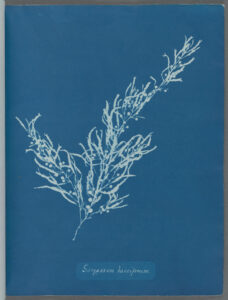
Atkins was a family friend of Herschel's. It is said that she once toured his laboratory, learning the cyanotype process while she was there. She then went on to use cyanotypes to document her extensive herbarium, becoming the first known female photographer. In 1843, Atkin published Photographs of British Algae: Cyanotype Impressions, the first known photography book. She also created publications on ferns and flowering plants.
All in all, the cyanotype was a significant catalyst for the future of photography. Those hues of blue bridged the gap between expression and research, and we have Hershel and Atkins to thank for it. Science and art; two forces that are often opposed in society, inherently crossing each other's path.
The Marquette Regional History Center will hold a Cyanotype Photography Workshop in conjunction with our current special exhibit on Wednesday, May 17, 2023, from 1:00-3:30 p.m. Create a cyanotype of a one-of-a-kind historic image, with instructor and Interdisciplinary Artist Maddie Pederson. You will learn a brief history of the cyanotype technique and how the sun can create beautiful works of art. Register by calling or stopping at the History Center. $25 per person includes all supplies. Ages 18 and up, open to beginners. The current special exhibit, Exposing Photography: Anything but a Small Business runs until January 13, 2024.