
Superior History: Skunk terrorizes downtown Marquette
Trending
By SARA SABIN NIEMI
Marquette Regional
History Center
Special to the Journal
As the weather warms up and wildlife reemerges, we thought we'd revisit an August 1878 Mining Journal article which reported on a skunk 'terrorizing' downtown Marquette. To the writer, and presumably to his audience, this was a witty story. The tale takes place primarily in the Masonic Block, which then was located on south Front Street. Several of the men involved worked at businesses on Front Street, including Freeman's Livery Stable, Moore's Publishing Company, and Reidinger's Meat Market.
Downtown Marquette had several large animals in residence. There were the horses housed at Freeman's livery stable, along with several goats; and the 'hero' of the story, Alderman Louis Reidinger, kept a pet bear behind his butcher shop. But if there were skunks living nearby, they were hidden away, except on this day.
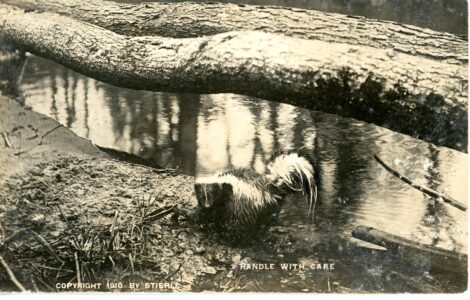
"SKUNK KILLED.--A skunk was killed on the stairway leading up to the Masonic Hall, Friday night last, a few moments too late for last weeks' issue of the MINING JOURNAL. It came from parts unknown and was playing with Freeman's goats near the post office as the marshal happened along and had his attention attracted to it by the goats snuffing the air loudly and making frantic efforts to commit suicide by butting their heads against the building. Finding himself growing tired of life, also, the marshal beat a hasty retreat down the street, before he could do anything rash, sounding the alarm as he went, and it wasnot long before Alderman Reidinger, Sam Burns, Len Crary, Frank Moore and the boss of Freeman's livery stable, came rushing up, inquiring the cause. With shut off noses, the men were taken to the spot, when hostilities were begun against the skunk with stones, brick bats [fragments of brick], and trade dollars [heavy coins], and it was forced from its strong-hold up the stairs and sought safety in the hallway. At this turn in affairs all turned pale but Reidinger, he offering to follow the animal into its lair if someone would get him a Marquette Chasseur musket and bayonet and fix his nose so it would suspend operations for an indefinite period. Not being able to receive the musket and bayonet, a pitchfork from the livery stable was given him instead, and with his nasal protuberance wrapped in a handkerchief soaked with cologne and camphor, Louis climbed the stairs, and a breathless silence prevailed. Suddenly a jab, or a succession of jabs, from the pitchfork was heard on the floor of the hallway above and Reidinger called out, "Dere he goes, boys--de tam liddle schmeller" as he fell heavily on the floor, like a man suddenly overcome by gas. As the skunk came running down the stairway it was hit by a couple of rocks from the party below and killed, after which one of the men ran up and carried Reidinger down and out into the fresh air, where he soon revived. The deceased skunk was taken outside the city limits and buried, and business suspended in the block for several days, until the hallway could be whitewashed with chloride of lime."
The Mining Journal article doesn't tell us how the goats recovered from their scare. But as any local pet owner could attest, it was probably several days before they were fit for company.
Skunks still cause occasional challenges but at least today animals can be live trapped and released into the forest.