
Typhoon batters S. Korea
Trending
By KIM TONG-HYUNG
Associated Press
SEOUL, South Korea -- The most powerful typhoon to hit South Korea in years killed at least six people, dumped 3 feet of rain, destroyed roads and felled power lines on Tuesday. The death toll could have been higher if not for proactive evacuations and school closures, officials said.
There was also greater public awareness about the storm and its risks. Typhoon Hinnamnor made impact just weeks after heavy rain around the capital, Seoul, caused flooding that killed at least 14 people.
Government officials put the nation on high alert for days as Hinnamnor approached, warning of potentially historic destruction and putting in motion life-s
After grazing the resort island of Jeju and hitting the mainland near the port city of Busan, Hinnamnor weakened as it blew into waters between the Korean Peninsula and Japan.
South Korea's weather agency said Hinnamnor was over the open sea 248 miles northwest of the northern Japanese city of Sapporo as of 9 p.m. and had weakened to a tropical storm.
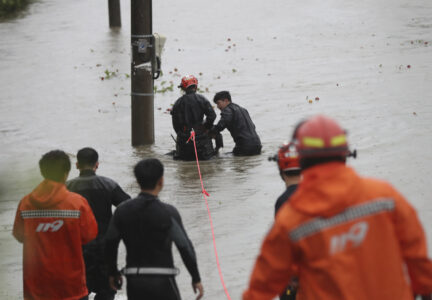
However, the damage was still severe in the southern city of Pohang, where five people were found dead and at least five others were missing after the storm submerged roads and buildings, triggered landslides and flooded a shopping mall.
Cars with smashed windows and trunks open lay scattered on roads like garbage. An entire two-story pool villa was uprooted from the ground and swept away by flash floods. Troops were deployed to assist with rescue and restoration efforts, moving in armored vehicles through streets turned into chocolate-colored rivers.
Firefighters navigated flooded neighborhoods in rubber boats, rescuing people and their pets. Merchants scrambled to salvage furniture and other belongings at the famous Guryongpo outdoor market, where workers deployed excavators to clear huge piles of debris.
The rain and flooding eroded the foundations of bridges and motorways, which were often broken in chunks or blocked by fallen trees and electricity poles. Factory buildings were tilted, while a shipping container blew away and landed above cars in a parking lot.
"I woke up at 5 a.m. at because of the explosive rain, and I got really concerned because the water rose right up to my doorway," Kim Seong-chang, a Pohang resident, said in an interview with JTBC. "The water was still thigh-high at 7 a.m. and those who parked their cars in the streets were in panic because their vehicles were submerged. ... Other residents were bucketing out water from their homes."
The storm dumped more than 41 inchesof rain in central Jeju since Sunday, where winds peaked at 96 mph. Southern and eastern mainland regions also had damage -- knocked-off signboards and roofing, toppled trees and traffic signs, and destroyed roads.