
Unlikely champions emerge at French Open
Trending
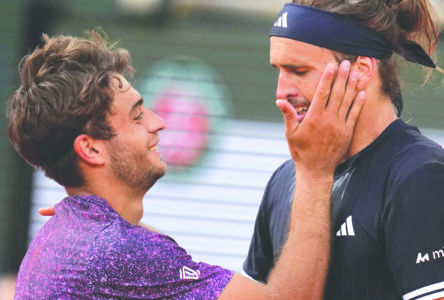
Runner-up Flavio Cobolli, left, greets champion Alexander Zverev after their men’s singles final at the French Open in Paris on Sunday. (AP photo)
But by the final weekend, each was the favorite in the championship matches, Alexander Zverev of Germany for the men on Sunday and Russian teenager Mirra Andreeva for the women a day earlier on Saturday.
Here are recaps of the finals:
Zverev finally breaks through
Zverev is no longer one of the best players never to win a major title -- now he’s a Grand Slam champion.
In his fourth major final, Zverev beat Flavio Cobolli 6-1, 4-6, 6-4, 6-7 (5-7), 6-1 for the title.
It was a unique opportunity for Zverev without Jannik Sinner or Carlos Alcaraz across the net and the third-ranked German took full advantage on the red clay.
When Cobolli missed an overhead on the second championship point after more than four hours of the five-set encounter, Zverev dropped on his back to the clay and covered his face with his hands as he began sobbing. When he got up, with his shirt and arms covered in clay, Zverev put his hands back on his face before he lifted both arms in celebration.
When Zverev was handed the Coupe des Mousquetaires trophy, he lifted it with both hands and let out a liberating roar.
“This court is so special to me in so many ways. I’ve had the best moments of my life on this court; I had the worst moment of my life on these courts,” Zverev said, referring to when he was injured and pushed off on a wheelchair during a semifinal against Rafael Nadal in 2022.
Zverev has now joined an elite group of players that captured their first major in their fourth final: Eight-time major champion Andre Agassi, 2001 Wimbledon winner Goran Ivanisevic and 2020 U.S. Open champion Dominic Thiem.
Zverev became the overwhelming favorite after the top-ranked Sinner struggled in the first week's heat wave and wasted a two set and 5-1 lead against Juan Manuel Cerundolo in the second round. A day later, 24-time Grand Slam champion Novak Djokovic was also eliminated.
Alcaraz, the two-time reigning champion, withdrew before the tournament with an injured right wrist.
The 14th-ranked Cobolli had never been past a Grand Slam quarterfinal until this week. He was attempting to become the first Italian man to raise the singles trophy at Roland Garros since Adriano Panatta 50 years ago.
Andreeva takes out qualifier
Bent over with her hands covering her face, her knees getting dirtied on the red clay court, Mirra Andreeva was celebrating -- processing might be the more appropriate word -- how she had finally overcome “so many demons inside” that came with being a teenage tennis phenom.
After bursting onto the scene at 15, Andreeva became a Grand Slam champion at 19 when she ended the run of 114th-ranked Polish qualifier Maja Chwalinska with a 6-3, 6-2 victory in the women's final.
“I’ve done a lot of visualizations before. Not just this tournament, but I’ve had dreams, I’ve had a lot of thoughts on how it’s going to happen, if it’s going to happen, when it’s going to happen, where,” Andreeva said, still hardly breathing as she talked quickly in true teenage style. “The feeling in real life is so much better than in your dreams.
“I can call myself a Grand Slam champion,” Andreeva added.
The biggest challenges for Andreeva have not been on the court -- she already has one of the best attacking baseline games in the sport -- it’s been the mental side. And her stubbornness.
“Her attitude is difficult,” said Conchita Martinez, Andreeva’s coach and a former Wimbledon champion. “You tell her something, and maybe she’s not open to listening. … When she works hard and when she listens and she does everything, she has no limits.”
Andreeva acknowledged as much during the trophy ceremony.
“I know I can be a tough cookie sometimes and it’s pretty hard to put up with me,” Andreeva said.
Chwalinska was attempting to become the first qualifier to capture the Roland Garros title. She was a promising junior alongside four-time Roland Garros champion Iga Swiatek before she began struggling with depression in 2019.
“Tennis is such a tough sport. It’s so individual. We start so early. We are basically kids when we start,” Chwalinska said. “People are expecting that we are going to behave like adults already and we are just kids really. So the pressure is huge.”