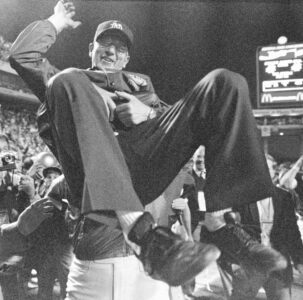
Hero at Notre Dame, Holtz dies at 89
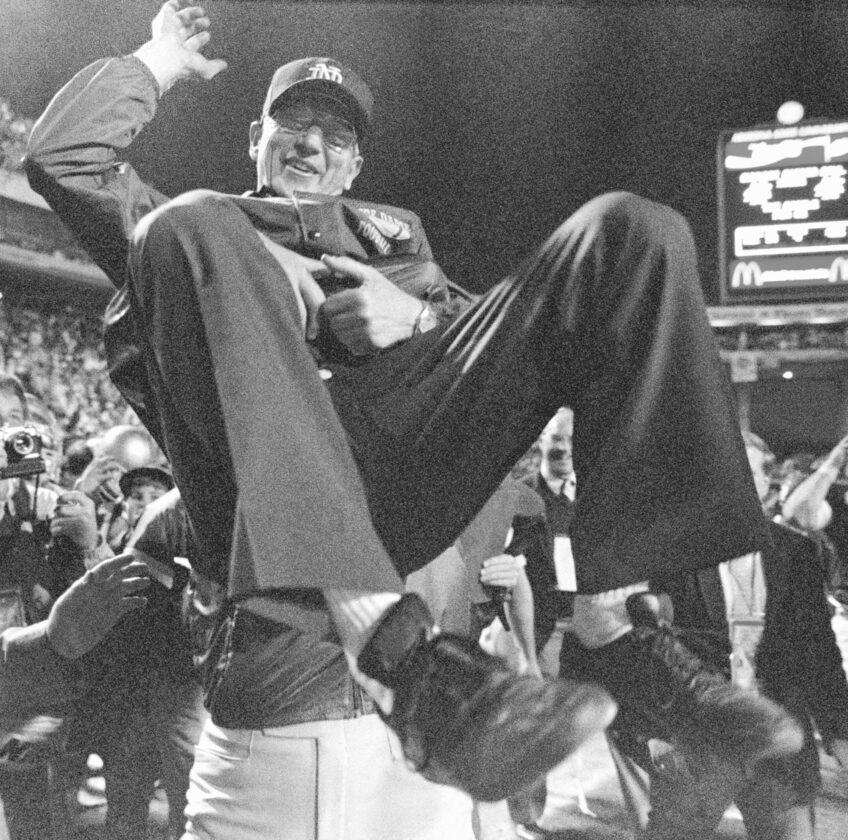
Notre Dame head coach Lou Holtz is raised up to be carried off the field after his team defeated West Virginia in the Fiesta Bowl to win the national championship on Jan. 2, 1989, in Tempe, Ariz. (AP file photo)
Lou Holtz never met an opponent that couldn’t beat him. Somehow, he squeaked out nearly 250 wins and a national title while cementing himself both as one of the most lovable and unlikable characters in college football — a one-of-a-kind iconoclast in a profession brimming with originals.
The pint-sized motivator who restored greatness at Notre Dame and demanded it everywhere else he went died in Orlando, Florida, Notre Dame announced Wednesday. He was 89.
Spokeswoman Katy Lonergan said the family did not provide a cause of death.
“Notre Dame mourns the loss of Lou Holtz, a legendary football coach, a beloved member of the Notre Dame family and devoted husband, father and grandfather,” Notre Dame president the Rev. Robert A. Dowd said in a statement.
His son, Skip, who followed Holtz into coaching, said in a post on X that his father had passed away and was “resting peacefully at home.”
“He was successful, but more important he was Significant,” Skip Holtz wrote.
Holtz went 249-132-7 over a career that spanned 33 seasons and included stops at Minnesota, Arkansas, South Carolina and, most notably, Notre Dame.
It was there that he won his lone national championship, in 1988, capped with a win over West Virginia in the Fiesta Bowl but highlighted by a 31-30 victory earlier in the season over Miami — one of the notable meetings in the so-called “Catholics vs. Convicts” rivalry of the ’80s.
For all the big personalities coarsing through college football during the day, none stood bigger than Holtz. He was only 5-foot-10, but commanded the sideline like someone much bigger. The lead-up to the big games were sometimes his best theatre.
Armed with a homespun brand of folksiness that could trickle into corny but always contained a kernel of truth, Holtz lit up bulletin boards and motivational posters with dozens of memorable quotes and pithy observations, virtually all of them constructed to inspire:
• “Life is ten percent what happens to you and ninety percent how you respond to it.”
• “When all is said and done, more is said than done.”
• “You’re never as good as everyone tells you when you win, and you’re never as bad as they say when you lose.”
He could make any team — from Akron to Army to Alabama — sound like a world beater on any given week. More often than not, his Fighting Irish figured out a way to scratch out the wins.
Restoring the Irish
Before Holtz arrived in South Bend, Notre Dame was wallowing in mediocrity — a mere shell of the program built on a foundation of Knute Rockne, Ara Parseghian, the Golden Dome and Touchdown Jesus. Holtz turned things around quickly and had the Irish in the Cotton Bowl in Year 2 and winning the national title the season after that.
His 1988 and 1989 teams won a school-record 23 consecutive games and he beat three teams ranked No. 1 — Miami in 1988, Colorado in 1989 and Florida State in 1993.
The Irish finished No. 2 in the AP poll in 1993. Holtz left South Bend after the 1996 season with a record of 100-30-2.
“Lou and I shared a very special relationship,” said current Notre Dame coach Marcus Freeman, who led the Irish back to the national title game in 2025 — a contest Holtz attended and spiced up with some trolling of the Ohio State program that beat the Irish that day. “Our relationship meant a lot to me as I admired the values he used to build the foundation of his coaching career: love, trust and commitment.”
Detour to NFL
Notre Dame was the highlight of a head-coaching career that began at William & Mary and North Carolina State and also included a one-year stop in the NFL.
Like so many who mastered the college game in his profession, he failed up there, resigning with one game left in a 3-10 campaign with the New York Jets in 1976 and proclaiming “God did not put Lou Holtz on this earth to coach in the pros.”
That opened the door at Arkansas, which was one of the four schools he led into the AP Top 25. His teams made 18 appearances there; eight of those were in the top 10.
After Notre Dame, Holtz transitioned into the TV booth with CBS.
___
AP Sports Writer Michael Marot in Indianapolis contributed to this report. Tom Coyne is a former AP sports writer.
___
Get poll alerts and updates on the AP Top 25 throughout the season. Sign up here. AP college football: https://apnews.com/hub/ap-top-25-college-football-poll and https://apnews.com/hub/college-football
National Sports

NHL trades heat up before today’s deadline
US opens World Baseball Classic today

Even with Giannis, Bucks hardly going anywhere
Spring football might return with changes to transfer window
Celtics’ Tatum anticipates return 9 months after Achilles rupture