
History of the Wassbergs
Trending
Karl Oskar Wassberg was born in Amal, Sweden, in 1865. Most of the family’s clothing and practically all of the food. They couldn’t afford whale oil for the lanterns, so even the candles were made in the home. Karl’s father was a lumber man and a jobber, having men work for him in the woods. Karl hated paydays because the lumberjacks didn’t show up for work. Karl’s father would keep him home from school on those days to drive the oxen or the horses. After completing the fourth grade, his father gave him a choice of working in the woods with him or working at the local sawmill. He chose the sawmill but all his wages went to his father. In 1883, he became a stone mason in Minneapolis, Minnesota. The company paid for his transportation from Liverpool, England to Ellis Island. He suffered from sea-sickness for 21 days. There was an odor and stench of sea-sick people who hadn’t had a bath for a month. They were herded into trains with their name and destination badges pinned to their clothing. They had to endure terrible food, poor personal facilities, no sleeping quarters and trains that were sidetracked for days. Upon arriving in Minneapolis at a boarding house, Karl was informed that his benefactor was working in Washburn, Wisconsin. When he went to the train station, the ticket agent refused to sell him a ticket. saying,” You are Wassberg,” confusing Washburn with Wassberg. some kind soul stepped in and explained that he was on his way to Washburn. Their room was over a saloon and the first night there were pistol bullets flying through the flooring. Sun-up to sun- down were the working hours. Hours were kept by the benefactor and became official when they were sent to the Swedish consulate in Minneapolis. The benefactors were dishonest and after many “slave hours,” Karl returned to what he knew in Sweden, lumbering.
He first worked as a lumberjack, but then as a blacksmith’s helper. He told the boss he was quitting as a lumberjack because he couldn’t stand bed bugs. The boss said, “I understand you know how to shoe horses. How about being the blacksmith’s helper and bus-boy for the cook?” Take a bath and “lye” your clothes. There are no bed bugs in the cook’s shanty.” Then the great depression of 1892-94 struck and the only jobs available were on the first WPA project, the Chicago Drainage Canal. Those were impossible working conditions but it was a job. Karl received his citizen papers in Joliet, Illinois. The nickname for Karl in Swedish is Kalle so by a twist of fate, Kalle became Charley and his legal name became Charles Oscar Wassberg. He tried gold mining in Utah but in time went back to blacksmithing. One day near Ely Minnesota a guy brought him a piece of machinery to fix for a Diamond drill.
The guy asked him to come and work for them. Blacksmithing, maintenance and repair became Charles Wassberg’s life-time occupation. Working out of Duluth, he was transferred to Palmer, Michigan to do exploratory work on the Isabella Mine. In1902 he moved to Negaunee to drill the area from the Mather B to the Tracy Mine, which was the Breitung at the time.
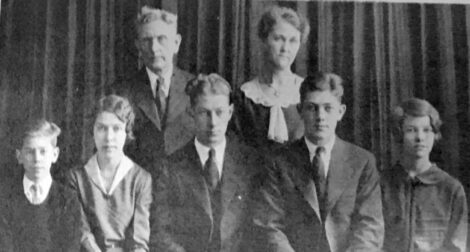
He got a room at the Moberg boarding house in the Rolling Mill Location. And in 1905 he married the eldest daughter of the family, Mary. They moved to Four Mile Carp, west of Ishpeming and he drilled for the Blueberry Mine. Sons Alfred and Oscar were born before moving to Negaunee. They moved to National Mine while drilling from National Mine to Palmer, where the Tilden still is, and the former Empire Mine was located. Charles(Karl) would often say they will never use that poor grade ore. But he didn’t live long enough to see how wrong he was. They moved again to a house on Case Street(still standing) where Ruth and Arthur were born. Charles(Karl) died in 1948 leaving an aura of nostalgia about his early years, sheep for wool, planting and harvesting for food, manual labor, oxen and horse doing hard work in the woods, tallow for candles. From that he saw in his later years, automobiles, radio, telephone, electric lights, running water and push button conveniences in the home. His contentment was a cup of coffee and his pipe. His sons, Arhur and Oscar were teachers and coaches for Negaunee Public School. Everyone knew Alfred as the man who sold insurance.