
Navigation Charts on the Mary Belle
Trending
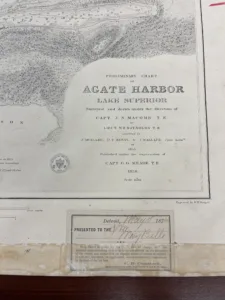
Staff at the Marquette Regional History are wrapping up a multi-year project to sort, re-catalog, and properly store the maps in the research library's collection. Recently cataloging librarian Emi Tinder began working on a series of twelve navigational charts of Lake Superior and the St. Marys River that had been donated to the museum in September 1966 by Captain and Mrs. Wayne Pringle.
The donation records indicated that the maps had been originally assigned to the ship Mary Belle. That raised three questions: What is the historical significance of the maps; what can we learn about the Mary Belle; and what was the connection between the Pringles and our museum?
We know the navigation charts are very old. The U.S. Army Corps of Engineers received the assignment to survey and chart the Great Lakes in 1841. The very first iron-hulled steamer on the Upper Great Lakes was built for the project in 1843 and named the Survey. As iron ore was discovered and shipping on Lake Superior accelerated the need became urgent, with a special push to finish charting the many rapids and islands of the St. Marys River before the opening of the Soo Canal in 1855. The very earliest chart in the museum's collection is from 1854 and is titled "Sketch of the Navigation through East Neebish Rapids, River St. Mary."
This chart, and four others from the 1850s, including a preliminary chart of Marquette harbor, were presented to the Mary Belle on May 18, 1871, which is presumably when the ship went into service. Charts were distributed free to all commercial ships on the lakes and insurance companies required ships to always have the most current ones on board. Updated charts of the St. Marys River were issued to the Mary Belle at the beginning of the 1885 shipping season and the collection from the Pringles also includes 1896 and 1898 revisions.
The history of the Mary Belle is not nearly as well documented, but she showed up in the Sault Ste. Marie newspapers often enough to give us at least a sketch of her interesting life. We don't know much about her first 25 years. But when she first shows up in the Soo newspapers, it's with quite a splash (fortunately no pun intended). On the front page of the September 6, 1897, "Special Klondike Jr. Special Edition" of the Sault Ste. Marie News, is an article "SOOITES BACK FROM WAWA: Mary Belle Party Returned Last Night and Speak in Glowing Terms of the New Gold Field Which They Say is Rich Beyond Compare." This same article gives us some sense of the size of the boat, when it says the expedition carried fourteen people, including its captain and owner Jay Hursley.
The gold rush in the Wawa area never really panned out (pun intended), and the newspapers reported that the investment group from the Mary Belle was "flim-flammed" on at least one of their claims. By the next July, the Soo Democrat reported Captain Hursley had sold the boat to George Kemp, who was fitting her out as a private pleasure boat. Just two weeks later the paper reported that "Miss Margaret Lemon entertained a number of her friends with a trip around Sugar Island on the yacht Mary Belle. A stop was made at the Neebish where luncheon was served."
In the following years the boat appears intermittently in the local newspapers offering private charters or scheduled fishing expeditions but is not mentioned in any of the archived sources available online after 1904.
This is where Captain Pringle enters the story. Wayne Pringle was born in Sault Ste Marie on September 27, 1903, when the Mary Belle was still sailing there. His father, who worked as a lumberman, drowned when Wayne was only eight years old. By the time of the 1920 census, when Wayne was 16, he was already at work, having left school after 8th grade. His occupation was listed as "sailor."
In 1924 he joined the Reiss Steamship Company as second mate and quickly rose to the rank of captain, remaining in that position for 31 years. The Reiss boats were classic Great Lakes carriers, delivering coal, grain, aggregate and iron ore. In March 1942 Wayne Pringle was elected president of the International Shipmasters' Association of the Great Lakes.
Wayne and Clara (McNeeley) Pringle, who was also from the Soo, ultimately made their home in Toledo. But they often came to the U.P. to visit family in addition to Captain Pringle's frequent trips delivering coal and returning with iron ore. After Captain Pringle retired in 1966, he loaned a collection of his nautical charts for an exhibit at the Toledo Public Library. When that exhibit closed, he and Clara donated the ones from the Mary Belle to the Marquette Regional History Center, stating they believed Marquette was a suitable home for them.
Wayne Pringle died on January 12, 1971, and Clara on October 9, 2002. The MRHC is grateful for them and for the many other donors who have contributed valuable items to the museum over the last 108 years. If you have an item that you think may be of interest to the MRHC, please contact the librarians, Emi Tinder and Beth Gruber, or curator, Jo Wittler, at 906-226-3571.