
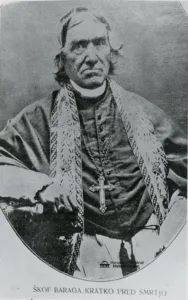
Bishop Frederic Baraga, the Snowshoe Priest
Trending
With America's 250th Fourth of July Celebration coming and going, I began thinking of local history here in the Upper Peninsula. One cannot discuss this history without mentioning the story of the Venerable Bishop Frederic Baraga, whether through the town named in his likeness, or the street in Marquette.
Born and baptized in Slovenia on June 29, 1797, Baraga was born to relatively affluent parents, Janez Baraga and Marija Katarina Jožefa (Jenčič). His sister, Antonija Höffern was the first Slovenian woman to immigrate to the United States. As a result of his higher education, Baraga learned many languages, including Slovenian, French, German, Latin, Greek, Italian, Ojibwe, and English.
Baraga was ordained as a Catholic priest in 1823. Then, in 1830, he was recruited for missionary work in the American Midwest. Initially assigned to preach to the German citizens in Cincinnati, Baraga slowly began learning the language and culture of the indigenous Ottawa in the area.
After some time in what is now Michigan's Lower Peninsula, he moved to La Pointe, Wisconsin and encountered the Ojibwe people. Baraga founded his first mission to preach to the Indigenous inhabitants of the Upper Peninsula and early settlers in Indian Lake near Manistique then moved to L'Anse in 1843 and founded a second mission.
According to Peter White, during Baraga's time in L'Anse, he assisted a small population of Native Americans in acquiring housing from the federal government after purchasing land. During this period in the rural Midwest, priests travelled all over the region to different parishes, leaving many towns without a pastor or Catholic mass for quite some time. For much of his early career, Baraga was one of very few priests in the area.
One reason for Baraga's travels would be "sick calls" where a community, usually a mining or lumber settlement, would request a priest to give last rites. The trips could be long, and Baraga often made the multiple day journey often on foot and snowshoe, which lead to his nickname of "the snowshoe priest." He continued these travels into his sixties.
Baraga was appointed Vicar Apostolic of Upper Michigan in 1853, shortly after he published his grammar and dictionary of the Otchipwe-English language. This was also when he began writing a diary of his day-to-day life. In early 1857, the Vicariate Apostolic was converted into the Diocese of Sault Sainte Marie, with Baraga as its Bishop.
Baraga lived a long life despite enduring hardships, including a series of strokes and intermittent deafness. He made his last known diary entry on July 16, 1863. His last public appearance was in November 1867 in Negaunee. He passed away in January 1868 at the age of 70 in his home in Marquette, Michigan due to complications from a fall 15 months earlier.
Today, Baraga has a complicated legacy. He was officially declared venerable in 2012 by Pope Benedict XVI, recognizing his living a life of heroic virtue and marking the second step towards sainthood. The cause for his sainthood is still being advanced by the Bishop Baraga Association to promote him from Venerable to Blessed, and eventually to Saint in the Roman Catholic Church.
To some modern groups of Native Americans however, his efforts bear the complicated stain of forced conversion and paternalism, even though his Indigenous contemporaries honored him by giving him deerskin vestments. He is also recognized for his extensive contributions to preserving the Ojibwe language.
If you wish to learn more, the Baraga House (the first Catholic church in Marquette) at 615 S Fourth Street contains many artifacts and displays about Baraga, including the preservation of his deathbed. St. Peter Cathedral contains Bishop Baraga's tomb, which may freely be viewed in a chapel to the right of the main altar.