U.P.’s miracle on ice
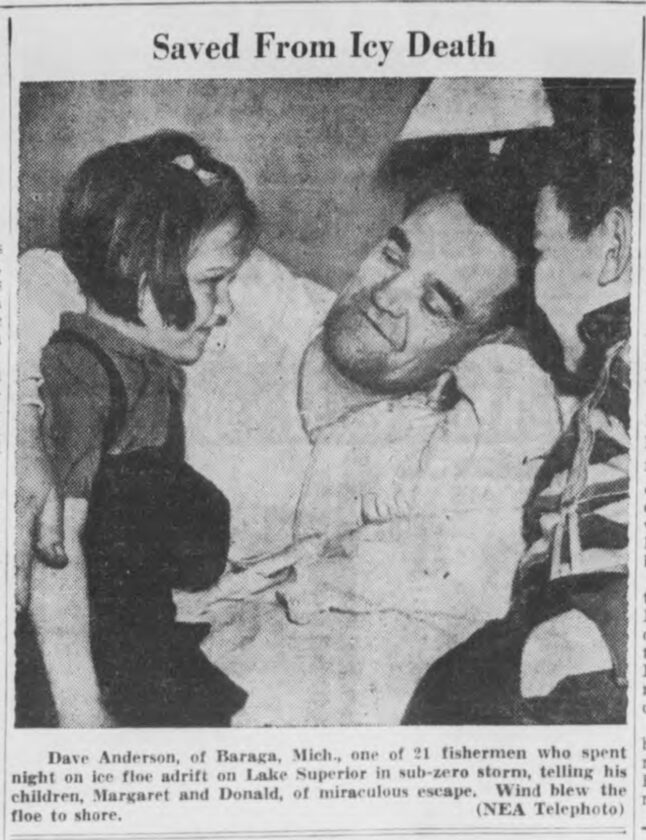
Daily Mining Journal photo from March 20, 1941, of survivor David Anderson with his children. (Photo courtesy of Marquette Regional History Center)
-
- Daily Mining Journal photo from March 20, 1941, of survivor David Anderson with his children. (Photo courtesy of Marquette Regional History Center)
-
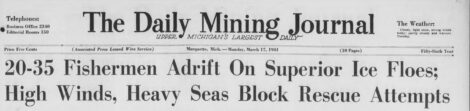
- Daily Mining Journal headline on March 17, 1941. (Photo courtesy of Marquette Regional History Center)
Around 10:30 in the morning, the storm hit without warning. Nana Kuivanen- who was ice fishing for the first time- reported that her husband, Edward, had just caught a 2-pound trout when, “All of a sudden everything turned white as snow and a high wind screeched off shore. Ed took our bearings by the sun and we headed for shore, bucking a wind that whipped right through us.”
At 10 inches thick, the ice should have been thick enough to support fishing. Current recommendations for the minimum thickness of new, clear hard ice are 4 inches for ice fishing and skating, 5-6 inches for snowmobiles and ATVs, and 8-12 inches for cars and small trucks. But the cracks began to form quickly.
Two men, David Anderson, of L’Anse, and Walter Soumela, of Keweenaw Bay, abandoned their fishing gear and jumped across three or four feet of open water to reach the main ice field which was still attached to shore. Along with other fishermen who remained on the main ice field, they reported to authorities that somewhere between 20 and 40 people remained stuck on a large ice floe drifting in the open waters of Lake Superior.
The Skanee, Portage Lake and Marquette Coast Guard Stations all attempted to launch surfboats, but 50-mile-per-hour winds, 25-foot waves and significant slush ice made the attempts futile. It was feared that the winds were blowing the ice floes in an easterly direction, parallel to the shore. As the temperatures dropped to zero, authorities held little hope for the survival of the missing.
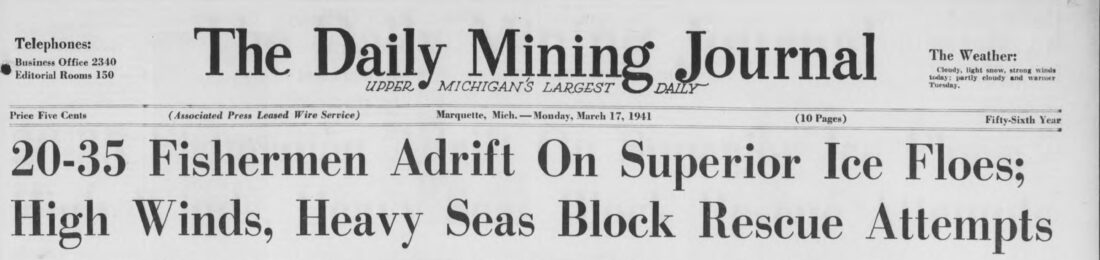
Daily Mining Journal headline on March 17, 1941. (Photo courtesy of Marquette Regional History Center)
As they drifted the ice floes broke into smaller pieces, separating the stranded people into smaller groups. They picked up small ice cakes floating near the floes to build windbreaks, although one survivor, Orville Schroeder, later reported, “At times, smaller ice cakes drifted past us on the large floe at freight train speeds.”
Around 3:00 on Sunday afternoon, group of five men managed to maneuver their small ice floe to shore about four miles southeast of the Huron River mouth. The men built a fire on the shore; four remained there while the fifth walked approximately eight miles to Sirard’s lumber camp. There he got a tractor and went back for the others. They finally reached Skanee just before midnight on Sunday.
Many of the remaining fishermen and women reached shore in small groups over the course of the night. Nana Kuivanen recounted her story to the reporters, saying, “Then ahead, loomed a great dark space- water, an endless space of open water. Our windbreak was whipped out of our hands. We met six other fishermen who appeared out of the snowy curtain. We huddled between three tiny windbreaks, not daring to go near the water’s edge for fear of falling through thin ice, unable to see more than ten feet away.
“We were surprisingly calm. I never thought I’d be able to face death quite like that. Our ice floe kept breaking off at the edges, getting smaller all the time. Finally, we gathered in the middle of the floe. It wasn’t very big. We couldn’t see anything but a great white wall and we heard only the raging wind and the roaring waters under the ice.
“It seemed ages before the storm cleared up for a little while and we saw the mainland, a welcome dark blot, about a mile away. We started to move toward it, jumping from one piece of ice to the next, sinking with each one, sometimes to our knees, and never knowing when we’d sink for good. When we finally though we would make it, we came to a channel that separated us from the shore ice. Drifting on our ice raft we waited a long while before enough large ice cakes drifted into the channel to enable us to cross.”
Nana and her group gathered with other survivors at Pine Point between the mouths of the Huron and Little Huron Rivers. They built a fire, eating what little food they had before walking five miles looking for a logging camp. Eventually they stopped for the night.
The search parties consisting of coastguardsmen, state police, and volunteers were organized along the lakeshore on Monday morning. One group started heading east from Skanee while another group started west from the Huron Mountain Club, planning to meet in the middle at the mouth of the Little Huron River. The search parties had toboggans, blankets, food and coffee for the survivors. Nana’s group walked another mile and a half on Monday morning before they were found by one of the search groups.
By Monday afternoon, 17 of the 22 missing people had reached safety. The five remaining fishermen landed not on the lake shore but on the east island of the Huron group. A chartered fishing tug broke a channel through the ice to the island and picked them up. They finally reached shore at about 4:00 am on Tuesday morning, nearly 42 hours after their ordeal began.
Remarkably everyone stranded on the ice floes survived without serious injury, although many suffered from significant frost bite to their faces, hands and feet. Overall, the storm claimed 76 victims across the Midwest, most of whom froze to death, but the storm’s toll could have been significantly worse without the miracle survival of 22 stranded fishermen and women.
Superior History

History quiz
U.P.’s miracle on ice
U.P. Moments in History
History quiz
QUESTION: Who was Marquette’s first known casualty during World War II? a. Abraham Fleury b. Alvar ...
Old Lady Lucy