Collecting folk music in the Upper Peninsula
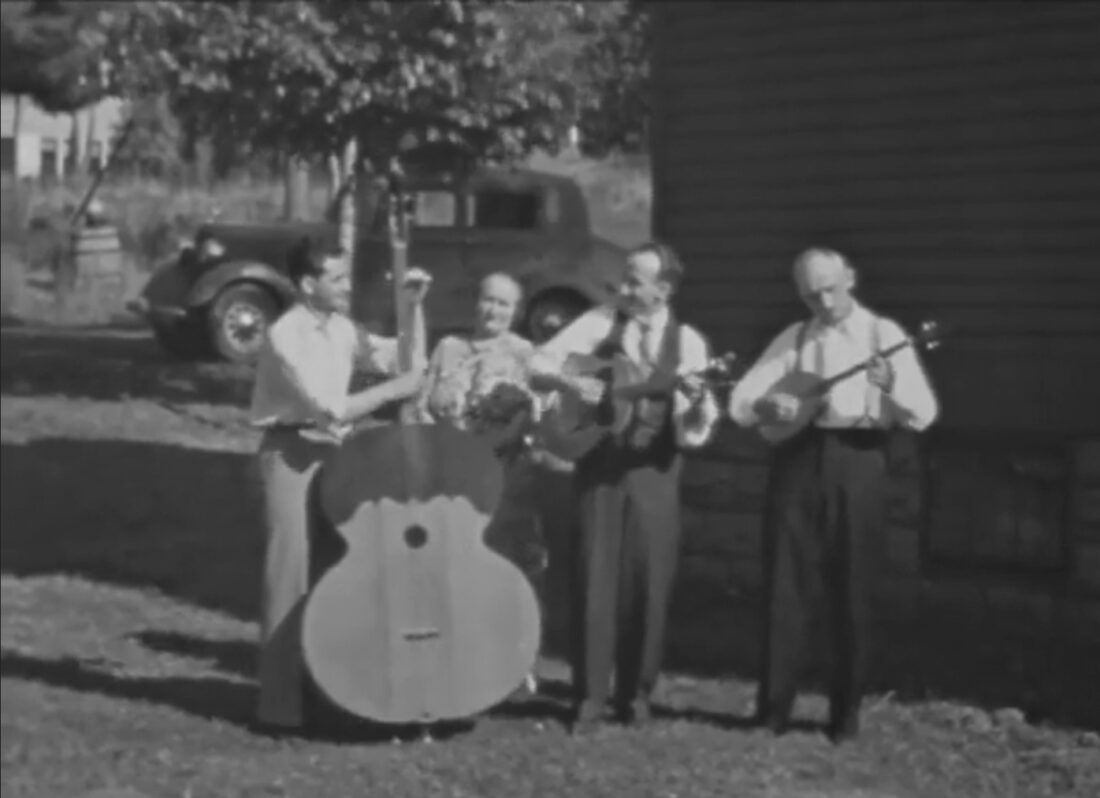
Veko, Margaret, Vladimir Jr. and Vladimir Floriani in Ahmeek, playing Croatian tamburitza music on Sept. 25, 1938. (Screenshot provided by the Marquette Regional History Center)
An article last year by the Marquette Regional History Center’s research librarian Beth Gruber looked at some of the projects undertaken in Marquette County by the Works Project Administration during the Great Depression. They included everything from building reservoirs and highways to repairing library books. Nationwide, these projects employed more than eight million workers, including more than 8,000 in Marquette County.
There was one national project, however, that was much smaller. In 1936 a young Texan named Alan Lomax was hired as “Assistant in Charge” (a somewhat paradoxical title) of the Archive of Folk Culture at the Library of Congress.
Although he was only 21 years old at the time, Alan already had years of experience. His father, John Lomax, had been collecting cowboy songs since his own childhood, and in 1910 published a book of cowboy songs with an introduction by former president Theodore Roosevelt that included such classics as “Home on the Range” and “Sweet Betsy from Pike.”
John took the teenage Alan along on collecting trips, including to Angola Prison in Louisiana where they first recorded a twelve-string guitar player named Huddie Ledbetter, later known as the great blues musician Lead Belly. In 1936 Alan accepted an invitation from Zora Neale Hurston to collect folklore in Florida, Georgia, and Haiti — a trip that collected some of the first audio recorded slave narratives.
In August 1938 the Archive sent 23-year-old Alan Lomax to the Great Lakes. Driving a 1935 Plymouth sedan — “the world’s most economical full-size car” — and carrying 150 pounds of “portable” recording equipment and movie cameras, he began in Detroit, continued across the Lower Peninsula to Beaver Island, and then in early September crossed into the U.P. at St. Ignace.
It was not an easy trip. Roads were terrible, the car frequently broke down, and he was always running out of money. On September 7th he wrote back to Washington, “Sorry to be such trouble — I am in funds now to the extent of $12.68. This will last me about five days … I am not wastreling — but songs in Mich. absolutely require beer.”
Even with the beer, he sometimes had problems finding people willing to record for him. He wrote from St. Ignace, “There are fine singers around, but one of them just had a death in the family and is off on a three weeks bender, another has an awful cold, another had a serious operation not long ago and yet others want pay and are suspicious and elusive … Not that the country isn’t fertile, but it is stubborn and the people simply can’t see why they should sing for me without pay.”
Notwithstanding the hardships, Lomax was pleased with the results of the trip. In addition to St. Ignace, he recorded songs in Newberry, Calumet, Champion, Amasa, Munising, Allouez, Pewabic, Ahmeek, Baraga, Bessemer, Lake Linden, Hancock, Ontonagon, Laurium, Greenland, Marenisco, and Ironwood. He made as many recordings in Baraga (52) as he did in Detroit.
Many of the recordings were in English, but he also recorded Finnish singers all over the U.P., Croatian singers in Ahmeek, Italians in Lake Linden, and French singers in Baraga and Champion. In Newberry, a Lithuanian immigrant, Charles Ketvirtis joined with Emil Maki to sing a Finnish army song, but also accompanied himself on accordion playing Lithuanian, Russian, and Polish songs.
In Lomax’s final report on the trip, he noted that “In Champion and Baraga I found French ballad singers who still enjoyed ballad fests that lasted all night long.” Two of these ballad singers in Baraga were Mose and Exilia Bellaire, who played 35 different songs for him, sometimes accompanied by a young boy, perhaps one of their sons, doing a percussive clog dance. One song Exilia sang bounced between French and English “I went to Marquette; J’ai une fille a marier” (“I have a girl to be married”).
Another of the Baraga singers was Wilfred “Fred” Carriere. A year later, when the French Broadcasting Service asked the Archives for some of the Michigan recordings, Lomax directed the staff to send them his recordings of Fred Carriere, adding, “Mr. Berger, the gentleman in question, will be our very good friend in Paris and I think it will do us no harm to render him every service we can.”
Lomax left the U.P. in mid-October, exhausted but exhilarated. He had collected 250 discs (records) and eight reels of silent color film. He had recorded 442 songs from 66 different musicians. He wrote, “The Upper Peninsula of Michigan proved to be the most fertile source of material. After six weeks of recording a mass of lumberjack, Finnish and French folk-songs, I felt that there was material enough in the region for years of work.”
He spoke several times of coming back, perhaps in January 1939 or the following summer, but it was not to be. His lengthy career was just getting started. He went on to record music all over the world, and produced scores of records, books, movies, and radio shows. He was credited with first introducing Robert Johnson, Woody Guthrie, Burl Ives, Muddy Waters, and many others to the American public.
Lomax died in 2002 at age 87. Fortunately, his letters and his collections have been digitized and are available online through the Library of Congress website. A contemporary Michigan group, Michigan I-O, has recently issued a new recording with their arrangements of some of the songs he collected. To see samples of his color films, including the Bellaires and a rendition of the mining song “Thirty-first Level Blues,” with scenes of the Copper County in the background, visit https://youtu.be/H7rfwGvQtto?si=kS61JtxkSqYVdmo3 on YouTube.
To learn more about folklore in the Upper Peninsula, join the next meeting of the U.P. History Book Club at 6:30 p.m. on Feb. 18 either in person at the Marquette Regional History Center or on Zoom. We’ll be discussing Richard Dorson’s classic “Bloodstoppers and Bearwalkers: Folk Traditions of the Upper Peninsula.”
-
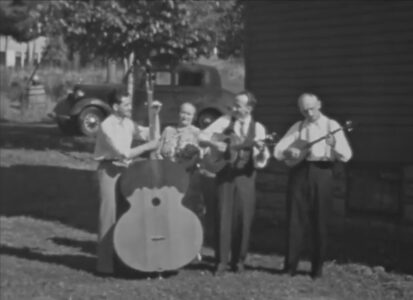
- Veko, Margaret, Vladimir Jr. and Vladimir Floriani in Ahmeek, playing Croatian tamburitza music on Sept. 25, 1938. (Screenshot provided by the Marquette Regional History Center)