
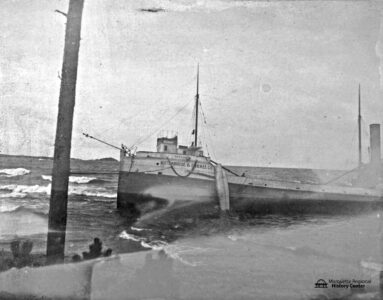
120th anniversary of the wreck of the Oregon at Partridge Bay, Oct. 20, 1905
Trending
October 19-20, 1905, saw "...old Superior in another of her fall tantrums, and she managed to kick up a very respectable blow." Western Marquette County received significant early snowfall while the lakeshore suffered erosion. There was significant damage on both land and lake, but luckily there was no reported loss of life.
The storm attracted gawkers, with the Mining Journal noting, "Not in years have as many people gone to Presque Isle to observe a storm on the lake as were out yesterday. The travel to the resort began in the morning and continued throughout the day, the cars being put on a fifteen-minute schedule in the afternoon to better accommodate the traffic ... The wave display on the north side of Presque Isle was very fine and well repaid the visitors."
Between Negaunee and Escanaba, 200 telegraph poles were down with another 60 down between Marquette and Michigamme. On Lakeshore Boulevard near the Dead River, the road was covered by two feet of sand and eight to ten inches of water, along with logs, stumps and boulders. Several hundred feet of planking were torn away from the new breakwater under construction at Presque Isle. Damage estimates for vessels across the Great Lakes totaled nearly $1 million, just over $36 million today.
One of the notable features of the storm was the significant damage to wooden schooners, which were described in the news as "...old timers that the storms are rapidly weeding out." It was noted that the wooden ships did not have the power or strength to withstand significant storms.
The wooden steamer Oregon and her consort (a schooner being towed as a barge), the S.H. Foster, were bound for Pequaming where they were supposed to pick up a load of lumber for Duluth. But as they neared Stannard Rock late on Thursday evening, October 19th, the 'goose neck' on the main steam pipe burst. The pipe was about two-thirds severed but Engineer Wellman managed to lash a heavy chain around it and fastened it to the throttle. This makeshift repair gave the steamer just enough power to take refuge behind Partridge Island.
Unfortunately, in the early hours of Friday morning, just as they reached safety behind the island, the ship's wheel was tangled in a net, making it impossible to turn the wheel. They were driven onto the beach just north of Middle Island Point and the Foster was cut free from its lines to avoid a similar fate.
The Oregon's Captain Elliott stated that it had been the worst storm he had ever seen in 25 years sailing on the Great Lakes, "I stood on the top of the pilot house and saw the boat head into waves that looked to be ten or fifteen feet higher than the place where I stood...We were so close to the breakers on the west side of Partridge Island that we could see the spray rise to a height of at least fifty feet when it struck the rocks. The storm out in the lake was not to be compared to the seas we found near the island."
Elliott continued, praising his crew, "Engineer Wellman never left the engine from the time the steam pipe burst until we were on the beach, although everyone knew that when the pipe severed completely, which it was liable to do at any time, he would be scalded to death. The crew behaved like men and worked on deck when it was possible."
Further east, the wooden steamer Myer was underway with two consorts, the Alta and the Olga. Near Grand Marais the schooners broke free, leaving them at the mercy of the wind and waves. The Alta wrecked on a reef in Trout Bay near Grand Island, while the Olga lost her rudder and masts but was able to anchor safely off the Pictured Rocks. Similarly, the steamer Barth successfully entered the harbor at Grand Marais, seeking shelter but her two consorts, the Nirvana and the Galatea, missed the entrance. The Nirvana sank a quarter of a mile from shore while the Galatea came to rest on a sand bottom near the shore.
In the days after the storm recovery efforts began. The Oregon was dredged out of the sand, and the water was pumped out. After being refloated, she was towed to Marquette's harbor where the hull damage was examined by a diver. Initial repairs were made to ensure the vessel's seaworthiness before it was towed to Milwaukee for full repairs. The Alta and the Nirvana were both complete wrecks, while the Olga, Galatea, Oregon and Foster were all repaired.
An employee of one of the marine insurance companies noted, "So far as I have been able to learn there were no steel boats damaged by the recent storm on the great lakes. In fact, the steel fleet has escaped the last two severe storms this year, but wooden boats have paid a heavy toll. It has been apparent for a number of years that the wooden vessel was doomed, and the steel freighter would eventually take its place." He was not completely right, because during the same storm the Canadian steamer Winnipeg broke some of her steel plates hitting Ripley's Rock in Marquette's Lower Harbor. But ultimately the spokesman was correct. The era of wooden ships on the Great Lakes was coming to an end.