
Sweet harvest: Maple syrup, sugar production significant in area
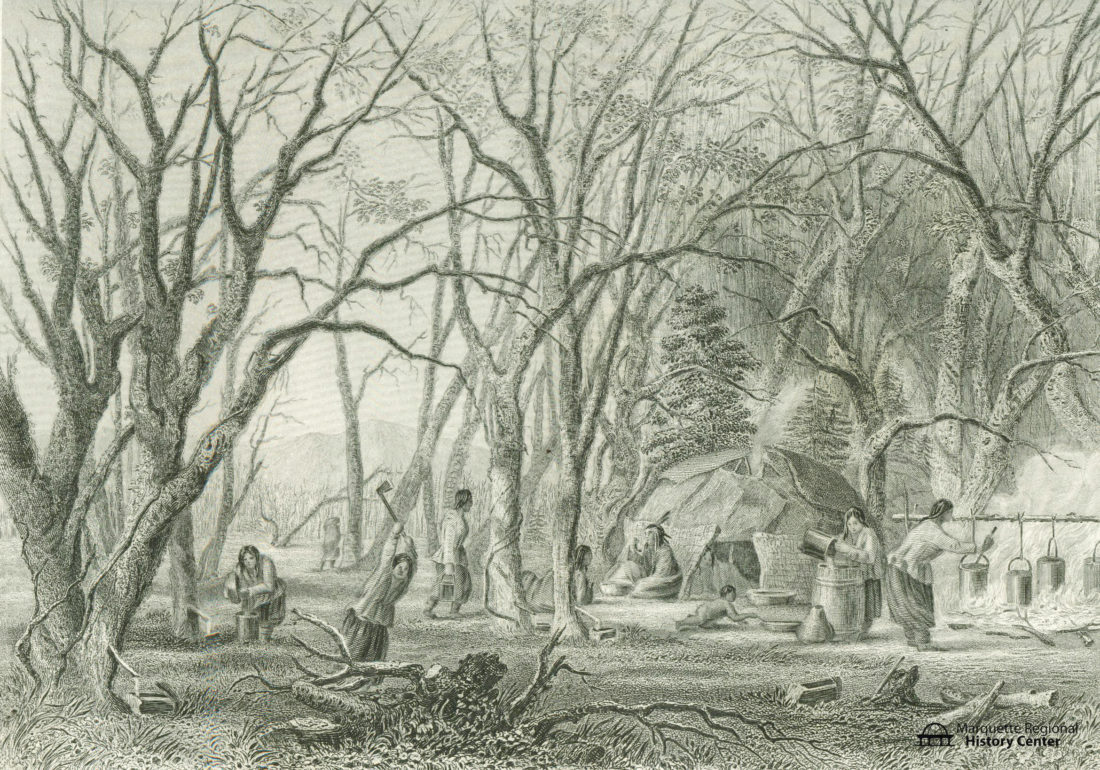
A Native American maple syrup camp is seen. (Photo courtesy of the Marquette Regional History Center)
MARQUETTE –The arrival of March means we expect to see a succession of thawing days and freezing nights in the near future. This forerunner of spring brings the gradual disappearance of the snow but is also the time when the maple sap starts running.
A rise in temperature of the sapwood to above freezing causes a positive pressure within the wood. This pressure causes the sap to flow up through the tree and if there happens to be a wound or tap hole, it flows out of the tree. During cooler periods when temperatures fall below freezing, negative pressure or suction develops, drawing water into the tree through the roots. This replenishes the sap in the tree, allowing it to flow again during the next warm period.
The production of maple syrup and maple sugar is a distinctly North American industry, originating with the Native Americans who later passed their knowledge down to the colonists. As far back as the early 1600s, French explorers and missionaries stated that when the spring came along, the Native Americans got the juice from the trees and distilled a sweet and agreeable liquid.
Brule and Nicolet, who got as far north as the Lake Superior shore and the straits of Mackinac, found the Ojibwa using maple sugar for seasoning their fish and meat and sometimes subsisting on it entirely. Johann Kohl, a German explorer and travel writer, even told of its being used as a cure for scurvy, at the Soo in 1857. He added, “Potatoes and good flour usually last only through February and the inhabitants then subsist mostly on salt pork and hardtack, thus suffering from this dread disease. For protection against this illness they make use of the sweet sap that rises in the spring and drink great quantities of it.”
Alexander Henry, fur trader and adventurer, who wrote in great detail of his trips around Lake Superior after 1760, described the process as practiced by the Native Americans in the Soo area. “A certain part of the maple woods having been chose, the party of eight, built a house about 20 by 14 feet, open at the top, with a door at each end and fireplace in the middle, running the whole length. We collected the sap in birch bark buckets, poured it into large moose hide vats for transportation and thus supplied the boilers, of which we had 12, from 10 to 20 gallons each. [Presumably these were brass or iron kettles, but he did not say.] The women collected the sap, boiled it and completed the sugar and the men cut wood, kept the fires going continuously, and hunted and fished, for part of our food. Finally, on the 25th of April we returned to the Fort with 16 hundred-weight of sugar and 36 gallons of syrup. Though we hunted and fished, yet sugar was our principal food during that whole month, and we certainly must have consumed three hundred-weight, and we thus had plenty to eat. In fact I have known Indians to live wholly on maple sugar for months…”
Some 60 years later, Henry R. Schoolcraft wrote of a similar experience, “I joined a party in vising Mrs. Johnston’s camps about 8 or 9 miles down the river, driving there on the ice in several carioles, then proceeding about a mile inland. Sleighs and dog trains have been departing for the maple forests in our neighborhood for several days now and Sault Ste. Marie seems like a deserted village. We found a large building there, surrounded with piles of ready split wood for keeping a fire under the kettles and ox hides arranged in such a manner as to serve as vats for collecting the sap from the hundreds of little birch containers scattered through the nearby woods. About 20 kettles were boiling over an elongated central fire and the whole air of the place resembled a manufactory. The principal amusement seemed to consist of pulling candy and eating the sugar in every form. After receiving the hospitality of our hostess we hitched our teams and pursued our way back to the fort, having narrowly escaped breaking through the river at one or two points.” Mrs. Johnston was his mother-in-law, an Ojibwa woman named Ozhaguscodaywayquay (also known as Neengay or Susan Johnston) who was married to famous fur trader John Johnston. This is believed to have been on Sugar Island, which got its name from that product. Other historians later noted that during the 1820s Mrs. Johnston annually harvested more than a ton of maple sugar there, in addition for great quantities of syrup.
Over time maple syrup and maple sugar have decreased in importance in the local diet as cane, and later, beet sugar took over. But the sugar bushes have endured, maple syrup remains a part of Upper Peninsula culture and is a staple item for tourists and locals alike. According to the Michigan Maple Syrup Association, Michigan currently produces about 90,000 gallons of maple syrup per year and ranks fifth in production in the U.S.
There are an estimated 500 commercial maple syrup producers in Michigan with some 2,000 additional hobby or home use producers.
Superior History
Everesta Steele & Ever Esta’s Dress Shop
History quiz
QUESTION: The Volstead act went into effect in 1920 nationally. What year did the Michigan ban on all alcohol ...
U.P. Moments in History
History quiz
QUESTION: Prior to the 1937 Lumberjack Strike in Gogebic County, what were lumberjacks typically paid? a. ...
U.P. Moments in History
National pastime – Early baseball in the Upper Peninsula
MARQUETTE — This evening’s Major League Baseball marquee matchup between the New York Yankees and San Francisco ...