
Trending
"September days have the warmth of summer in their briefer hours, but in their lengthening evenings a prophetic breath of autumn." -- Rowland E. Robinson
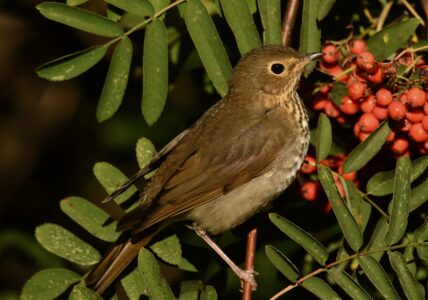
It is a bit difficult to talk about the warmth, let alone the heat of summer here in the Upper Peninsula this summer. It is almost a surprise there weren't more mornings of frost. Now it is September, and many will hope there will be at least a few really warm days ride out on as October draws nearer. Feeling those north winds though, it seems like October is already here. Those winds have cleansed the sky of Canadian wildfire smoke -- this past Wednesday morning the sun peered out of some of the bluest skies seen in some time. There have been several mentions of mountain ash fruits this summer as a bumper crop of them is shaping up to be one of the best in Marquette in some time. When ripe the fruits are a deep orange color, almost, but not quite red, but definitely a shade to catch the eye. This year the large clusters of fruits are heavy from the wet summer, bending tender, flexible branch far closer to the ground. In the next week or so hermit, Swainson's and a few gray-cheeked warblers should begin moving through the area on their way south.
Gray-cheeked thrushes are coming down from northern Canada and Alaska and headed to northern South America. Swainson's and hermit thrushes nest here in the U.P. in summer but have very different winter ranges. Swainson's head to South American and nearly all the way down the Andes Mountains. Hermit thrushes seem to ironically be the hardiest of the three, wintering all along the west coast and southern tier of the U.S. and some parts of Mexico.
Warblers continue to trickle through the U.P. on their way to warmer places. Peninsula Point is one of the better places to catch them right now. Last Friday 13 of the 56 species seen by two birders were warblers. There may have been even more. Fall warblers with young and adults molting to plainer winter plumage are often extremely difficult to identify and 75 birds did not offer a clear enough view to be properly identified. One blackburnian, one Canada and two blackpoll warblers were some of the highlights of those seen.
In summer the blackburnian warblers are quite showy, with males having orange markings on head and throats. In their fall molt though they lose the orange and like many warblers are pale yellow, olive, brown, white, and black. With yellowish heads, white wing bars, dark wings, and light breasts, all meant to blend into the rainforest canopy, many of the warblers look quite similar, hard to see in the trees and extremely difficult for most to correctly identify.
Blackburnians are headed to northern South America and the Andes Mountains for the winter. Bay-breasted and blackpoll warblers spend their summers most to the north of the U.P. and are primarily seen in spring and fall migrations. The former summers in central Canada and winters in Cuba, Venezuela, and Columbia. Blackpolls travel even further spending their summer months in northern Canada and Alaska and wintering in much of northern South America.
For shorebirds, one of the best places continues to be Whitefish Point in the eastern U.P. Waterbird counts https://dunkadoo.org/explore/whitefish-point-bird-observatory/wpbo-waterbirds-fall-2023 continue to show some daily runs with good diversity, aided by the north winds probably pushing them through at a slightly faster rate. Up to eight different species are seen there on most days. While the favorable winds do push many birds straight through, the shallow pools at the tip of the point continue to entice birds that may be weary from crossing Lake Superior to stop for a rest or to feed.
Dabbling ducks are also regulars at Whitefish Point, but red-necked grebes continue to be the most common species passing by with over 3,500 counted so far this fall. They are well adapted to spending winters in colder climates, along both east and west coasts and Lake Ontario. When the fall migration counts were started at Whitefish Point it was a big surprise to find red-necked grebes did not travel at night but many used a migration path past the point. In record years up to 21,000 have been counted.
Back in the Marquette area, sandhill cranes and wild turkeys continue to put on great shows along Cornerstone Drive near the township fire hall and office. The cranes have one youngster that is quite entertaining as it continues to stretch and exercise its wings. It is about the size of the adults with a very pale white and buff-colored face. They have been busy feeding on new winged ants and other insects and invertebrates in the short cut grass lawns of offices and businesses. Preferring quiet spots near water in evenings, they may take advantage of the old mitigation pond in the area and may have even nested there. The pond was created to handle water used to clean equipment at the former dairy in the area and keep milk products from reaching the Dead River. Today the pond is quiet and completely surrounded by trees, shrubs, and cattails.
The turkey family is larger with the hen currently watching over eight young. They, too, are foraging for insects mostly and are frequently seen late in the day. It looks like a little of that summer heat may still be around this weekend and that should make cranes and turkeys happy to see some insects and people to see some summer.
Scot Stewart is naturalist at the MooseWood Nature Center, a writer and photographer.