
Officer’s camera misses key moment of Patrick Lyoya’s death
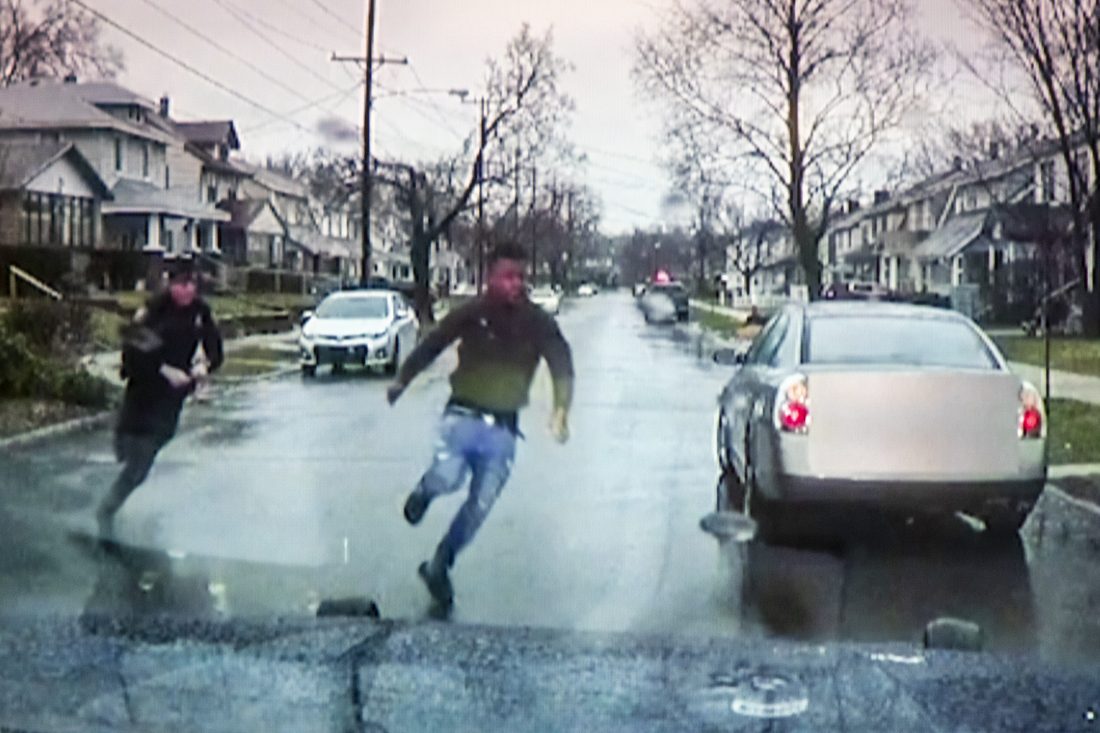
A TV display shows video evidence of a Grand Rapids police officer struggling with and shooting Patrick Lyoya at Grand Rapids City Hall on Wednesday. Lyoya, 26, was shot and killed about 8:10 a.m. on April 4, after what police said was a traffic stop. (Grand Rapids Police Department)
Body camera footage of Patrick Lyoya’s fatal encounter with a Michigan police officer shows a close-up view of an intense struggle, but the video goes dark 42 seconds before the officer shoots the Black man in the head.
It’s the latest high-profile case in which body cameras — touted as tools to hold police accountable — have failed, leaving prosecutors and the public to rely on bystander video for a clearer picture of what happened.
One expert said vendors could make changes to avoid accidental camera deactivations, though it’s not clear that is what happened in Lyoya’s case, and some activists said an accident seems unlikely. Regardless, Lyoya’s family and their attorneys say it shows the importance of citizen video. The shooting was captured by Lyoya’s passenger, with a cellphone, and a doorbell camera across the street.
“Keep videoing the police because transparency is important for them and it’s sure important for us,” said Ben Crump, an attorney for Lyoya’s family.
The officer was on top of Lyoya, who was facedown on the ground, when he shot the 26-year-old Congolese refugee in the head April 4.
Body camera video released by police this week shows the initial stop, and the officer saying the car’s license plate wasn’t registered to the vehicle. It shows Lyoya’s attempt to run away and a struggle as the officer repeatedly tells him to stop. At one point, Lyoya has his hand on the officer’s stun gun, and the officer yells at him to let go.
The video then goes black. Police dashcam captured some audio but no images of the shooting.
Grand Rapids Police Chief Eric Winstrom said officers have to hold a button on the camera for three seconds to turn it off. He said the button was hit many times during the struggle in this case, but at the point the screen went dark “that was the first moment that it was held down for more than three seconds. That’s what deactivated it.”
One body camera expert said it appeared to have been unintentional.
“That officer, he is in a full-on struggle with that citizen. And I’m sure turning the camera off would’ve been the least of his concerns,” said Michael White, a professor at the School of Criminology and Criminal Justice at Arizona State University and co-director of training and technical assistance for the U.S. Department of Justice Body-Worn Camera Policy and Implementation Program.
Michigan News

Winter storms bring snow, freezing rain and cold as Thanksgiving travelers journey home

Michigan Senate passes reforms on collecting petition signatures
Michigan Senate advances stopgap funding for SNAP as federal funding cliff nears
LANSING — Members of the Michigan Senate on Thursday voted to advance a supplemental funding bill providing $71 ...
Michigan House committee considers bills to streamline CPS investigations into abuse, neglect
LANSING — The House Committee on Families and Veterans considered two bills Tuesday, put forward by state Rep. ...
As regulators plan for Michigan’s energy future, environmentalists speak out on data centers
LANSING — While members of the board overseeing Michigan’s energy resources consider long-term plans for the ...
Detroit Mayor Mike Duggan’s independent bid for Michigan governor gaining traction, new poll says
DETROIT — Mayor of Detroit Mike Duggan, who is running an independent campaign for Michigan governor in the 2026 ...