
Changes coming to Wild Rivers Invasive Species Coalition
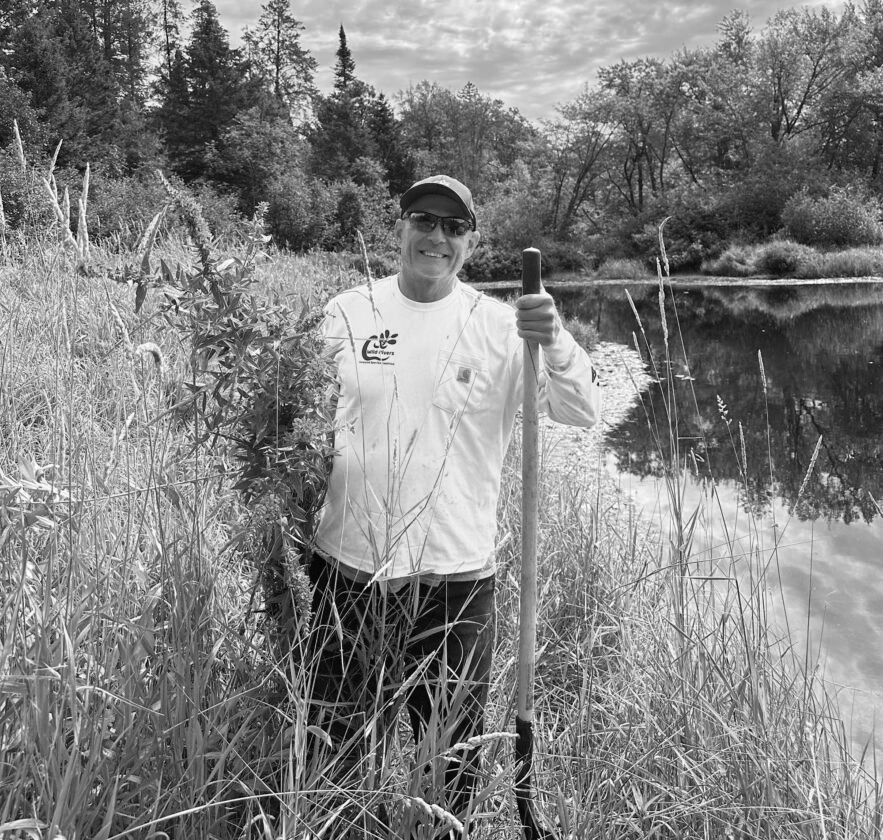
Wild Rivers Invasive Species Coalition seasonal technician Robert Martonen removes invasive purple loosestrife from the Michigamme River as part of a shoreline habitat restoration project funded by WE Energies. (Courtesy photo via Iron Mountain Daily News)
IRON MOUNTAIN — The Wild Rivers Invasive Species Coalition will become a non-profit with a new name later this year using a $70,000 state grant to help make the transition.
The group will share in a total of $2.4 million that the Michigan Invasive Species Grant Program recently awarded to 27 projects statewide “for efforts that address the prevention, detection, eradication and control of aquatic (water-based) and terrestrial (land-based) invasive species.”
Wild Rivers Invasive Species Coalition is awaiting 501(c)(3) designation as the Roots & Rivers Collaborative, with a hard launch of the new organization planned during the annual meeting set for June 5 in Crandon, Wis., said Lindsay Peterson, now WRISC coordinator and expected to be executive director of the new non-profit.
The mission of invasive species management and education across its five-county area — Dickinson and Menominee counties as well as Marinette, Florence and Forest counties in Wisconsin — will remain much the same as when the group formed in 2009, “just under a new name and a little bit of a refresh,” Peterson said.
“It’s something the organization has talked about for several years,” she said, explaining it will make seeking grant funding easier and better allow for growth and expansion.
WRISC is completely grant-funded, securing about $650,000 in grants over the past several years to support local invasive species projects and create jobs, according to its website.
The organization for now will remain at the Dickinson Conservation District office, 420 N. Hooper St. in Kingsford, Peterson said.
The Michigan Invasive Species Grant Program also awarded $70,000 to the Iron Baraga Conservation District, which oversees Iron, Gogebic and Ontonagon counties. The money will be used to manage and prevent invasive species in those western Upper Peninsula counties, particularly aquatic threats such as Eurasian watermilfoil. The group will develop strategies for early detection and rapid response while building partnerships, engaging volunteers and diversifying funding sources, according to the MISGP website.
To date, more than $42 million has been awarded to support 328 projects undertaken by units of government, nonprofit organizations and institutions.
The program – cooperatively implemented by the Michigan departments of Agriculture and Rural Development; Environment, Great Lakes, and Energy; and Natural Resources – has four key objectives —
• Preventing the introduction of new invasive species;
• Strengthening the statewide invasive species early detection and response network;
• Limiting the spread of recently confirmed invasive species; and
• Managing and controlling widespread, established invasive species.
This year, grants will support each of Michigan’s 22 regional cooperative invasive species management areas, the network of partnership organizations working to manage and control invasive species, actively serving all 83 counties in the state.
The full list of grants can be viewed at https://www.michigan.gov/invasives/grants/misgp/misgp-grant-awards?utm_campaign=misgp+awards2025&utm_medium=pr&utm_source=govdelivery.
Local
Aspirus Iron River nurses OK new contract
IRON RIVER – Nurses at Aspirus Iron River Hospital have voted to approve a new union contract. “This contract ...
BLP offices to close today for Good Friday
MARQUETTE — The offices of the Marquette Board of Light and Power will be closed today in observance of ...
Food truck coming to Harvey
HARVEY – Silver Creek Church and Silver Creek Thrift are partnering with Feeding America West Michigan to host a ...
Changes coming to Wild Rivers Invasive Species Coalition
Maritime museum program on lighthouse keeper set
MARQUETTE — The Marquette Maritime Museum's Maritime History on Tap presents The Ghost of Lighthouse Keeper Adam ...
Spaghetti benefit dinner planned
L'ANSE — Join organizers for the 56th Annual Ed Clements Spaghetti Dinner from 5-7 p.m. Saturday, April 18, at ...