
What’s Flying: Let’s see what the new year brings
-
- A Cooper’s hawk looks on. (Scot Stewart photo)
-

- STEWART
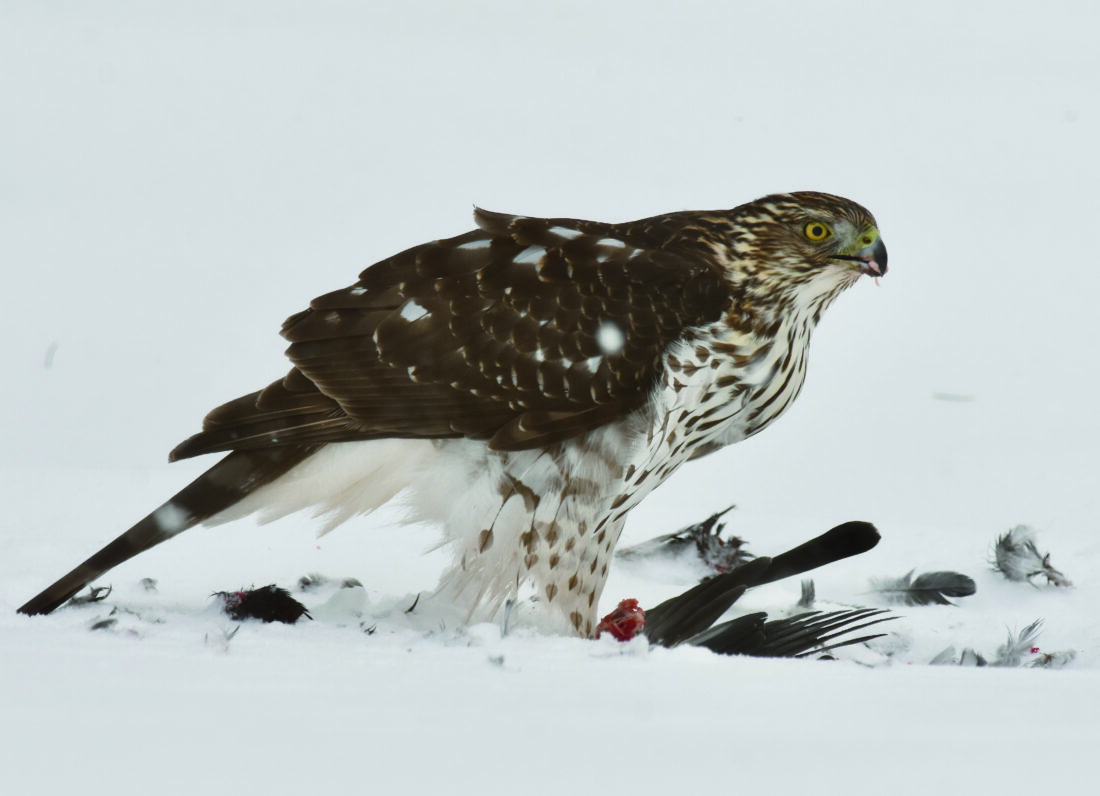
A Cooper's hawk looks on. (Scot Stewart photo)
“It’s not an end, it’s not a beginning, just a continuum of wonder and surprises birds provide each year.” – Anonymous
With the start of 2026 there is a long gaze back at the past year, and a hopeful look ahead at the one to come. 2025 featured another year of seesaw temperatures and very unusual weather. The mild January and February saw a late winter with a light measure of snow and only a few truly cold days compared with a wild winter start this December with two high powered blizzards already and some sizeable snowfalls.
Spring had some unseasonable cool temperatures with both May and most of June’s well-below average. Late summer and most of autumn bounced back with more seasonable temps and while it seemed like a dry summer rainfall levels were close to average.
There were a number of bird species maintaining regular or semi-regular appearances. Trumpeter swans have made stops on the Dead River in Marquette throughout the past year from last January through last week. Most have been by groups or families of adults and juvenile birds. They have seen been frequently feeding in the shallows of what birders call the “Dead River Marshes”, shallows just upstream from the Dead River Bridge on Lakeshore Blvd. Recently they have been there for only a few days at a time, sometimes moving upstream, occasionally moving on after only a day or two on the river.
Cooper’s hawks are stocky pigeon-hunters becoming established in the northern U.P. They have been seen during the past through winters in Marquette and are well established in many suburban areas farther south, comfortably nesting in quiet neighborhoods, subsisting on feeder birds and pigeons. For those with active feeders seeing a quiet day with few goldfinches, chickadees, woodpeckers sometimes find their feeders are quiet for an entire day or two without signs of a bird. It might come after a visit by a Cooper’s hawk, a merlin, or even a rare visit by a northern shrike.

STEWART
The Cooper’s hawks are now in being seen in Marquette throughout the entire year. Accipiters, they have fairly broad-wings and narrow tails. They can be identified sometimes by their wingbeat, a flap, flap, glide, flap, flap, glide. Their diet is almost exclusively birds. Cornell’s “All About Birds” page notes 23% of Cooper’s may have healing breast bones, broken from chasing prey birds through trees. Male Cooper’s hawks are smaller than females and can be mistaken for sharp-shinned hawks as both have similar plumage pattens and similar size. Juveniles have brown backs and brown streaked breasts, while adults have gray backs and reddish-streaked breasts for both species.
Snowy owls were another species seen regularly during the early weeks of 2025. One owls spent its early days in the year out on the Lower Harbor breakwall. Around 5 p.m. in the afternoon it would fly up onto the Lower Harbor ore dock putting the pigeons roosting on nearby apartments nearby into the air. The owl would move up onto nearby docks and eventually onto the apartments themselves hunting the pigeons.
Snowy owls returned to the Marquette area again this fall in November. Several appeared along the Lake Superior shoreline between Hawley Street and Fair Avenue. They eventually moved to south Marquette where they appeared to be hunting cottontail rabbits, Crows can harass owls if they roost in the open and some birders believe as the owls adapt to the area, they may become more nocturnal to avoid conflicts and harassment with the crows. This made them more difficult to find but a delight when they are located. Snowy owls were found in south Marquette in early December but then disappeared from regular discovery until the end of the month where they were seen again near the helipad for the hospital near downtown where they had hung out several years ago.
Fall proved to be a dynamic time for birding in Marquette where a number of great birds showed up, much to the delight of birders. In the harbors of Lake Superior an impressive list of birds was seen. The list included several harlequin ducks, both male and females. A western grebe also appeared. Good numbers of long-tailed ducks appeared regularly also in the Lower Harbor too. The Christmas Bird Count provided several others.
This winter also provided small groups of pine grosbeaks and larger flocks of bohemian waxwings. These species often appear at the result of the production of the American mountain ash, winterberry, and crab apples fruits that fail elsewhere, pushing out of their usual fall and winter regions, out into areas in the U.P. where the food is more prevalent.
Even Marquette’s Christmas Bird Count (CBC) offered a few surprises. The 22 wild turkeys at Presque Isle were a new high for Marquette city limits for a CBC. For the CBC week there were two late lingerers seen just before the count, a common grackle and a red-winged blackbird. Other highlights included a red-throated loon, Townsend’s solitaire, a northern pintail, greater scaup. The loon was seen flying over Lake Superior north of Presque Isle and is a first for the Marquette CBC. The others three were all seen near Lake Superior. The scaup and solitaire have made previous counts, but the pintail is also a rare winter visitor to the Upper Peninsula.
It would appear climate may have a greater impact than some other factors to draw more species out of the ordinary to the U.P. in the coming year. It seems unfortunate the changing conditions featuring fires, drought, hurricanes and other events may be the biggest influences to bring them here. Let’s see what the new year brings.
Local
What’s Flying: Let’s see what the new year brings
Officer cleared of charges
NIAGARA, Wis. — An investigation into a fatal crash Nov. 5 in Niagara, Wis., has ended with no charges filed ...
Superior’s icy winds make delicate designs
School of choice districts announced
HANCOCK — The Copper Country Intermediate School District has announced that the following schools have elected ...

Giving to the community
Police log
EDITOR’S NOTE: The following information is collected from Marquette City Police Department dispatch log books ...