
What’s Flying: Christmas bird counts could be diverse

STEWART
“What fire could equal the sunshine of a winter’s day?” – Henry David Thoreau
Mid-December starts the darkest period, at least sunshine wise, for the Upper Peninsula. Although it is just nine days until Winter begins and the days begin to again grow a bit longer each day, taking two weeks just to get back close to the length of the days now. Then the evening will last a bit longer each day and the mornings will continue to start a bit later into mid-January It is the time that challenges the times.
In the meantime, life continues to adjust the true signs of winter. Following the big storm before Thanksgiving there were many questions about how the tremendous winds, dropping temperatures, and new snow would affect birdlife. Some late departures may have headed south but most of the regular winter resident birds still in the area have been prominently making their way about.
Presque Isle Park saw more significant effects of the big storm, with some large limbs snapped from maple, poplar and white pine trees, especially near the breakwall-gazebo area, and a large red pine tree toppled on the west side of the park. Several noticeable smaller trees were also taken down across the park.
One white cedar tree next to the trail between the nature center and the pavilion was blown down, twisting the base of the trunk and opening it up. It became a perfect site for pileated woodpeckers to brush aside snow covering the base where the trunk was ripped open and begin excavating the rotten heart wood to remove carpenter ants and other insects living inside. Two pileated woodpeckers were seen in the woods there about a week ago. The evidence, wood chips piled below the open trunk, indicated there was a significant amount of work done by the woodpeckers.
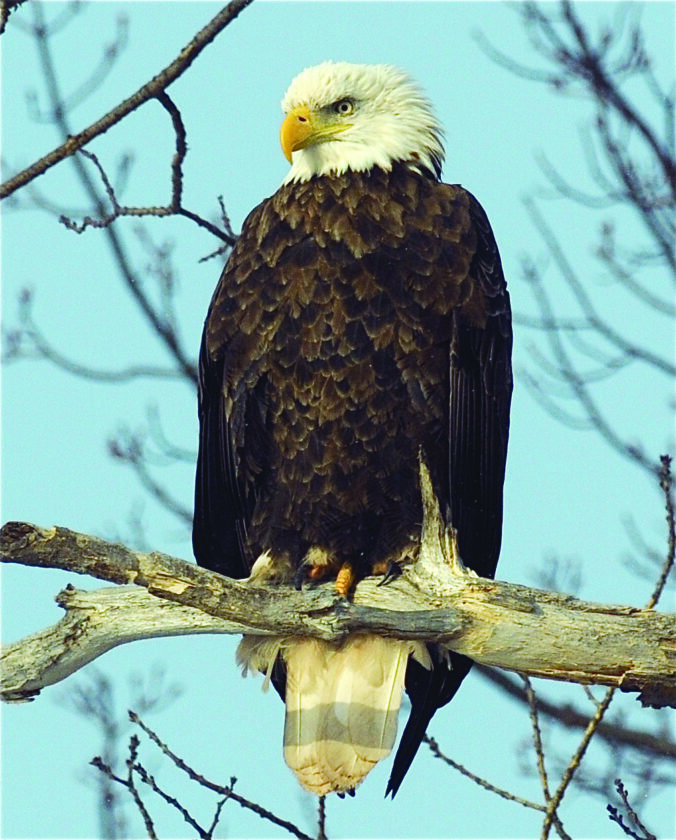
A bald eagle looks on. (Scot Stewart photo)
Crows and ravens also have been very active at Presque Isle recently and have been very vocal. Some of the activity included hoarse caws of the crows, indicating they were not happy with the presence of the ravens passing over the park. Other times there did not appear to be a raven nearby, suggesting the crows may have been scolding an eagle, hawk or owl. Bald eagles have been busing along the shoreline hunting fish, and a family of barred owls is known to frequent the park.
The eagles will have a more difficult time perching along Lakeshore Blvd. near Lambros Park following the storm as the high winds severely damaged several trees where the eagle often roost during the daytime. Only one large maple was spared there.
In Marquette’s Lower Harbor a good variety of waterfowl has continued with nearly all the species seen there recently being expected ducks — mallards, three species of mergansers, bufflehead and common goldeneyes. One horned grebe, a lingering species and a handful of long-tailed ducks were seen in the Lower Harbor this past week with the other ducks. A few lingering common loons have also popped up along the Lake Superior shoreline between Marquette and Munising.
What appeared to be a family of trumpeter swans also showed up on the Dead River near the river mouth this past Tuesday. Totally unpredictable appearances of small groups of trumpeters have been become a regular surprise on the river during the past year or so, delighting birders. They will be one of the hoped for species to hang around for the 78th Annual Marquette Christmas Bird Count (CBC) on Saturday, Dec. 20.
Snowy owls continue to make irregular appearances in Marquette. There have been two sightings along the U.S. 41 by-pass near McClellan St. This is a site that has frequently been used over the years by visiting snowy owls around dusk. Mice, voles, and cottontail rabbits are all easy to spot on and along roadways and much easier for the owls to grab when hunting. Unfortunately, snow owls, because of their normal range in the Arctic Tundra of Canada and Alaska have no experience with motor vehicles, especially semi-trucks. They have run into trouble with them along the bypass and several have been killed there. Another snowy owl was recently reported on the east side of Marquette not too far from downtown.
One recent notable vagrant, a Townsend’s solitaire has been seen again on the east side of Marquette, following a report from about a week before. These thrush relatives normally are found on the east side of the Rocky Mountains in winter but do wander during the winter months, sometime reaching the Midwest and some places even farther from their normal range. This new sighting was in the same mountain ash tree were another had been seen.
Both pine grosbeaks and bohemian waxwings continue to visit mountain ash and crab apple trees across the Upper Peninsula. The largest flocks of pine grosbeaks seem to be in the Houghton area where they have numbered to more than two dozen. In Marquette smaller flocks of up to a dozen have been more common. Bohemian waxwings have also appeared in many areas, mostly in small flocks, but a few larger groups have been observed moving through area fruit trees.
Larger flocks of American goldfinches and smaller numbers of pine siskins and redpolls are also appearing more frequently at bird feeding stations in the U.P. As birch seed numbers begin to dwindle, they may become more common at both black-oil sunflower and thistle feeders.
A few white-throated and American tree sparrows are also popping up and could make upcoming CBC’s more diverse. Search
-

- STEWART
-
- A bald eagle looks on. (Scot Stewart photo)
Local
Negaunee Middle School announces honor roll
2025-26 5th Grade, first marking period All As Emmi Barron Evelyn Bennett Willow Bleau Isaac ...
What’s Flying: Christmas bird counts could be diverse

Elks support Negaunee Schools Giving Tree program
UPHS-M receives OB award
MARQUETTE — UP Health System–Marquette has been recognized with the 2025 Safely Averting NTSV Cesareans Award ...
Superiorland Yesterdays
30 years ago ISHPEMING - Project Newborn Rock’n’Read recently brought books to preschool children at Birchview ...
GACS announces first quarter honor roll
GWINN — The Gwinn Area Community Schools congratulates the following high school and middle school students for ...